*This is the final instalment of a six-part series.
For the final instalment of the “Power Play in the Arctic” series, Marcus Wong (MW) sat down with Dr. George Soroka (GS) of Harvard University’s Department of Government, who also serves as Executive Officer of The Harvard Academy for International and Area Studies at the Weatherhead Center for International Affairs. A specialist in Russian and Eurasian politics, Arctic governance, and the politics of history and memory, Dr. Soroka brings a uniquely wide lens to the future of the High North.
Drawing on his widely cited analyses of Russia’s Arctic strategy and great-power competition in venues such as Foreign Affairs and the Arctic Yearbook, Dr. Soroka explores how Arctic security, regional governance, and alliance strategy might evolve through 2040. He shares a rigorous and forward-looking assessment, one that helps situate Canada’s and NATO’s Arctic dilemmas within a much broader story of institutional change, great-power rivalry, and climate-driven transformation in the High North.

Headshot of Dr. Soroka
MW: Russia currently enjoys a capability edge in the Arctic but faces long-run constraints from sanctions, demography, and fiscal pressures. Over the next 10 to 15 years, do you expect Moscow to consolidate, economize, or retrench its Arctic posture, and what would you look for as early indicators of that shift?
GS: Ideally, Moscow would like to further consolidate its Arctic footprint, both militarily and economically, but whether geopolitical realities and market forces will preclude that remains to be seen. However, if I had to venture an educated guess, I think the Russian government, if it stays on its current course (because Putin is unlikely to still be its leader in 10-15 years), will manage to do so.
While Russia’s much ballyhooed remilitarization of the Arctic, which reached its apogee in the mid-to-late 2010s, significantly increased its defensive as well as offensive capabilities in the region, Russia’s military presence in the High North is still short of what it was in the Soviet period. Additionally, multiple Arctic formations have been re-purposed to take part in Russia’s war on Ukraine, which has depleted them in terms of manpower and materiel.
At the same time, Russia nonetheless enjoys a noticeable military advantage in the region relative to Europe, Canada and the United States that will take, even with concerted effort on the part of the latter actors, a decade or more to close. So, Moscow is ahead of the game in this regard already, and when the war in Ukraine is concluded, it will undoubtedly start paying more attention to the Arctic again, especially since a robust presence in this region is so important for a status-conscious power such as Russia.
Economically, the use of the Northern Seat Route for transporting containerized cargo is likely never going to match the Kremlin’s over-optimistic projections, especially because, if the sea ice melts enough for this route to be viable, shippers will also have the option of using the Transpolar Sea Route, which is more direct and avoids Russia’s coastal waters. Still, Russia’s Arctic hydrocarbon (and especially LNG) projects are impressive, and their output will only increase when Western sanctions are attenuated or removed completely.
Given all this, Russia will remain the dominant Arctic power for the foreseeable future, though the degree to which it is able to consolidate its presence there will depend on the outcome of its war in Ukraine and the state of its relations with the West.
MW: You describe the Russia-China relationship in the Arctic as pragmatic and unequal. Do you think we are more likely to see an emerging division of labour emerge between them in the region (for example, Russia as security provider, with China as capital and technology provider), or a gradual decoupling as their interests diverge? Under what conditions, if any, could NATO’s behaviour push towards either outcome?
GS: Sino-Russian relations are an important potential wedge issue that NATO can exploit to its advantage. To be very clear, despite ostentatious affirmations of friendship, China is not and never has been Russia’s preferred partner, and there exists mutual mistrust between them; their interests only temporarily converged as the result of outside factors. The West, because it is democratic, remains far more predictable and transparent in its foreign policy than Beijing, and it is where Russia has historically located itself. Moscow still views itself as a European and not Asian power, and this will not change in my lifetime.
The current marriage of convenience is one wherein China provides funding, and Russia grants Beijing preferential deals. But Moscow wants, first and foremost, to keep the Arctic for itself—free from both the presence of NATO and China. The pressure-point, then, is obvious—convince Moscow by any means necessary that an economic powerhouse on its borders, moreover one that is militarily ascendant, is not one that Russia can abide as an ally. Doing so will mean resolving the conflict in Ukraine and rebuilding some semblance of trust between Russia and the West, but the Russians are not naive—they are fully aware that NATO will not attack unprovoked, whereas China’s long-term intentions are less certain. If NATO keeps hammering this point home repeatedly, the message will be heard. Especially if this is followed up with economic easing on the part of the West. Morally and politically, this is hard to do in the present climate and with Russia’s present leader, but we are talking not about years but decades—the strategy needs to be long-term in nature and consistent in application.
MW: NATO is starting to pay more attention to the High North, albeit very incrementally. Ten years from now, do you think the Arctic will function primarily as (a) a northern extension of the Euro-Atlantic theatre, (b) a distinct strategic theatre with its own logic, or (c) a kind of laboratory for Alliance adaptation to multi-domain, climate-affected conflict? Why?
GS: Yes, NATO is paying more attention to the Arctic, but it is still not enough. This is, in part, because of NATO’s geographic scope—the Scandinavian countries have very different security imaginaries and threat perceptions than do the countries of southern Europe. So I think what we will most likely see is a continuation of the Arctic being treated as a northern extension of the Euro-Atlantic theatre at the aggregate level, with the practical comprise that regional cooperation in northern Europe will be further decentralized to allow for specific security adaptations, both to respond to the threat of Russia and a rapidly changing climate.
MW: Given the exclusion of Russia from multilateral organizations such as the Arctic Council and other related fora, what do you see as the most realistic institutional architecture for managing frictions in the High North by the 2030s?
GS: Well, the Arctic Council was never intended to deal with “hard” security issues in the first place, so clearly something new is needed. I have two thoughts about this—first of all, far too many overlapping working groups and organizations—most of which had fuzzy boundaries and limited ability to effectuate concrete decision-making—came to exist by the 2010s. As a result, what is desperately needed is a more orderly set of consultative institutions going forward, fewer in number but possessed of actual power.
Second, and more importantly, it is absolutely crucial to restart regular talks with the Russians on security matters. These need to happen not just at the highest levels (where they are confined today), but to involve regular military-to-military contacts. Politically this will be a hard sell, but it is essential in order to avoid potentially tragic misunderstandings and to start rebuilding the ability to co-exist in a space where neither side is going anywhere.
MW: You’ve warned about the Arctic becoming a “tinderbox of potential escalation,” particularly around critical infrastructure and hybrid activity. Where do you see the greatest risk of miscalculation: undersea infrastructure, air and naval encounters, nuclear signalling, or something else?
GS: Communication infrastructure is the lifeblood of the modern economy. Given Russia’s embrace of “hybrid warfare” tactics, I see the greatest threat arising from its disruption. In the Arctic and nearby environs, this means mainly sabotaging undersea cables. This is not to say a spectacular miscalculation leading to a high-stakes naval or aerial incident would have momentous ramifications, but if the last decade has taught us anything, it is that Russia is not eager to confront the West directly, but to probe its weaknesses in a manner that allows for some degree of plausible deniability.
Another distinct arena of risk consists of the Northern Sea Route (NSR) and Russia’s claims over this series of intertwined passages, which are not upheld by international law. Moscow is very touchy about its claimed prerogatives in the NSR, and if these were to be threatened—say, by a freedom of navigation exercise by a Western navy intended to challenge them—the consequences could be quite dire.
MW: Finally, looking out to, say, 2040, do you expect today’s mix of limited militarization plus rhetorical escalation to solidify into a new stable equilibrium in the Arctic, or is this just a transitional phase toward something qualitatively different? Where does NATO fit into all of this? What mechanisms do you think will lock in whichever trajectory we end up on?
GS: There is nothing stable about the Arctic today, a region that is experiencing the effects of global warming at an accelerated rate compared to other parts of the globe (with the obvious exception of Antarctica). Also factor in a declining power Russia, a newly re-assertive United States that is apparently serious in its attempt to take over Greenland, and China’s burgeoning status-related ambitions. Consequently, I don’t think we will see an equilibria emerge any time soon.
The most likely course of action is that NATO will, through various smaller-scale initiatives spearheaded by its Arctic and near-Arctic members, gradually become more of a presence in the High North. Russia, meanwhile, will also keep building out its commercial and military infrastructure in the region, possibly with the continued assistance of China. The result will be that the Arctic will revert to a more securitized space than it has been for decades. The future is the Cold War past. The real unknown, however, is what a melting cryosphere will bring; certainly, an increased ability to economically exploit this region will also raise the threat levels therein. What is unclear is the degree to which this will come to pass.
MW: Dr. Soroka, thank you for taking the time to walk through these questions and to look so far ahead. Your insights will give readers a lot to think about as we consider where Arctic security and NATO policy may be heading next.
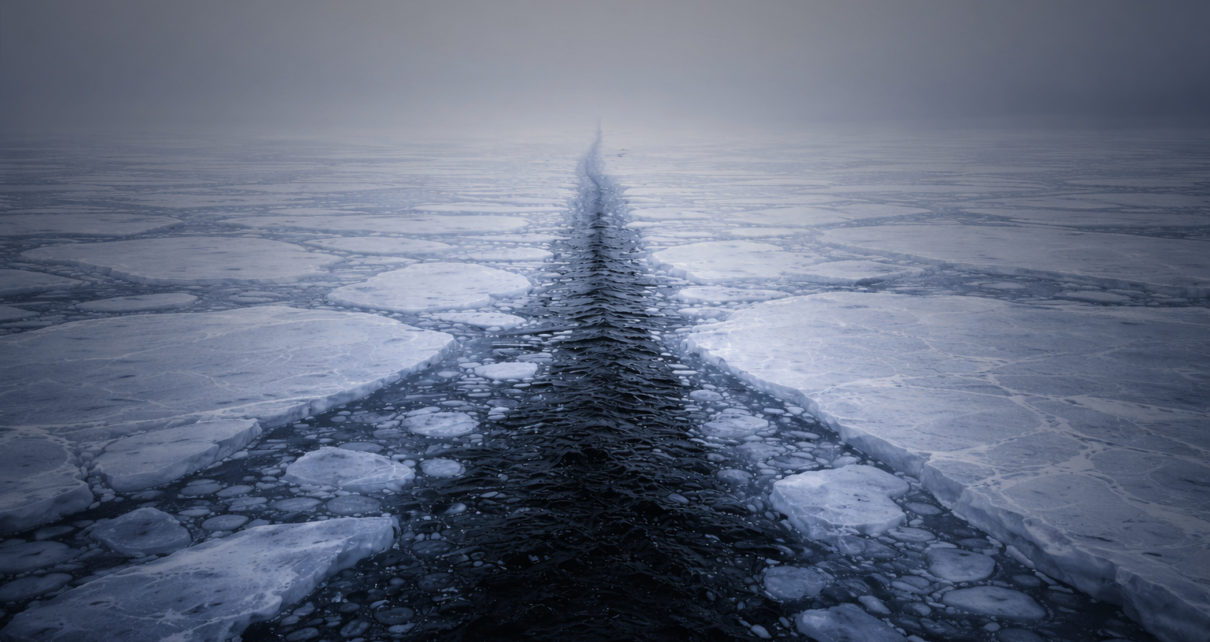
Cover photo: A picture of ice on the ocean with a big crack via ChatGPT.
Disclaimer: Any views or opinions expressed in articles are solely those of the authors and do not necessarily represent the views of the NATO Association of Canada.