*This is the second instalment of a six-part series.
As each Arctic state strengthens its security and defence capabilities in the High North, there is likewise an overall intensification of geopolitical rivalries, an expansion of coastal states’ territorial and energy ambitions, increasing clashes of interest, and a corresponding potential for instability. Problematically, NATO lacks an Arctic policy, despite having stated that it intends to “defend its interests in the Arctic…[and] uphold the international rules-based order, which includes freedom of navigation.” Thus, although the Arctic has traditionally experienced a low level of hard security tension, the necessary conditions for conflict are beginning to emerge in the Arctic. This context is also exacerbated by the exclusion of Russia from multilateral discussions in Arctic affairs, especially as they relate to security. This is also further complicated by the lack of alignment between Arctic states on a continuing vision for the Arctic, especially vis-à-vis competing land claims, natural resources, and shipping lanes. Indeed, as will be explored in this second instalment of a six-part series, the intersection of these incongruent national interests with those of Canada has increased the probability of unresolved disputes, which in turn is leading to a heightened level of militarization and aggression that was not previously present. This new reality stands to have important ramifications for Canada’s sovereignty and security in the Arctic, and its ability to defend its national interests.
Russia
Russia has been rapidly restoring its decommissioned Soviet-era military installations and airfields, developing Arctic bases, conducting increasingly frequent and larger military exercises in the north, and has established the Northern Fleet-United Strategic Command, in order to protect Russia’s northern shipping and fishing activities, its Arctic-shelf oil and gas reserves, as well as the country’s northern frontiers. Russia also possesses modern submarineswhose reduced acoustic signatures make them increasingly difficult for underwater surveillance assets to reliably locate and predict, thereby giving them the ability to travel in the Arctic Ocean undetected. Additionally, Russia is strengthening its anti-access/area denial capabilities to protect is waters and hasdeployed an additional 6,000 soldiers and established surveillance infrastructure near Murmansk.
Russia’s use of hypersonic missiles, which can be equipped with either a conventional or nuclear warhead and fired from fighter jets, also presents a concerning threat to Canada’s Arctic security, as NORAD does not currently have the ability to defend against hypersonic missiles. Even if it did, Russia asserts that these weapons are impossible to intercept, an important wrinkle also substantiated by China, which possesses similar weapons systems. Moreover, as Russia’s closest base to North America is located on Wrangel Island, a mere 500 kilometres from Alaska, major Canadian cities such as Vancouver, Calgary, and even Ottawa, are well within range.
To further complicate matters, Russia’s on-going conflict with Ukraine led to the full suspension of all Arctic Council meetings in 2022, when Russia held the role of Council chair. Only when Norway took over as chair, in 2023, did the Council resume partial activities. As the Arctic Council’s mandate explicitly prohibits hard security discussions, Canada has had to work through a fragmented set of secondary forums, such as the Northern Chiefs of Defense Forum and the Arctic Security Forces Roundtable, to advance its Arctic security agenda. However, these also went on hiatus and/or proceeded without the participation of Russia. These exclusions have thus created a gap through which Russia can engage in Arctic militarization and strategic economic investments without interference, all of which is highly problematic for Canada’s Arctic, given overlapping territorial claims.
Moreover, Russia’s “no-limits partnership” with China has enabled it to mitigate the sanctions from the West. In fact, billions of dollars have been invested by China in Russian Arctic oil and gas projects. That being said, as China’s global status continues to rise, Arctic cooperation between the two states remains primarily self-serving and is marked by enduring Russian doubts about China’s ultimate intentions and activities in the region. Thus, these cumulative factors heighten the risk of confrontation in the Arctic, which will only become more pronounced as Russia’s economic and security interests come into continued conflict with those of Canada and the remaining Arctic states.
China
To actualize its claim as a “near Arctic state,” China has engaged in “omni-directional” tactics, whereby it maneuvers its way into Arctic affairs through whatever means best serve its interests at any given time, whether by leveraging existing governance frameworks (such as attaining official observer status on the Arctic Council) or by bypassing them altogether in favour of bilateral deals.
Notably, China has invested significantly in icebreakers, Icelandic port facilities, petroleum and natural gas sites located in the Russian Arctic offshore region, together with Greenlandic mineral extraction projects, air transport hubs, and supporting maritime infrastructure in order to normalize its presence in the Arctic. In fact, it has participated in 14 Arctic expeditions to date, making China the only country to have voyaged through all three polar routes – the Northern Sea Route (NSR), Northwest Passage (NWP), and Transpolar Sea Route. At present, China does not possess submarines capable of operating under Arctic ice, but given its self-declaration as a “near-Arctic state,” future Chinese submarines will likely have that capacity. Indeed, as both Russia and the United States already possess submarines with this capability, it is only logical that China will seek strategic parity for its military. As such, although China has used these trips as a means to assess their viability for future Chinese shipping, the significance of this fact should not be underestimated—all three of the world’s major powers now have the ability to navigate through Canada’s Arctic (with or without its consent). Indeed, over the past several years, Chinese naval vessels have also showcased their proficiency and determination to function in the Arctic by engaging in exercises with the Russian navy, while Chinese icebreakers have conducted tests with autonomous submersible systems and aircraft engineered for operations in polar environments. China has even sent high-altitude surveillance balloons through the Arctic into North America and has deployed monitoring buoys in Canadian Arctic waters.
Not surprisingly, China has sought to additionally increase its Arctic influence through scientific diplomacy, using scientific research as both a means and an end. However, in part due to its “wolf-warrior” diplomacy and progressively aggressive foreign policy actions in non-Arctic regions, such as its confrontations with the Philippines in the South China Sea, this approach has had mixed success thus far. Arctic states have become increasingly wary of Chinese scientific diplomacy as a potential avenue by which it seeks to leverage dual-use research for the intelligence and military outcomes in the High North. That being said, while there have been limited scientific engagements by China in Canada as a result of Canada’s security concerns regarding Chinese espionage, theft of intellectual property, and interference in domestic affairs, it is uncertain how long this resistance may last, given the financially constrained Canadian research sector. Potential Canadian research partners may find it difficult to decline Chinese interest and funding; thus, Chinese scientific diplomacy may prevail in the end.
Concurrently, China’s pursuit of economic opportunities in the Arctic has focused heavily on securing access to unclaimed resources in international waters and investing in energy and mineral projects, particularly in Russia, Norway, and Iceland. While some media and analysts portray these efforts as vast, often citing figures exceeding $90 billion USD, such estimates frequently include “unsuccessful investment projects and proposed projects that have not been implemented,” thereby exaggerating the true scale of Chinese investment. Although many proposed ventures have not materialized, a number of projects have been completed and remain economically significant to their host countries, with China continuing in its attempt to acquire significant land holdings, cultivate strategic partnerships at both bilateral and multilateral levels, and expand its capabilities in Arctic-related research and technology.
Not surprisingly, China sees the NWP as an international strait that is vital to its economic interests vis-à-vis shipping. That being said, China’s position on the NWP is paradoxical, as it claims the Qiongzhou Strait (located in the middle of Guangdong and the Hainan Islands) as internal waters and not an international strait. However, as this strait “has rarely, if ever, been a matter of debate,” China has been able to adopt a contrarian position with respect to the NWP (unlike Russia vis-à-vis the NSR), while highlighting the importance of abiding by the United Nations Convention on the Law of the Sea (UNCLOS) in the Arctic in a clear attempt to “internationalize” the Arctic as a “global common” and justify China’s role in the Arctic. Nevertheless, as China’s perspectives, interests, and priorities in the Arctic become more prominent over time, it will likely anticipate being recognized as a stakeholder with equal standing in decisions related to Arctic governance. As such, Canada must realize that it is not merely dealing with yet another country or trade partner, but rather a rising global power that has the potential to become the next “polar great power,” such that “not engaging China just isn’t an option.”
The United States
As to be expected, the United States and Canada have shared Arctic interests as they relate to scientific research, as well as environmental and human concerns. However, the United States’ stance regarding the NWP creates an acute dilemma for Washington, especially since the NWP will soon become permanently accessible. By rejecting Canada’s claim that the NWP is a part of Canada’s internal waters, the United States avoids setting a precedent that could lead to restrictions on the free passage of American military and civilian ships through other international straits, such as the Strait of Hormuz and the Strait of Gibraltar. However, by deeming the NWP an international strait, the right of overflight and maritime navigation is accorded to all states as per UNCLOS, which, given current geopolitical tension with Russia and China, is problematic. Indeed, ensuring maritime access to Alaska is crucial for economic reasons, as is access for U.S. military ships and submarines for security reasons. However, Washington is also wary that rising maritime activity could transform the Bering Strait into a critical passage, which has prompted heightened U.S. surveillance of the area—ironic given the United States’ stance that the NWP is an international strait that should be open to navigation.
Coupled with Washington’s current foreign policy stance towards Canada, only time will tell as to how and to what extent the United States will become a competitor to Canada rather than a collaborator in the Arctic as the oft-dismissed Arctic scramble heats up. Indeed, given that Canada’s traditional reliance on the United States for security has become increasingly unpredictable, it would seem that Canada is finding itself progressively in a position of relative isolation with respect to achieving its sovereignty and security goals. As I shall propose in greater detail in the next few articles of this series, Canada must urgently implement effective policy solutions to independently address its internal and external Arctic sovereignty and security challenges.
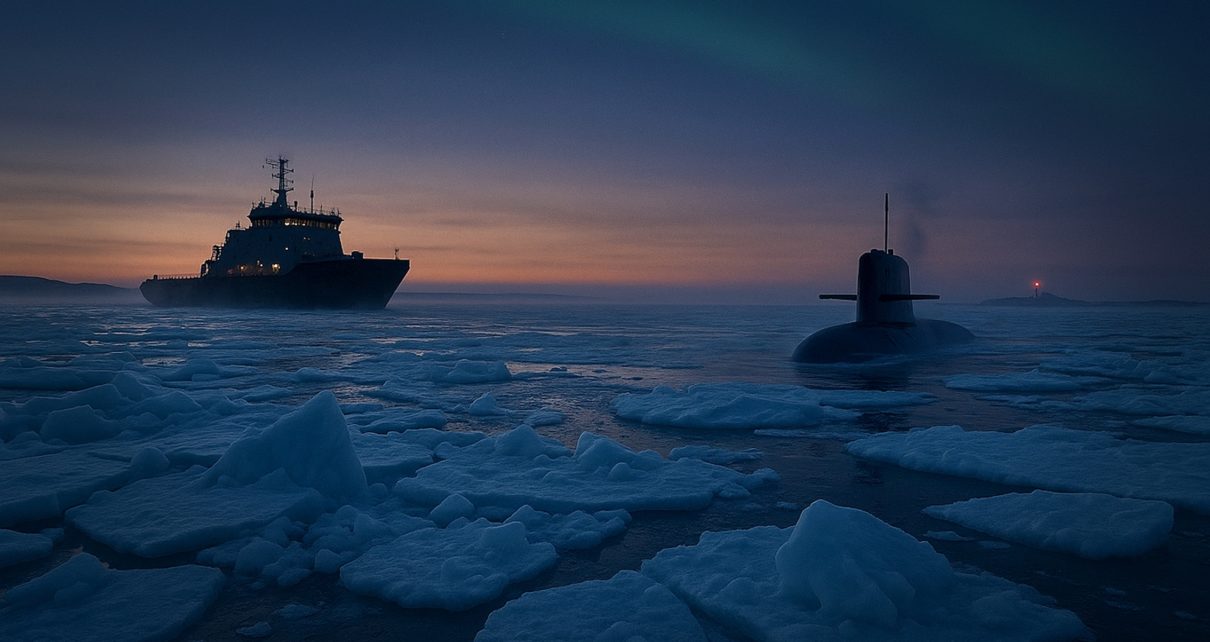
Cover photo: An ice-breaker and submarine stalk each other in the High North, (2025), by Marcus Wong via ChatGPT.
Disclaimer: Any views or opinions expressed in articles are solely those of the authors and do not necessarily represent the views of the NATO Association of Canada.