*This is the first instalment of a six-part series.
Although the Arctic’s extreme environment has historically been an effective obstacle to threats to Canada’s sovereignty and security, the region is now being reshaped by climate change. In 2007 alone, over 2.5 million square kilometres of ice melted in the Arctic Circle, leaving only half of that which was present in 1950. In fact, the Intergovernmental Panel on Climate Change estimates that the Arctic could begin experiencing ice-free summers sometime between 2030 and 2050. This reduction in sea ice has already allowed a growing number of regular vessels, such as cruise ships, to navigate through the Northwest Passage (NWP) during the summer and transitional seasons. This opening will also have a growing impact on international shipping routes between Asia and the eastern seaboard of the United States, which could shorten by over 8,000 kilometres (or about seven days) and avoid geographic bottlenecks targeted by pirates.
This change is further intensified by the scale of the Arctic’s untapped natural resources. According to the United States Geological Survey, over 90 billion barrels of oil, close to 1,700 trillion cubic feet of natural gas, and 44 billion barrels of natural gas liquids are located in the Arctic. All of this translates to close to 13 percent of the world’s untapped oil reserves and 30 percent of unexplored worldwide natural gas – 84 percent of which can be found offshore in water less than 500 metres deep. The Arctic also holds valuable minerals such as “diamonds, gold, iron, copper, bauxite, and nickel”. Indeed, as hydrocarbon prices and energy security concerns continue to increase, not only will there be exponential economic interest in the Arctic, but these prices and concerns will only further justify the research and development of new technologies in order to access the Arctic’s natural resources.
While Canada has consistently claimed ownership of the land and waters in its Arctic, it has historically treated its northern regions as an afterthought. Certainly, Canada has attempted to take symbolic and concrete steps to demonstrate its sovereignty over its portion of the Arctic, from establishing Royal Canadian Mounted Police outposts, to relocating Inuit populations to remote parts of the Arctic, to planting its flag on claimed Arctic land. However, these activities have always been prompted by external threats, with intervening periods of general passivity and lack of commitment to the Canadian Arctic (and its residents therein). As such, northern Canada has become characterized by low Arctic population density, vast uninhabited areas, small remote settlements, and significant logistical hurdles for both civilian and military operations. To complicate matters, while Canada continues to publish Arctic strategies such as Our North, Strong and Free, it has not defined any operational objectives vis-à-vis the Arctic. This has led the Royal Canadian Navy and Canadian Army to define their own individual objectives in isolation of each other, while the Royal Canadian Air Force does not have such objectives. Indeed, as the Department of National Defence admits, “without a comprehensive strategy for Arctic operations, the [Canadian Armed Forces] is unable to identify a clear role,” which in turn has obstructed the “identification and mitigation of current and future threats in the region, which perpetuates the insignificance of Arctic operations, exercises and capabilities.” This challenge has also been further hampered by inadequate staffing as well as very limited Arctic military infrastructure and equipment (much of which is also deteriorating).
Nevertheless, while many Arctic states have historically treated the Arctic as an exceptional zone of collaboration and peace, the Arctic Ocean is in actuality not a shared global resource like Antarctica and is not governed by any legal instrument analogous to the 1959 Antarctic Treaty. The growing Arctic accessibility has also encouraged global competition in the region. In fact, both Arctic and non-Arctic nations have begun to enhance their military and civilian capacities to ensure that they can take advantage of the opportunities that will emerge when the region is fully accessible. For example, Russia is rapidly rebuilding its Arctic defence and security capabilities while seeking to expand its claims over underwater territory, some of which overlaps with Canada’s own claims. At the same time, China has declared itself to be a “near Arctic state,” keen to establish a “Polar Silk Road” as part of its Belt and Road Initiative and ensure that it can maximize the Arctic’s economic opportunities, going so far as conducting hydrographic charting of the NWP before Canada. Even the United States, Canada’s historically closest ally and trading partner, disputes Canada’s jurisdiction over the NWP. The intersection of these incongruent national interests with those of Canada has thus increased the probability of unresolved disputes, which in turn is leading to a heightened level of militarization and tension in the area that was not previously present. This new reality stands to have important ramifications. Clearly, more so than ever in its history, Canada must decisively prove that it can and will protect its national interests, including safeguarding its territorial and maritime sovereignty and security in the Arctic.
Coincidentally, the geopolitical window to do so may be approaching. As the consistency of U.S. global leadership faces uncertainty and a possible recalibration, a strategic vacuum in the Arctic is developing whereby Canada has the unique opportunity to carve out a new international role for itself as the principal architect of NATO’s Arctic policy. Although NATO has stated that it intends to “defend its interests in the Arctic…[and] uphold the international rules-based order, which includes freedom of navigation,” it still does not have an Arctic policy. As will be explored further, through existing and new multilateral alliances and legal frameworks, Canada must adopt a significantly more assertive foreign policy stance and international leadership role to effectively solidify itself as the primary Arctic thought leader. Indeed, in a departure from its traditional stance as a conciliatory middle power, Canada must become an agenda-setting nation on Arctic issues, focused on building a credible multilateral deterrent posture by leading a coalition of like-minded Arctic and near-Arctic states. By doing so, Canada can ensure that collective Arctic security remains a long-term transatlantic priority, while (selfishly) defending its own national interests.
However, as will be discussed and proposed in further detail over the course of this six-part series, before Canada can take on this mantle of leadership, Canada must first address the internal and external challenges to its own sovereignty and security in the Arctic through bold, integrated public policy solutions that align security, economic, legal, and diplomatic strategies – solutions that represent a departure from what has historically been required (or comfortable). Canada can no longer assume that the harsh Arctic conditions will continue to serve as an effective barrier to foreign states. Indeed, this nation will soon be entering the next phase of its history (if it has not already), whereby it must secure and protect its territorial and maritime claims in the Arctic. As such, Canada cannot, and must not, squander this opportunity. Failure to demonstrate Canadian sovereignty will not only compromise Canada’s security in the Arctic but lead to the eventual erosion and transgression of Canada’s borders and foreign exploitation of its natural resources. It will be, in effect, an open invitation for foreign powers to dictate the nation’s future.
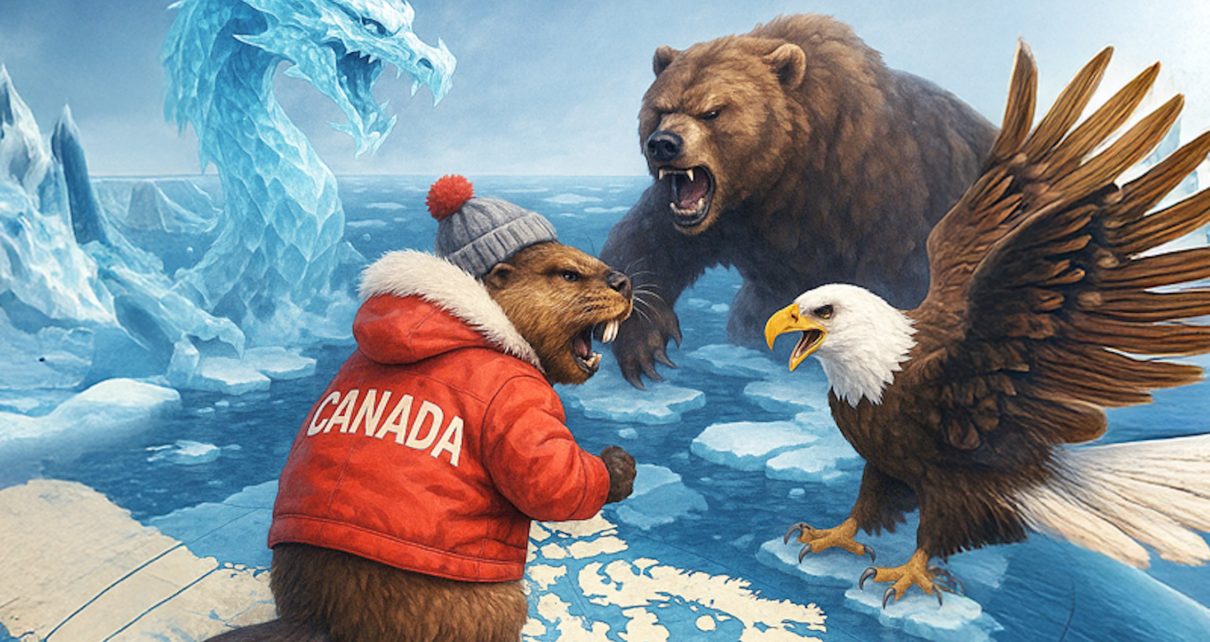
Cover photo: The Canadian beaver, American eagle, Chinese ice dragon, and Russian bear in a standoff (2025), by Marcus Wong via ChatGPT.
Disclaimer: Any views or opinions expressed in articles are solely those of the authors and do not necessarily represent the views of the NATO Association of Canada.