In July 2024, Canada became the only NATO state to adopt a military led by a woman. Prior to her appointment as Canada’s Chief of Defence Staff, General Jennie Carignan joined the Canadian Armed Forces (CAF) in 1986 and was soon commissioned into the Canadian Military Engineers. Since then, she has contributed to Canada’s security both at home and abroad. She commanded two Combat Engineer Regiments that facilitated crisis operations in Quebec’s 2019 flood relief effort and was deployed to Bosnia-Herzegovina, Syria, and Afghanistan, where she became the first woman to command a Canadian combat arms unit. In 2019, she became the first woman to lead a NATO mission, commanding the advisory and capacity-building mission in Iraq. While her leadership abilities indicate the wider role of women in combat, her contributions to achieving gender equality in the CAF are evident through her appointment in 2021 as the first Chief of Professional Conduct and Culture. In 2021, after the implication of several senior CAF leaders in cases of sexual misconduct, Gen. Carignan was entrusted with enhancing the reporting mechanisms for these issues. She led the development of new pathways for granting agency and stronger support for those affected by sexual misconduct in the CAF. For instance, she began consolidating input from survivors and affected persons, ensuring the publication of a Decision Support Framework (DSF) that articulates meaningful responses to complaints of misconduct. The framework promises to offer investigations, disciplinary action, and respondent support. Her trajectory in the CAF, and most recently her appointment in 2024 as the Chief of Defence Staff, is a symbolic moment for Canada; it embodies Canada’s capacity to consolidate its title as a leader in institutionalizing the Women, Peace, and Security (WPS) agenda, particularly regarding the provision of equal opportunity for women in combat roles.
The Women, Peace, and Security (WPS) agenda aims to embed women’s rights in frameworks for conflict prevention and resolution. Among its NATO allies, the CAF is regarded as a leader on gender issues in the military; women participate meaningfully in all aspects of domestic and international missions. Canada’s National Action Plan (NAP) for enacting the WPS agenda directs the incorporation of gendered perspectives into the conduct and evaluations of CAF missions. In practice, this entails sustained education and training that enhances the understanding of the disproportionate challenges faced by women in combat. Gen. Carignan’s commitment to achieving WPS goals is exemplified through her leadership as the former Chief of Professional Conduct and Culture, where she supported the strengthening of accountability mechanisms regarding gendered violence inside the CAF. This is evident in the 2023 ‘Trusted to Serve’ CAF ethos, which systematizes gender equality and standards for accountability that command the creation of a more cohesive military. This ensures that military personnel are best able to execute their duties in a manner that reflects a gender cognizant outlook. Gen. Carignan is thus an essential contributor to this continued initiative, and her leadership of the CAF is a symbol of Canada’s effort to institutionalize a feminist approach to peace and security. Her record of advancing reform signals how WPS principles are not secondary to military effectiveness but necessary. Under her leadership CAF’s values have codified the deployment of this effort, as a recent Training Needs Assessment produced several recommendations that guided a new holistic approach for eliminating harmful behaviors in military institutions.
Gen. Carignan’s leadership is representative of another pillar of the CAF ethos: employment equity. The CAF Employment Equity Plan (2021-26) guides the commitment to representation, inclusion, and participation of under-represented groups, across all levels of the military. Canada’s approach embodied through her leadership, collapses the divide between the theorization and implementation of gender equality. It reflects the ongoing progress of Canada’s dedication to equity, as it is not confined to recruitment but extends into all ranks.
Gen. Carignan’s commitment to institutional reform and Canada’s WPS goals is a display of Canada’s capacity to establish its leadership in advancing NATO’s WPS agenda. It marks an actualized rather than rhetorical commitment to inclusivity. While almost all NATO states similarly endorse gender equality and formal commitment to the WPS agenda, few have elevated women’s rights to this degree. This strengthens Canada’s credibility as an instigator of gender equality within NATO, creating a benchmark from which allies can draw from as militaries confront renewed pressures. Amidst a volatile international arena, institutional reform is essential to strengthening collective defence posture; Gen. Carignan’s leadership of the CAF is representative of Canada’s commitment to operating effectively in complex multinational environments. This symbolizes an understanding that contemporary security frameworks must ensure CAF members are not just recruited, but valued and offered equal access to opportunity. Canada demonstrates a necessary approach to maintaining military credibility in an era of growing international uncertainty; it is exemplary for its NATO allies, who can similarly prioritize gender equality as a means of achieving higher quality combat readiness.
There are several ways NATO states can borrow from Canada’s commitment to offering equal opportunity for women; the initial step demands the removal of barriers preventing women in service from accessing leadership roles. Gen. Carignan’s appointment as Canada’s Chief of Defence Staff can be understood as a starting point where NATO allies can observe the institutional gains that follow when women are honoured for their military contributions. Promising equal opportunity must not be interpreted as an end in itself, but rather as a foundational step that must be embedded by sustained education and training, and the systematization of standards that institutionalizes the WPS agenda. As the only woman currently at NATO’s table of military leaders, the task is to extend this progress to achieve enduring strength across the Alliance. Reforms can be nurtured within military institutions by embedding accountability and inclusivity into military ethos and enforcing these principles through stronger command pathways. The strengthening of institutions from within promises resilience to external threats, an effect that would be compounded through an Alliance-wide replication of Canada’s efforts.
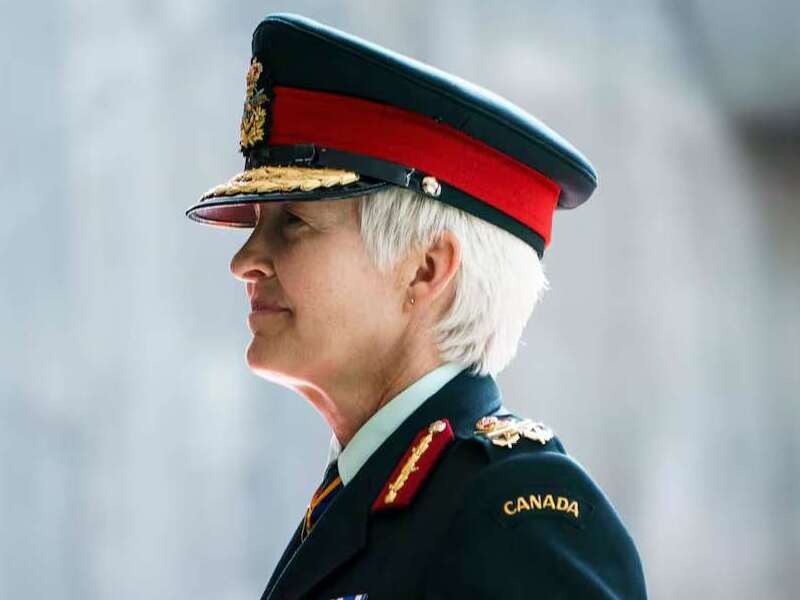
Photo: This image captures General Jennie Carignan in her CAF uniform. Source: The Honest Talk
Disclaimer: Any views or opinions expressed in articles are solely those of the authors and do not necessarily represent the views of the NATO Association of Canada