“To further safeguard Canada’s national security and sovereignty, the Government of Canada
intends to leverage the Defence Production Act to stockpile critical minerals in order to…
Advance the North Atlantic Treaty Organization’s (NATO) deterrence and defence goals by
expanding transatlantic capacity.”
Natural Resources Canada, October 2025 Release
In 2010, China restricted rare earth and critical mineral exports to Japan over a territorial dispute in the East China Sea. At the time, Japan depended on China for around 90% of such exports, leading to the disruption of key industries. The episode exposed the vulnerability that heavy reliance on a single supplier can create, as Japan saw how easily vital trade resources can be used as tools of economic coercion. Today, nations are mitigating this threat through de-risking policies using both bi- and multilateral partnerships and strategies to diversify supply chains. Allies are seeking the safeguards needed for sustainable resilience, essential for capacity building within NATO as well.
In due course, Japan’s shock sent out a signal to global markets. Legal challenges followed, and in subsequent years, amidst broader trade tensions, the United States (U.S.), the European Union, Canada, and many countries alike began to re-evaluate and strategically redesign critical supply chains. In 2020-2021, COVID-19 further exposed these fragilities, and, combined with rapid technological advancements, spurred by warfare and innovation alike, pushed nations to accelerate policy reconstruction on rare minerals. Allies have shifted away from the cheapest or most convenient pathways to reliable ones. As NATO highlights in a 2024 release, “[t]he availability and secure supply of these materials are vital to maintaining NATO’s technological edge and operational readiness.”
‘Friend-shoring’, increasingly central to institutions that rely on trust between sovereign states, is a “trade practice where supply chain networks are focused on countries regarded as political and economic allies.” The concept gained traction in the critical minerals sphere as concerns grew over China’s dominance in production and refining. The U.S.-led Minerals Security Partnership (MSP) of 2022, of which Canada is a core member, signalled the growth in multilateral efforts to build sustainable supply chains outside of an ecosystem dominated by China. With renewed threats to territorial integrity and rising demand for secure mineral networks, allies have shifted talk from strictly de-coupling, a prevalent theme in earlier years, to de-risking, often emphasized as a nuanced and pragmatic approach that diversifies sources and anchors investment in trusted jurisdictions.
All told, what was largely driven by market principles, supply and demand, is now directed by national policies and government intervention surrounding security and resilience. Governments are willing to pay a premium for stability, accepting higher upfront costs to avoid future economic coercion and disruption. To illustrate, Canada’s evolving strategic frameworks allow it to prioritise secure projects even when commercial pricing would not support them, using policy tools to redirect investment towards capacity that would not otherwise be financed.
In this light, the creation of the Defence Investment Agency, to overhaul the procurement system, underlines Canada’s stated goal to be “prepared to defend our people, to secure our sovereignty, and to protect our Allies.” By counting investment in sustainable critical mineral infrastructure toward NATO’s 5% spending target, Canada creates more fiscal room to accelerate projects. So comes the new $2 billion Critical Minerals Sovereign Fund intended to direct strategic investments in critical mineral projects and companies, while graphite, scandium, and rare earths are designated as national security priorities under the Defence Production Act (DPA). This status gives scope for direct government intervention in these markets to counter foreign dominance. The DPA is legislation that allows the federal government to regulate defence supplies and materials essential for national security. In late 2025, Energy and Natural Resources Minister Tim Hodgson announced 26 new investments totaling $6.4 billion, many co- financed with nine allied countries to ensure supply for collective defence industries.
On further allied fronts, Canada’s G7-backed Critical Minerals Production Alliance (CMPA) is designed to de-risk and accelerate secure projects by helping them reach financing. A central tool is offtake agreements, long-term contracts where a buyer agrees to purchase future output before it has been produced. This guarantees a level of revenue for the producer while providing financing for the project and reducing risk for other lenders as there is an assured market for the product. The CMPA also brings public lenders to the table such as Export Development Canada, and their counterparts in partner countries, so private banks are not carrying the risk alone. All of this sits inside a broader defence context: NATO’s Defence Production Action Plan that aims to coordinate industrial capacity across member states, ensuring that “mine–to–magnet“ supply chains for military hardware are shielded from foreign coercion.
The G7’s Roadmap to Promote Standards–based Markets for Critical Minerals, announced at the 2025 Summit, complements the same effort with a rulebook approach. It exhibits commitment from sovereign leaders to “transparency, diversification, security, sustainable mining practices, trustworthiness, and reliability as essential principles for resilient critical minerals supply chains.” In principle, producers are expected to show where material comes from, how it was processed, what its environmental footprint looks like, and all in a way that auditors and investors can verify. Consistency in those records across borders allows buyers to write clearer contracts and makes enforcement easier. Conjointly, governments are encouraged to use price floors and temporary price guarantees, like insurance if the market drops below an agreed level, to counteract the price volatility that would otherwise deter financing in a regular market. Though these guarantees are not infinite subsidies, they are time-bound insurance meant to keep the capacity active as new supply chains are scaled.
Ucore, a Canadian rare-earth separation firm, is scaling a Louisiana plant with a US$18.4 million US Department of Defense award, while Ottawa has conditionally approved up to C$36.3 million for Canadian processing. Framed within its G7-backed CMPA strategy, these public anchors derisk the project and help crowd in private capital.
There are, however, real frictions to consider. While the big moves towards resilience are great, a hard constraint is time. Whole supply chains aren’t built in a matter of months and mid-stream plants don’t spring up from the ground. Fostering genuine partnership with Indigenous communities, on whose land many projects sit, is also high on the priority list. Trade laws add another barrier by rendering allied commerce difficult. The EU’s Carbon Border Adjustment Mechanism (CBAM) requires importers to pay for the carbon content of goods. If allies do not align their carbon pricing or standards, these charges could inadvertently penalize friendly producers and disrupt the secure supply chains trying to be built.
Ultimately, building resilience and friend-shoring require high upfront costs that many nations have decided are worth paying for long-term security. Canada’s toolkit includes anchored offtakes and transparent standards that aim to protect Canada from a fate similar to Japan’s. With such policies, governments are designing harder to weaponise supply chains and making it easier to finance trusted networks. It would be nice for success to look like the cheapest ton on earth, but as Prime Minister Mark Carney put it at the 2026 World Economic Forum: “Collective investments in resilience are cheaper than everyone building their own fortresses. Shared standards reduce fragmentations. Complementarities are positive sum.”
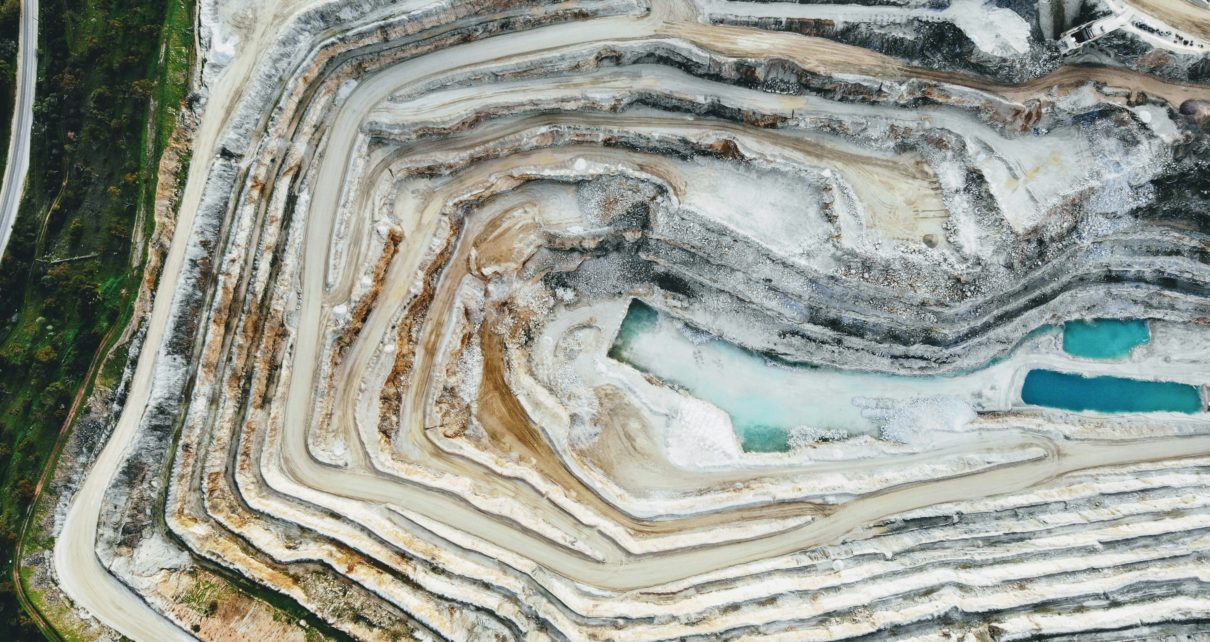
Photo: An aerial view of a quarry with a blue pool sourced via Unsplash.
Disclaimer: Any views or opinions expressed in articles are solely those of the authors and do not necessarily represent the views of the NATO Association of Canada.