Women have long played critical roles in peacebuilding, crisis response, and military operations. Yet, for much of modern history, their contributions have been under-recognized or excluded. This changed in 2000, when the United Nations adopted the Security Council Resolution (UNSCR) 1325 and formally launched the Women, Peace, and Security (WPS) agenda.
NATO has recognized WPS as key to its strategic priorities, integrating gender equality into its missions, policies, and overall governing structure. Canada, a founding NATO member and self-declared feminist policy advocate, has been vocal in promoting the WPS agenda abroad. Yet this contrasts with persistent gender equality challenges within the Canadian Armed Forces. This raises questions about how much of Canada’s feminist branding reflects an institutional commitment. As the 25th anniversary of UNSCR 1325 approaches in October 2025, Canada has a timely opportunity to reflect on its legacy as a global WPS leader and in its pursuit of real change at home.
The WPS agenda is built upon four foundational pillars: participation, protection, prevention, and relief and recovery. UNSCR 1325 was the first UN resolution to acknowledge that women and girls are uniquely affected by conflict through gender-based violence, displacement, and exclusion. Since 2000, the WPS agenda has grown to include 10 related Security Council resolutions including:
- UNSCR 1820 (2008): Recognizing sexual violence as a tactic of war
- UNSCR 1888 & 1889 (2009): Mandating protection roles for female leadership
- UNSCR 2242 (2015): Links WPS to counter-terrorism and violent extremism
NATO has codified this through the Policy on Women, Peace, and Security, which was first adopted in 2007 and updated in 2021, which obliges member states to mainstream gender across administrative and combative operations.
In 2010, Canada was one of the first countries to adopt a National Action Plan on WPS which is now in its third iteration (2023-2029), promoting it across multilateral forums such as NATO, the UN, and the G7. The Elsie Initiative for Women in Peace Operations (EIF) is an example of Canada’s international contribution to upholding WPS by increasing the meaningful participation of women in peace operations. EIF supports countries by providing:
- Gender-Strong Units (GSU) rewards for troops with strong female representation
- Targeted funding for training and reform of institutional and structural obstacles
These efforts align with NATO’s gender mandates, particularly by enhancing the operational effectiveness of NATO-led/partnered missions. However, critics warn that such programs are valued more for short-term mission effectiveness than for implementing institutional change or genuinely recognizing the strategic contributions of uniformed women.
Canada’s leadership has showcased its WPS credentials. In Iraq, Canada deployed Gender Advisors and trainers through the NATO Mission Iraq, which strengthened the Iraqi Security Forces’ capability to respond to sexual, gender-based violence. In Latvia under Operation REASSURANCE, advisors engaged NATO allies in assessing how deterrence missions disproportionately affect women and girls. In the NATO enhanced Forward Presence battlegroup, Canadian-led forces integrated gender analysis into their assessments of the conflict situation, including awareness training on trafficking risks and threats faced by women.
The impact of these deployments warrants further investigation. Have these advisory rules actually reshaped mission strategy, or are they being used primarily to satisfy external policy requirements?
Although Canada is recognized as a global advocate of the Women, Peace, and Security agenda, the private dynamics of the Canadian Armed Forces demonstrate that challenges remain. As of December 2024, women made up around 16.3% of the Regular Force and 17.4% of the Primary Reserve. The numbers are somewhat better amongst officers with 20.8% in the Regular Force and 16.8% in the Primary Reserve, though this remains below the CAF’s 25% female representation target by 2026.
Feminist scholars such as Cynthia Cockburn and Stéfanie von Hlatky have criticized NATO’s engagement with WPS as being driven by strategic priorities. For example, Female Engagement Teams were deployed in Afghanistan and Iraq to connect with local women, as these roles are culturally off-limits to male soldiers. While praised for their effectiveness, these teams reveal a deeper issue; women were included not to advance gender equality, but to serve temporary, operational needs. This use of gender awareness to fill these occupational gaps has prompted concerns that the WPS agenda, at times, has been used as a “force multiplier” to enhance mission outcomes without fully addressing the underlying structural inequalities. Canada, by extension, risks falling into this trap: promoting gender equality abroad while tolerating inequity at home.
In addition, the 2022 Arbour Report (led by Justice Louise Arbour) exposed the deep structural failings hindering gender equality within the Canadian Armed Forces. In response to growing sexual misconduct scandals, the report found that gender based harassment, discrimination, and assault were systemic problems, rather than isolated incidents. Female officers, more commonly those in junior positions, faced potential expulsion for reporting abuse and thus lacked trust in the internal accountability systems within the CAF.
This report emphasized the need for greater accountability within CAF leadership to ensure a safe environment for all – especially for its female and marginalized officers. Justice Arbour called for the transfer of sexual assault cases to civilian courts to provide an unbiased and independent oversight. One of the report’s biggest shockers was the proposed reformation or closure of military colleges, as they were identified as breeding grounds for problematic cultural norms.
For young Canadians, especially women thinking about a military career, the recent reports are alarming. The gap between Canada’s global WPS leadership and its military culture deters many women from joining. The consequences are clear: fewer women enlist, the culture remains male-dominated, and reform becomes harder to achieve. Ongoing inaction weakens Canada’s credibility and undermines its ability to meet WPS commitments, both domestically and internationally.
Nonetheless, there have been recent significant advancements for women in the armed forces. In July 2024, Canada appointed Jennie Carignan as the Chief of Defense Staff, the first woman to hold this position. The CAF has also included Gender Advisors (GENADs) into planning operations and mandated training in diversity, equity, and inclusion. In addition, updates to the Canadian Forces Dress Instructions, such as the removal of gender-specific uniforms, flexibility in personal appearance, and makeup, demonstrate that professionalism is not defined by stereotypical gender expectations. These programs are intended to promote a more inclusive environment within the CAF, to especially advance the WPS pillar of participation.
Meeting the CAF’s 2026 gender targets is essential to encourage women to join, to challenge the male-dominated culture, and to maintain Canada’s global credibility.
One way forward is to embed gender equity into career advancement, making inclusive leadership a requirement for promotion. If Canada claims a feminist foreign policy, that must be reflected in real reforms. At the NATO level, a domestic compliance index could hold member states accountable for WPS implementation at home, not just in deployed missions. Peer mentorship programs and targeted retention efforts could help build trust and shift military culture from within. Promoting more women into senior leadership would also send a powerful signal that the institution is changing.
By taking these steps, Canada can turn its WPS commitments into solid change. As NATO continues to evolve its gender and operational standards, Canada’s dual role as an international advocate and domestic reformer, positions it uniquely to shape the course of WPS implementation.
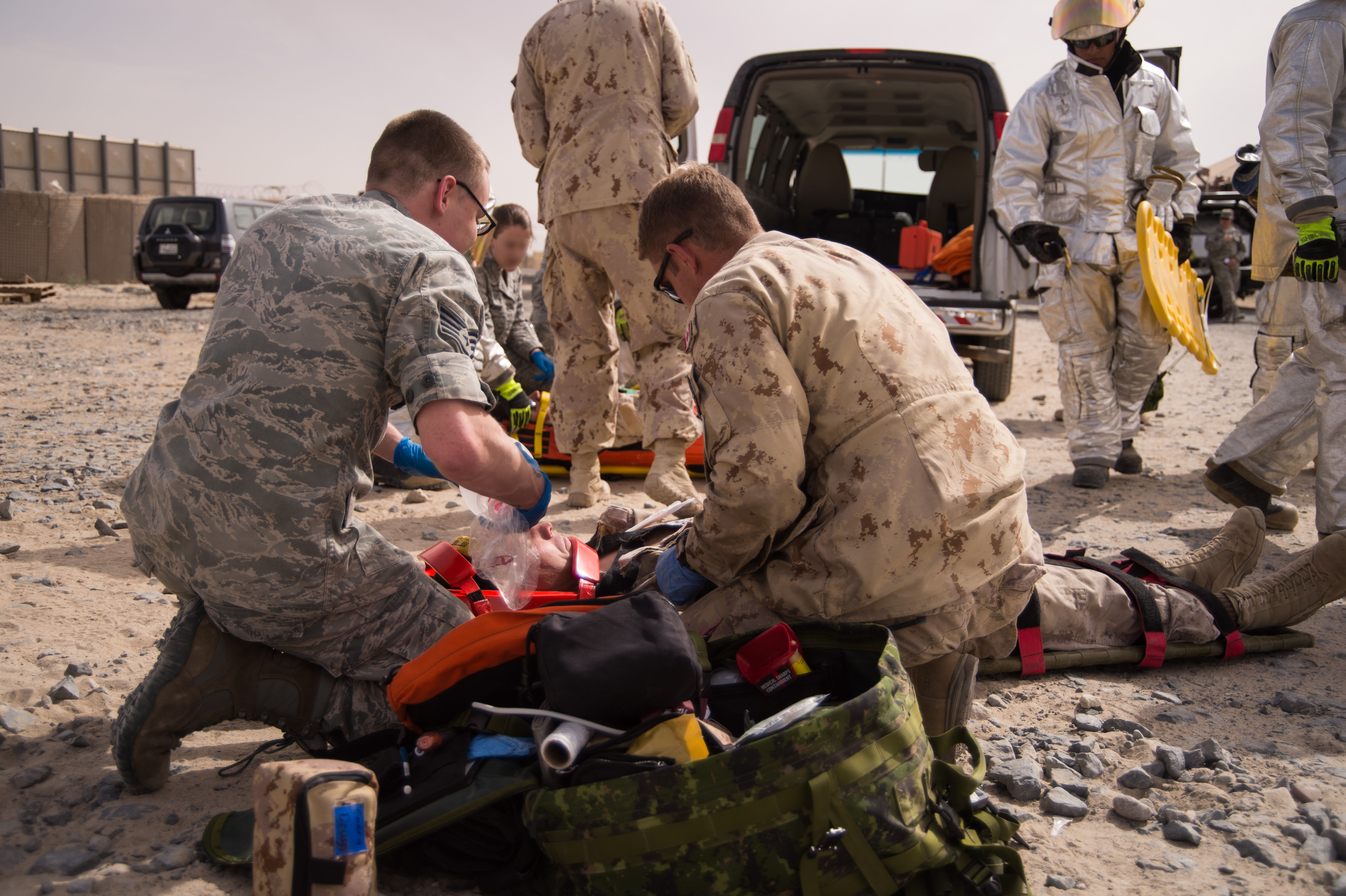
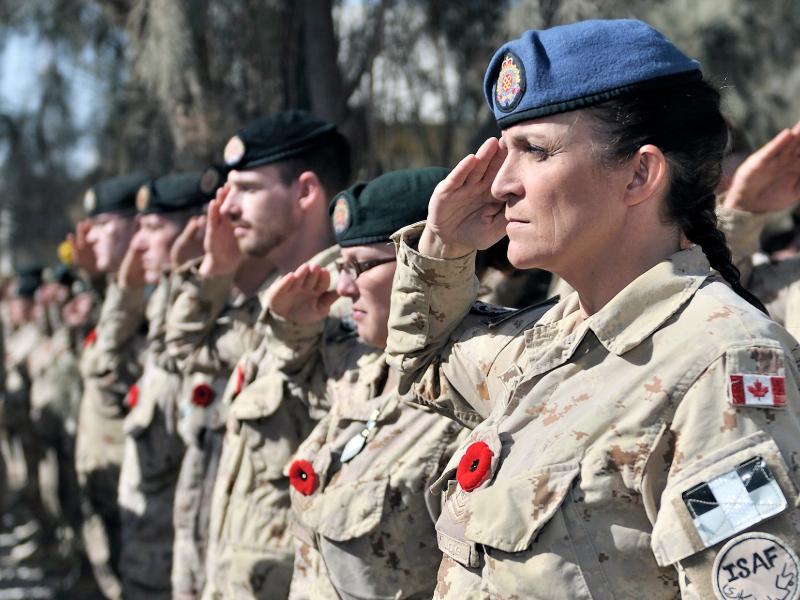
Photo: Canadian Armed Forces, via Forces.ca (“Women in the CAF”)
Disclaimer: Any views or opinions expressed in articles are solely those of the authors and do not necessarily represent the views of the NATO Association of Canada.