Somali referee Omar Artan had described officiating at a World Cup as the biggest dream of his life. That dream ended at passport control. Artan was interrogated for eleven hours at Miami International Airport before being denied entry to the United States on grounds of an alleged association with suspected members of terror organizations. He denied any association and maintained that he had no knowledge of the organization. In the aftermath, British Columbia Premier David Eby and Toronto Mayor Olivia Chow stated Artan would be welcomed in their host cities — a largely symbolic gesture, set against Canada’s record of border exclusions over the tournament.
The 2026 FIFA World Cup, co-hosted by the U.S., Canada, and Mexico, has become a case study in the application of immigration discretion, excluding players, officials, and fans on both political and individual grounds. This has exposed inconsistency in the standards applied by the tournament’s two NATO member co-hosts, as well as a gap in NATO’s own resilience doctrine.
Canada’s individual screening cases concern the admissibility of two World Cup players. Ghanaian midfielder Thomas Partey was denied entry to Canada after authorities refused his visa application. Partey pleaded not guilty to seven counts of rape and one count of sexual assault relating to four women between 2020 and 2022 and is awaiting trial. Under Canadian law, inadmissibility can be found without a foreign conviction. A Federal Court appeal by his lawyers was dismissed. Ivory Coast forward Elye Wahi was initially denied entry to Canada over an investigation into alleged spot fixing in Ligue 1, tied to suspicious betting activity around a yellow card he received. Canadian officials delayed his visa authorization to request further information on his legal situation. The Ivorian federation later confirmed the necessary authorizations had been obtained.
These individual cases stand apart from the exclusions that followed on explicitly political grounds. Canada denied entry to Mehdi Taj, president of Iran’s football federation, ahead of FIFA’s congress in Vancouver in April 2026. His links to the IRGC, an organization listed as a terrorist group in both Canada and the U.S., were cited as the reason for the denial. The refusal prompted Iran to demand a series of guarantees from FIFA and the tournament’s hosts, including assurances that all players, coaches, and officials, including those who had completed military service with the IRGC, would receive visas, insisting it would compete “without any retreat from our beliefs, culture and convictions.”
The U.S. replicated that same logic once the tournament began, applying it to Iran’s delegation directly. The Republic accused the U.S. of “politically biased interference in sport” after members of its backroom staff, including the head of its football federation, were denied entry to the country, while players were granted visas only on the condition of same-day entry and exit for each match.
The exclusion did not stop at delegations. Between November 2025 and March 2026, Canada approved only 41 percent of nearly 17,000 visitor applications submitted by soccer fans from over 160 countries. Citizens from eTA-eligible countries, including Australia, Germany, and New Zealand, were approved at a rate of 96 percent. Those requiring a full visa were approved at just 32 percent, with some nationalities denied entirely, including Syria, Uganda, and Sri Lanka. Ghana, which submitted the most applications of any country at 1725, saw an approval rate of just under 11 percent.
Some of these exclusions reflect legitimate risk assessment. Canada’s co-hosting of the tournament resulted in 175 refugee claims from visitors who traveled to the country during the tournament, an exercise of the legal right of foreign nationals to seek asylum after entry. Countries are often reluctant to grant visas to nationals from states with higher migration potential, given the possibility of conversion to asylum claims.
These cases reveal both politically driven exclusion and individual discretionary screening. Partey and Wahi were screened on individual conduct, a process that remained procedurally grounded. Taj’s exclusion reflects a political pattern within Canada, as does the scale of Canada’s disparate visa approval rates by nationality. The U.S.’s treatment of Iran’s delegation follows the same pattern.
NATO coordinates defense and security policy among its members, but immigration and border admissibility remain entirely sovereign, falling outside the Alliance’s mandate. This institutional gap means member states can be fully aligned on collective security while producing incompatible outcomes on basic questions of civilian mobility. That gap has always existed, but the World Cup is the first time it’s been tested so publicly, exposing a fault line the Alliance’s own resilience doctrine claims to cover.
This incoherence is reinforced by NATO’s 2022 Strategic Concept, which identifies resilience, understood as the combined civil and military capacity of member states to withstand disruption, as essential to the alliance’s core tasks, rooted in Article 3 of the founding treaty. That framework treats population movement as a resilience concern. One of NATO’s seven Article 3 baseline requirements calls on members to manage the movement of people so it doesn’t interfere with military mobility. Coordinated entry standards for an event two members are co-hosting fit within that logic, yet the Alliance has never extended its framework to it. That gap between what NATO’s doctrine claims resilience should encompass and what it actually coordinates has been visibly exposed, undermining the case that shared alliance membership produces shared standards, not only on the battlefield, but in the civil domain NATO itself says matters.
NATO does not need a new mandate to close this gap, only the extension of one it already has. Its seven Article 3 civil preparedness baselines cover energy, transport, and communications, but none address coordinated mobility among member states. An eighth baseline would not mean shared immigration policy or a common adjudication body, the way the EU pursues through Schengen. It would apply the same coordination logic NATO already uses for infrastructure: shared standards for how visa and border decisions are made and disclosed for accredited participants, while each member keeps final control over its own sovereign decisions.
Under the energy baseline, NATO already coordinates the Central Europe Pipeline System, a shared fuel network spanning six member states with standardized procedures set by a joint programme office, without any member ceding control over its own energy policy. An eighth baseline would need to preserve that same distinction: coordinated standards for how accreditation and screening decisions are made and disclosed, not a shared adjudication process.
That distinction is what makes the proposal workable. States will resist ceding ground on immigration, but the baseline does not ask them to. It asks only for shared standards on how accreditation and screening decisions are made and disclosed, the same ask NATO already makes on energy and transport, where sovereignty is just as sensitive but has not blocked coordination. Without that constraint, member states would reject the proposal outright. Without the baseline, states will keep applying sovereign, uncoordinated immigration discretion, undermining the resilience NATO claims to prioritize.
The 2026 FIFA World Cup has unintentionally exposed an Alliance that has spent decades building interoperability for its militaries while leaving the civilian mobility of its own citizens, and the world’s, to sovereign discretion alone. NATO’s 2022 Strategic Concept already claims resilience as a shared responsibility spanning both civil and military domains, but the World Cup shows that claim remains aspirational at the border. The question, then, is not whether Canada or the US can deny entry, but whether the restrictions they impose are transparent, proportionate, and consistent with the principles of international cooperation both claim to uphold. Until that question is answered and that gap is closed, the 2026 FIFA World Cup will remain a reminder that the game belongs to everyone, provided they have the proper documentation.
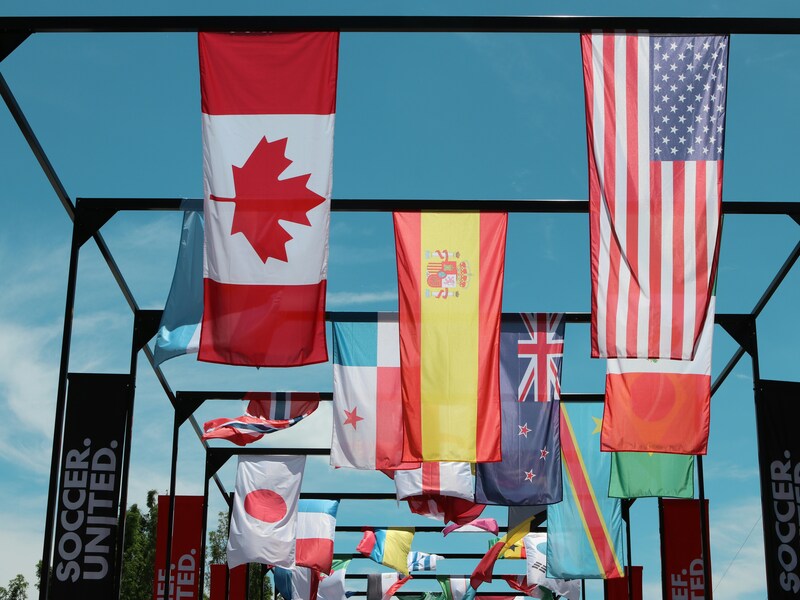
Image credit: FIFA World Cup 2026 Flags at Toronto Harbour front (2026) by Waseem R via Unsplash. Licensed under Unsplash License.
Disclaimer: Any views or opinions expressed in articles are solely those of the authors and do not necessarily represent the views of the NATO Association of Canada.