Europe’s political and economic stability rests heavily on the cooperation of the European Union (EU), a bloc of 27 states that anchors much of the continent. The EU’s unity is central to the region’s security, something exhibited blatantly after Russia’s full-scale invasion of Ukraine in February 2022. Although support for Ukraine has been nearly universal across the EU and NATO, some states’ economic ties to Russia highlight fractures in European cooperation. A weakened Europe is a win for Canada’s adversaries. It creates opportunities for foreign information manipulation and interference that plant further fractures within the union. Adversaries have exploited existing disagreements to erode European trust in democratic systems, pushing disinformation on policy issues like immigration and energy. A strong and united Europe is a reliable ally. As Canada grows closer to its transatlantic allies, ensuring the region’s strength and security is paramount.
Canada is actively deepening its ties with the EU, launching industrial policy dialogues, defence partnerships, and most recently, promoting Canadian natural resources as an alternative to Russian energy sources. While Canada has friendly relations with individual member states, the agreements and partnerships are formed with the whole union. As a result, many of Canada’s foreign policy plans depend on the EU’s cohesion. Because of this, Canadians should keep an eye on emerging fractures and vulnerabilities across the continent.
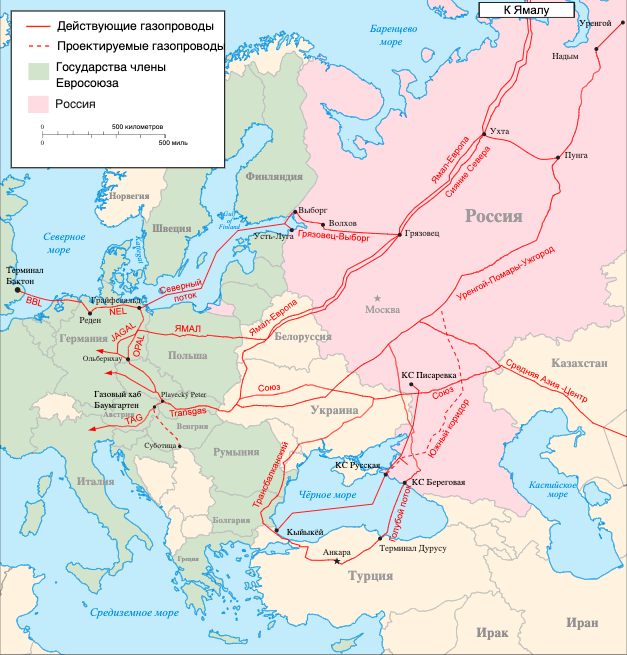
For years, concerns about energy security have held a major place in European foreign policy discussions, with the 2022 full-scale invasion of Ukraine bringing significant attention to the EU’s dependence on Russian oil and gas. Before 2022, Russia accounted for almost 40% of the EU’s gas imports. Pipelines between Russia and Europe have often been the subjects of geopolitical and economic disputes, raising questions over their reliability. In recent years, Europe has discussed the phasing out of Russian fuel entirely – something easier said than done. Years of investment and negotiations on infrastructure with Russia have left policymakers hesitant to shift the course drastically. What happens if Russia chooses to shut off the taps during the winter? Or if Ukraine continues to target Russian energy infrastructure, how will this affect energy supply to Europe? As the war continues, the EU has had to adapt to the new reality: a dependence on Russian fuel undermines energy security. To tackle this vulnerability, the EU has proposed a gradual phase-out plan, which aims to stop Europe’s imports of Russian fuel by the end of 2027.
While most EU members have committed to ending their energy dependency on Russia, Hungary and Slovakia have instead deepened their ties with Moscow. Partially due to their reliance on Russian energy, Hungary and Slovakia have also blocked aid for Ukraine and sanctions against Russia. This reliance leaves them vulnerable to the effects of these sanctions, such as increasing gas prices or supply disruptions. Adversaries exploit these vulnerabilities through targeted disinformation campaigns and the bribery of elected officials, further enforcing the idea that Europe cannot fuel itself without Russia.
Despite repeated calls from EU and NATO members to seek alternative suppliers, Hungary and Slovakia have doubled down on imports from Russia, citing infrastructure limitations as the main reason. Existing pipelines and infrastructure make it expensive to transition to new suppliers or alternative energy sources. Slovakia has asked for patience with this lengthy transition. However, its lack of initiative in strengthening renewable energy production signals a reticence to transition at all. Analysts have shown that accelerated deployment of renewable electricity, energy efficiency, and electrification could have already enabled the EU to achieve independence from Russian gas.
Energy transition is a costly endeavour, but one that would ensure Europe’s long-term security. Supply dependencies also exist in renewable energy, such as the need for imported critical minerals and equipment from outside of the EU. However, the independence that countries gain by producing their own energy makes this trade-off worthwhile. Researchers have outlined options for Hungary and Slovakia to diversify their energy supply, including tapping into the Adria pipeline from Croatia rather than relying on Russian infrastructure. Hungary has rejected Croatia as an energy partner, claiming its pipelines are not adequate for Hungary’s needs. Ante Šušnjar, Croatia’s Economy Minister, has responded that “this is just an excuse [to continue] buying Russian oil.” As long as Hungary and Slovakia remain adamantly dependent on Russia, the EU’s attempts to pass sanctions on Russian energy will continue to fail, as they require unanimous support that Hungary and Slovakia are unwilling to provide. The hesitation to transition has also caused the EU to finance both Russia and Ukraine simultaneously. By purchasing fuel from Russia, the EU pays for the Russian war effort. This is counterproductive as it also supplies Ukraine with aid to resist the invasion. Europe could spend less on Ukraine’s defence if it were not also funding Russia through energy imports.
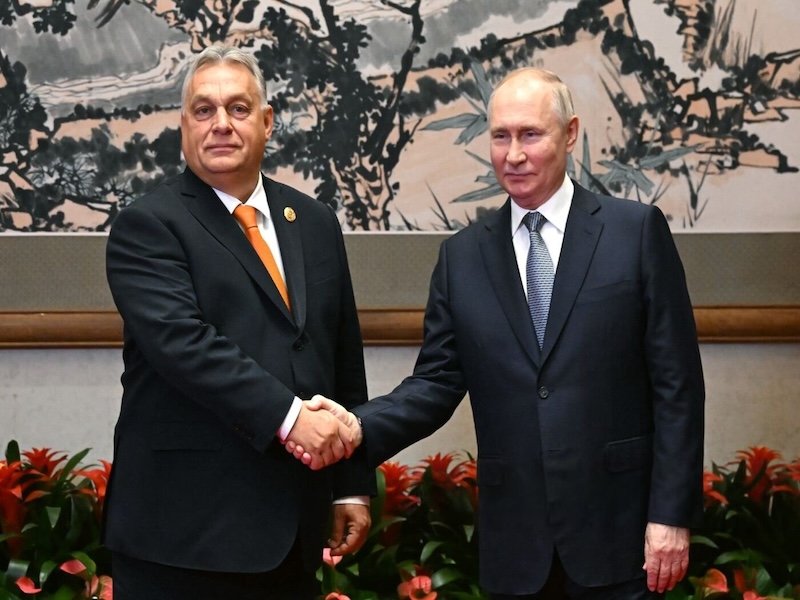
Hungary’s opposition to sanctions is not rooted solely in its reliance on Russian fuel. It signals a broader pro-Russian alignment within the government. On several occasions, Budapest has used its veto power to block the release of frozen Russian assets and other financial aid packages to Ukraine. Hungary’s Prime Minister Viktor Orban also visited Moscow in 2024, meeting with President Vladimir Putin, a move that was heavily criticised by EU and NATO member states. Hungary’s adamant opposition to phasing out Russian fuel may therefore stem less from economic constraints than from Orban’s political alignment with Moscow.

As a part of a coordinated series of attacks, Ukraine is now targeting Russian energy infrastructure to disrupt the country’s main source of war income – oil and gas exports. In August 2025, Ukraine hit a pumping station on the Druzhba pipeline in Russia, a key route supplying Hungary and Slovakia with Russian fuel. This caused an uproar in both countries as officials called it an attack on European energy security. By late October 2025, Ukrainian drone strikes had hit over 50% of Russia’s 38 major refineries more than once. As winter approaches, both countries are targeting each other’s energy infrastructure with varying goals. Russia is trying to stress Ukrainian resolve and Ukraine seeks to financially weaken Russia’s energy industry. Though Ukraine is not directly targeting Hungary or Slovakia, the effects of these strikes, such as the temporary suspension of gas imports, are felt far from the frontlines by those reliant on Russian energy.
Since the August attack on the Druzhba pipeline, the EU has been considering intervening in the flow of Russian fuel to Hungary and Slovakia. This move will likely cause more disagreement between the two countries and the rest of the bloc. High-level discussions on this subject are ongoing. On October 8 2025, EU ambassadors agreed to proceed with the bloc’s phase-out plan, which would oblige Hungary and Slovakia to set national plans to cease their imports of Russian gas by 2028. In an attempt to secure a ceasefire, the US has increased its sanctions against Russian energy, and President Trump rejected Orban’s request for exemption. On this matter, Péter Krekó, director of the independent Budapest-based Political Capital think tank, has argued that, “If the sanctions [proposed by the US] go ahead, Hungary will have to start taking alternatives seriously.”
As the 2028 deadline approaches, Europe is seeking new sources of energy to heat its homes and power its factories. Part of Europe’s REPowerEU plan seeks to diversify energy supplies. This means both investing in renewable energy and sourcing fuel from alternative suppliers. Canada can step in and supply Europe with natural gas, further establishing itself as a trusted and reliable ally. With the US shifting away from international cooperation toward national interests, now is the time for Canada to strengthen its transatlantic relationships and cement its commitment to European security.
Photo: Russian President Vladimir Putin shakes hands with Hungarian Prime Minster Viktor Orban during a meeting ahead of the Belt and Road Forum in Beijing, China, October 17, 2023. Source: Grigory Sysoev.
Disclaimer: Any views or opinions expressed in articles are solely those of authors and do not necessarily represent the views of the NATO Association of Canada.