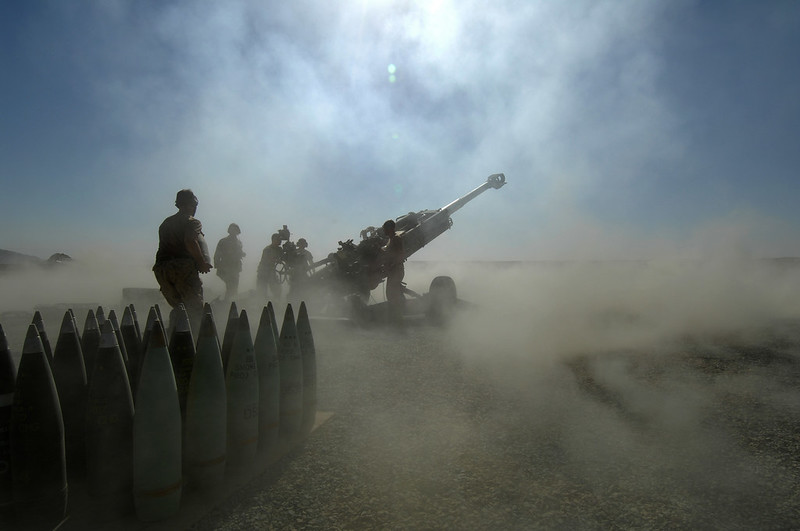
This September marks twenty years since Operation Medusa — the battle that defined Canada’s war in Afghanistan and reshaped how the country saw its military. At the centre of it was Brigadier-General David Fraser, the officer running his country’s force in Kandahar and NATO’s southern command. Most retellings stop at the victory his forces won; this piece looks instead at the stakes leading into Medusa, the decisions Fraser made under pressure, and what its costs still ask of Canada now, as the NATO Association of Canada brings him back into the conversation for the anniversary.
The Stakes Leading Up to Operation Medusa
Operation Medusa was Canada’s answer to a five-year mission edging toward collapse — measured less in territory than in NATO’s operational credibility. The Taliban, driven from power in 2001, had spent years quietly regrouping in Kandahar’s rural districts while the province remained an American responsibility. NATO’s UN-mandated mission stayed confined to the calmer capital until 2006, when it reached the volatile south and Canada took over as lead nation for Kandahar — inheriting the most contested ground just as the Taliban had rebuilt the strength to test it. That test came fastest in Panjwayi, a district outside Kandahar city and the birthplace of the Taliban movement, where walled compounds and irrigation canals sheltered Taliban fighters and slowed every advance. The true scale of that buildup was not clear until a company on Masum Ghar, a hill overlooking the valley, came under attack from three to five hundred Taliban fighters in one evening. The Canadians held, killing roughly a hundred insurgents without losing a soldier, revealing the extremists held far more strength than commanders had estimated. Killing a hundred fighters did nothing to shrink the buildup: NATO, an alliance backed by the world’s most powerful militaries, still risked a standstill against an insurgent force with a fraction of its resources.
Medusa in Action
Fraser’s answer was the largest combat operation Canada had mounted since the Korean War; its true beginning, by his commander’s account, was the order to anticipate it, not the fighting. The Taliban’s shift from hit-and-run ambushes to massed assaults was, in Fraser’s words, a bid “to prove to the world and the Karzai government that they could take us on”; he believed “they thought they could win it then. His answer was to build a coalition of nearly 1,400 troops from nine nations — pulled almost entirely from his brigade, since “NATO was politically hamstrung to give me anything more than I could get (from inside my brigade).”
His instinct to act in the moment, more than the plan itself, drove what followed. Coalition forces sealed the Taliban’s escape routes and pushed across the Arghandab River, trapping the enemy in a pocket roughly five square kilometres wide — but when a planned air strike on Taliban command positions fell through, Fraser ordered three days of bombardment instead. Every order to the battle group was effects-based, built to shift on conditions rather than the clock — so when Fraser moved the ground attack forward by 48 hours, it was that kind of call, not a break from the plan. Intelligence showed the Taliban at their weakest point yet; his troops were nearing the ‘culminating effect’ of running out of steam, and the units he had borrowed from other tasks were needed back. The call prompted a direct, lively discussion with his battle group commander — one Fraser calls productive, not adversarial. As the Major-General said, “We were talking about the hardest fight either one of us had ever done in our military career” — “and, as commanders, we’re dealing with lives of soldiers, and lives of Afghans.”
That decision committed Canadian troops to a mechanized assault on a dug-in position— the kind of attack they had not mounted in decades. Nearly two weeks of fighting followed, coalition forces grinding down Taliban defenses until resistance gave way. The main offensive was declared complete on September 14, though Medusa formally continued into September 17, with follow-on operations after. What resulted looked, on paper, like what Fraser had gambled for: a broken Taliban, a cleared district, and NATO’s first battle won.
What Medusa Left Behind
The battle ended in less than two weeks. Its legacy took much longer to settle — and in some ways, still has not. That reckoning begins with the casualties: the majority of Canadians killed in the fighting died from direct enemy fire, a cause of death that had claimed almost no Canadians before. Four soldiers died in the September 3rd ambush alone, and a fifth the next day to friendly fire — losses that came at the outset, before the ground assault was ever moved up. The acceleration decision itself cost no additional lives. Medusa’s end was not the end of the fighting: in the follow-on operations that continued across the district, insurgent bombings and buried mines killed even more Canadians than the battle itself had.
Canada’s self-image as a peacekeeping nation — built through two world wars and Korea — grew harder to sustain. The losses were severe enough that researchers named the pattern the “Trenton effect,” after CFB Trenton, the Ontario airbase where flag-draped soldier caskets were flown in and met by family and media before the procession home. Each homecoming became an occasion to reconsider the mission, and researchers found the pattern wore down public support that had carried the war through its early years — support already thinnest in the year Medusa was fought.
Winning the Battle, Losing the Peace
The erosion was not just a matter of public mood. Fraser himself was blunt about what followed. While Ottawa publicly promised a coordinated “development, diplomacy, and defence” approach, Fraser spent his early months lobbying Ottawa for basic development and policy specialists, and coalition forces leaned on U.S. funding to cover reconstruction costs Canada could not. He called the result “more than embarrassing” — proof, in his own words, “that we were lying about being in for the long haul.” Canada was slow to build that effort out, but the commitment did not stop there: over the following decade it invested more than a billion dollars and delivered a credible effort.
The Taliban did not disappear after Medusa; they changed tactics, reverting to smaller-scale attacks that cost Canadian lives for another five years, until the combat mission wound down in 2011. Some villages Canadian troops fought to secure still looked little better than in 2006, and by 2021, the Afghan government Medusa had helped defend was gone entirely. None of that diminishes what was accomplished, or what it cost the soldiers who fought there — but it is why revisiting Medusa now means asking what came of it, not just remembering a battle won.
Twenty Years On
Twenty years on, Operation Medusa still reads as two stories at once: a battle Canadian soldiers won, and a commitment to Afghanistan’s long-term rebuilding that the country never fully kept. Those soldiers paid the ultimate price believing their sacrifice would secure a lasting peace for Afghanistan, and that belief deserves to be honoured plainly. But honouring it is not the same as answering for what came after. The real question the anniversary raises is more specific than remembrance: whether Canada’s follow-through ever matched what was sacrificed.
Disclaimer: Any views or opinions expressed in articles are solely those of the authors and do not necessarily represent the views of the NATO Association of Canada.
Photo: “Gunners from X Battery, 5e Régiment d’artillerie Légère du Canada (5 RALC) at Patrol Base Wilson, conduct a fire mission with the M-777 155mm howitzer, to support Coalition forces who have located a Taliban position”, via Veterans Affairs Canada. Public Domain.