As NATO deepens its technology cooperation with Indo-Pacific partners, it has yet to resolve a fundamental question: who should be permitted to fund the startups it supports? In January 2026, NATO opened its Innovation Continuum exercises to Australia, Japan, South Korea and New Zealand for the first time, with a spokesperson noting that the change allows the Alliance to “tap into the advanced science, technology, and industrial ecosystems of the Indo-Pacific partners”. Since then, Japan has reportedly approached NATO about joining the Defence Innovation Accelerator for the North Atlantic (DIANA), a move that would make it the program’s first non-member participant. Funding, however, has not followed: the Capital Network that DIANA established this year to shield its companies from adversarial investment admits only investors headquartered in NATO member states, leaving partner capital to enter case by case.
Recent developments in China have made that shortfall harder to overlook. Its revised National Defense Mobilization Law, in force since October 1, 2026, obliges firms in key sectors to support defence mobilization and allows the state to draw on their data, making the origin of any investment in an Allied startup a more pressing concern. As NATO considers folding Indo-Pacific partners into its innovation programs, it should counter adversary-linked investment with more vetted funding rather than merely tighter screening; that means bringing partner capital in on trusted terms, beginning with admission to the Capital Network.
Few defence startups can scale on venture capital alone. The NATO Innovation Fund (NIF) observes that traditional venture capital is “rarely sufficient to carry companies from early development to procurement readiness”, given long development timelines and delayed revenue. A startup facing a gap between milestones therefore has strong incentives to accept capital with little scrutiny of its source. Five Eyes agencies warn emerging technology firms that investment can be used to gain access to – and influence over – their companies, since an equity stake can unlock sensitive information or a say in strategic direction. NATO names one source of that risk in its 2022 Strategic Concept, which states that China seeks to “control key technological and industrial sectors, critical infrastructure, and strategic materials and supply chains”.
China’s revised National Defense Mobilization Law provides a legal mechanism for that ambition. Article 60 requires sectors including telecommunications, cybersecurity and defence research and production to undertake defence support tasks once mobilization is declared, and to train for them in peacetime. Article 7 lets the state collect and use data “closely related to defence mobilisation” from Chinese entities. Under these provisions, a Chinese state-linked investor with access to an Allied startup’s technical or commercial information could be legally required to share what it learns. The risk now lies in the investor’s legal obligations, not its intentions.
In principle, DIANA has already anticipated this risk: the Capital Network is meant to protect DIANA companies from adversarial investment and influence, with every participant screened against “trusted capital standards” and bound by the network’s investment principles. However, because membership is limited to Allied investors, the first cohort named in September included none from NATO’s four Indo-Pacific partners. Investors from those countries may still back DIANA firms, but only ad hoc, with each deal subject to the host country’s screening.
That arrangement leaves startups relying on a safeguard that is essential but reactive, as national screening can stop a risky deal but cannot supply a better alternative. Screening also works one deal at a time, leaving much of the vetting to young firms with little capacity for due diligence; the Five Eyes guidance, tellingly, asks companies themselves to decide how much proprietary information to share with prospective investors. A larger pool of trusted investors would ease both pressures, offering an alternative to risky capital while sparing startups the work of vetting investors themselves.
The most natural source of that money is the partners NATO is already courting, several of which have acted on the same concern that underpins the Capital Network. Australia and New Zealand co-issued the Five Eyes guidance on protecting emerging technology firms, while Japan’s May 2026 amendments pave the way for lower screening thresholds for higher-risk investors, including entities subject to foreign government information-gathering obligations; this description fits investors bound by laws such as China’s. Admitting their investors would align the network’s funding with cooperation already under way, consistent with the Strategic Concept’s recognition that developments in the Indo-Pacific “can directly affect Euro-Atlantic security”.
Some Allies may worry that widening the network would weaken it, since partner investors could carry their own exposure to adversary capital. The concern is legitimate but argues for rigorous vetting rather than exclusion. Partner investors would meet the same trusted capital standard as Allied ones, and national screening would be kept as a second layer of security without replacing the first. Excluding them, by contrast, does not eliminate the risk; it leaves startups with fewer trusted options and the same need for financing.
Nor can public funds alone meet that need. Funded by Allied governments, the NIF has a €1 billion portfolio to invest directly in startups, while late-stage European defence startups raised $4.7 billion in 2025 alone, mostly from private investors. Enlarging the Fund would also be slow: Canada committed to join in 2024 but only entered negotiations, pending members’ approval, in July 2026. Public funds can complement private capital but not replace it, which makes vetting private investors, including partners, the more pressing task.
Three measures would bring partner capital into the network on Allied terms. First, DIANA should create a partner track within the Capital Network, vetting individual investors from the four partners against the same trusted capital standards and investment principles as Allied members. The track should begin with Japan, whose request to join DIANA remains under discussion. Vetting should examine ownership, sources of funds and any undisclosed commercial, political or military ties, as the Five Eyes guidance advises. Because the partners’ screening regimes differ, and Japan’s is still in flux, admission should be assessed per investor rather than by country.
Second, Allies should keep national screening intact, and network membership should exempt no deal from foreign investment review in the startup’s home country. To keep its vetting current, DIANA should regularly exchange information with Allied and partner screening authorities on adversary-linked investors.
Finally, NATO should start small and review the results. A limited first cohort of partner investors, assessed after one year on investment volume into DIANA companies and any security concerns, would let Allies test the arrangement before expanding it. Any expansion should rest on Allied consensus, just as Japan’s bid to join DIANA would need member state approval.
NATO’s Indo-Pacific outreach has so far centred on technology and the firms that develop it, leaving capital as the missing piece. China’s mobilization law shows how an adversary-linked investor could become a channel to the state, and screening can only refuse such capital one deal at a time. Admitting vetted partner investors to the Capital Network would give DIANA companies a credible alternative to risky capital while leaving national safeguards intact; it would also extend the Alliance’s Indo-Pacific partnerships to the funding on which their shared innovation depends.
Disclaimer: Any views or opinions expressed in articles are solely those of the authors and do not necessarily represent the views of the NATO Association of Canada.
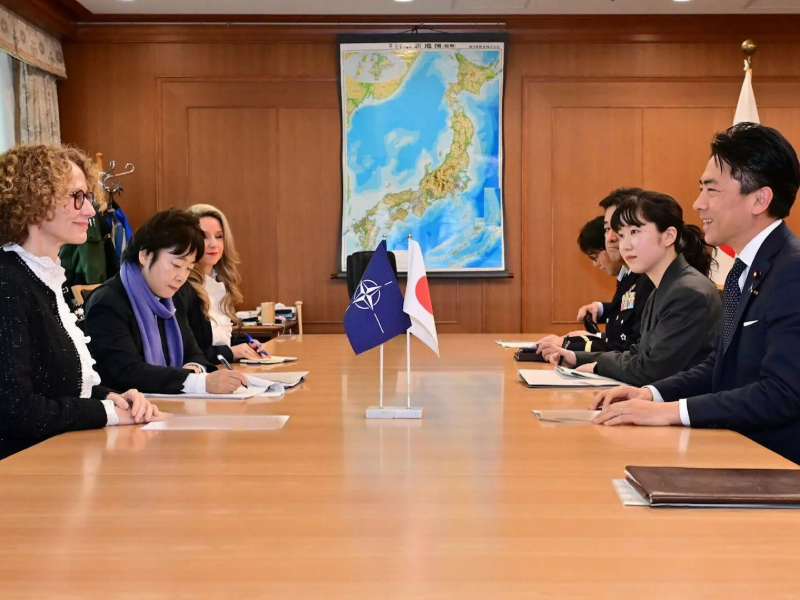
NATO Deputy Secretary General Radmila Shekerinska meets with Shinjirō Koizumi, Minister of Defence of Japan – March 2026 (Photo: NATO)