Azerbaijan and Italy are tightening energy ties, and this is having system-wide Euro-Caspian effects. In September, it was reported that SOCAR agreed to acquire Italiana Petroli, one of Italy’s largest fuel retailers, pending approvals. This purchase does not add gas capacity on day one, but it does insert Azerbaijan directly into Italy’s downstream market, bringing the seller closer to end-customer behaviour inside Italy.
Italiana Petroli will provide SOCAR with a platform for linking commercial timing to practical work along the Southern Gas Corridor (SGC). For Italy, SOCAR brings balance-sheet depth and operating reach. As winter approaches, gas throughput will be set by compression upgrades, accurate metering, and planned maintenance. The purchase can provide coordination between SOCAR’s engineers and financiers and Italian operators, facilitating the alignment of matching contracts, permits, and equipment deliveries to real work windows.
TAP Capacity Ramps Up as Italy Coordinates EU Buying
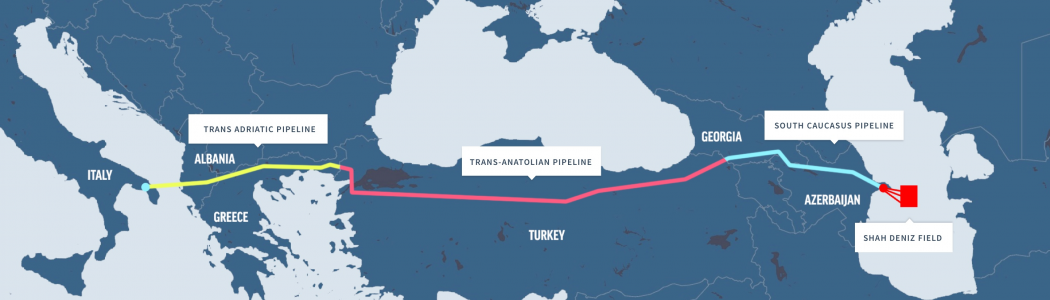
Landfall of the Trans-Adriatic Pipeline (TAP) at Puglia, on the heel of Italy’s boot, gives this partnership leverage on the ground, while Azerbaijan’s upstream and transit roles give it weight. By early September 2025, cumulative TAP deliveries passed 50 billion cubic metres (bcm). At that level, flows begin to track Italian storage cycles and LNG regasification (technically called “send-out”) with some regularity.
Shippers can then push a little farther east into Greece and Bulgaria, or they can keep volumes in Italy for the shoulder months. When pipeline and storage data are posted on time, a promise turns into a delivery date that lenders and buyers can plan around. The strategic frame is the July 2022 EU–Azerbaijan memorandum of understanding on strategic partnership in energy, which foresees delivery of “at least 20 bcm per year [bcm/y]” to the EU by 2027.
On recent evidence, hitting that figure will require steady execution by both sides. Azerbaijan needs to maintain deliverability at Shah Deniz at least flat to slightly higher, while keeping it moving through the Trans-Anatolian Natural Gas Pipeline (TANAP) across Turkey, which SOCAR leads as majority shareholder. At the same time, TAP needs to bring phased capacity when promised while Italy maintains its buyer-coordinator role within the EU system.
How Azerbaijan and Italy Have Built a Corridor That Works
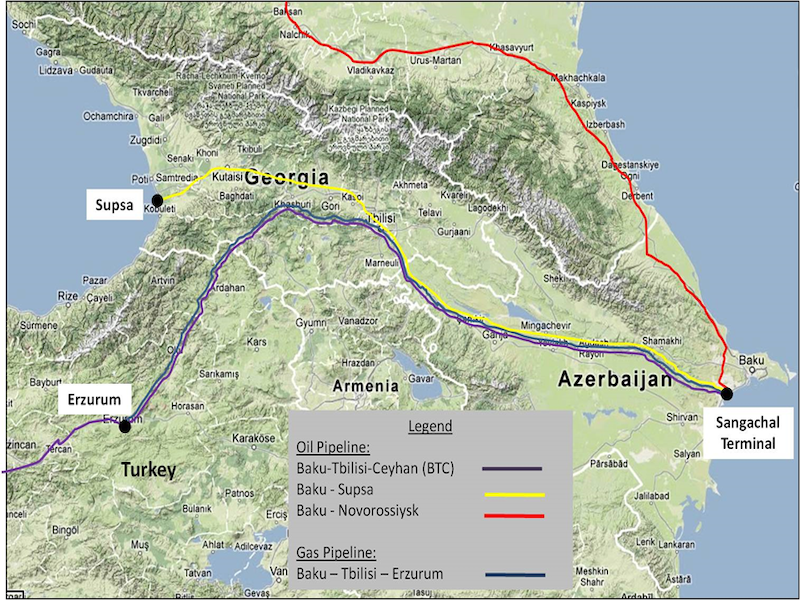
The SGC emerged in the late 2000s as an EU-backed route to diversify away from Russian pipeline gas. Azerbaijan supplied both the anchor resource and the political will to move it from plan to operation. The core chain—the expanded South Caucasus Pipeline (SCPx) from the Caspian through the South Caucasus, TANAP across Turkey, and TAP into Italy—linked up fully in 2020, after long cycles of permitting and investment. Baku earns offshore and strengthens its alliance with Turkey while keeping a reliable door open to European demand. Europe, for its part, is a long-haul option with its own upstream base, routing, and rules.
Rome’s role has matured alongside Baku’s. Italy has moved from being a large end-market to acting as a routing hub for east-to-west flows. Azerbaijan has moved from single-field exporter to corridor leader having upstream, transit, and now downstream presence. High storage in Italy dampens winter demand spikes, while steady LNG send-out smooths short swings in demand. This mix of instruments allows Italy to send gas toward the Balkans when spreads justify it and pull volumes back when domestic balances tighten. It also rewards Azerbaijan’s consistency: when Baku delivers what it books and issues credible updates, operators on both sides plan rather than improvise.
The Mattei Plan, named after the founder of the Italian energy company ENI, is an initiative launched by Prime Minister Giorgia Meloni in January 2024 to establish a new framework for cooperation with African nations. It links energy, finance, and development in the Mediterranean and connects to EU tools such as Global Gateway and to multilateral lenders like the African Development Bank.
For Azerbaijan, the payoff here is partners who set firm dates and share costs for such practical upgrades as new compressors, better meters, system tie-ins, and support for cross-border connectors. Within the European Union, committees establish the pertinent rules that govern the setting of tariffs, the auctioning of pipeline volume, and the reporting on emissions. Predictable cross-border tariffs, posted early, allow shippers in Baku and buyers in Italy to lock in multi-year capacity with fewer surprises. If methane monitoring follows realistic equipment timelines, then operators avoid redesigns and bookings can open sooner.
How Italy and Azerbaijan Should Coordinate Markets and Flows
SOCAR’s entry into Italy’s downstream tightens the loop between Azerbaijan’s upstream plans and day-to-day market signals in the EU. The seller gains sight of Italian wholesale inventories, retail patterns, and logistics limits. The buyer gains a partner able to act across the chain. That two-way link pulls maintenance forward when needed on TAP. Lenders see how gas will be monetized in Italy and, where warranted, re-routed into neighbouring markets. As a result, modest but time-critical midstream tasks face lower perceived risk.
Execution steps sit mainly in Europe yet serve both parties. For example, a short quarterly note, shared by the main operators and regulators, would fix maintenance windows, indicate when extra capacity is offered, and set the data that must be published. Information regularly shared about TAP flows, Italian storage, LNG send-out, and Algerian receipts provides transparency for decisions on volumes east or west.
Risks will not vanish, but they need not set the tone. Offshore work can slip because of drilling issues, tie-ins, or weather, even as Shah Deniz signs new contracts and brings new wells online this year. Equipment can arrive late, certification lines can slow delivery, and tariff decisions that come too slowly chill firm bookings.
If LNG is cheap and plentiful, buyers may hold back on pipeline reservations unless terms are sharp. Changes to methane rules mid-project can also move costs. None of that is new. Better timing, clearer data, and steadier decisions will cut the odds that a small delay becomes a missed season. This interest is shared equally by Baku and Rome.
The Result Is That Europe Resets Its Gas Mix with a Caspian Anchor
Europe’s gas balance is moving toward a mixed model: flexible LNG paired with a smaller, steadier pipeline base. Within that model, Azerbaijan’s leadership and Italy’s coordination work together. The SOCAR–Italiana Petroli deal is a practical step linking Azerbaijan’s production and transit strategy to an EU hub capable of turning policy signals into booked capacity and fixed-date deliveries.
In geoeconomic terms, the SGC becomes a durable pillar in a wider Eurasian adjustment. Europe continues to limit exposure to Russian supply risk. The Central and Eastern Mediterranean grow more connected through Italian storage, LNG regasification, and interconnectors. Azerbaijan, working with Turkey, consolidates a westward route built on steady increments, credible timetables, and transparent data rather than one-off grand builds.
If three conditions hold, then the EU’s 2027 target is feasible and resilient. First, Azerbaijan keeps deliverability at Shah Deniz at least stable, preferably slightly higher, while TANAP advances toward 31 bcm/y on time. Second, TAP delivers its first expansion by 2026 and prepares a second phase that depends on firm bookings. Third, Italy anchors purchases and system balancing, using storage and LNG domestically while routing marginal volumes east and north when spreads justify it.
The payoffs of proceeding in this manner extend beyond volume. Regular data releases and predictable auction calendars trim winter price volatility and reduce shock-driven tenders. That strengthens EU policy on Russia by turning diversification into routine practice, and it improves diplomatic leverage from the Black Sea to the Central Mediterranean by tying commitments to delivery and finance.
Conclusion: Mutual Benefit from Euro-Caspian Energy Cooperation
For Azerbaijan, this means reliable cash flow on a schedule it helps set, closer ties with Turkey and Italy, and a stronger position for post–Shah Deniz development phases. For Europe, it means a second long-haul option that runs to plan. The direction is practical and exacting, but it means that the Caspian route will sit inside Europe’s post-Russia order, with Azerbaijan recognized as a co-architect of how the corridor works.
SOCAR’s planned purchase of Italiana Petroli embeds Azerbaijan in Italy’s downstream, tightening links between market signals and SGC operations. Azerbaijan sustains upstream and transit roles through Shah Deniz and TANAP; Italy anchors purchases, storage, LNG regasification, and routing via TAP into Puglia and interconnectors.
Transparent flow and storage data and auction calendars will turn pledges into dated deliveries. With TANAP moving toward 31 bcm/y and TAP phasing in capacity, and with Italy coordinating balancing, the EU’s 2027 goal is reachable without new trunk-lines. The result will be a mixed gas model, less Russian exposure, and stronger leverage in the Mediterranean.