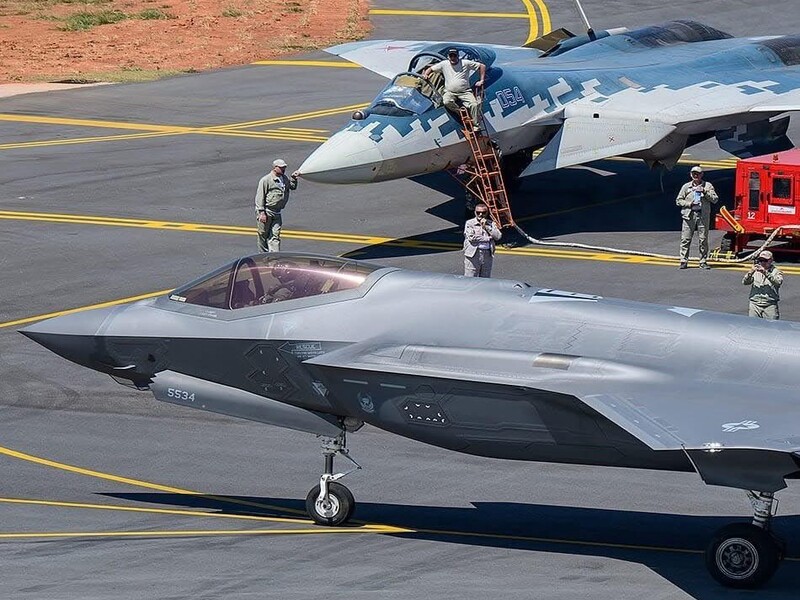
A curious sight greeted plane spotters and defence enthusiasts alike at the 2025 edition of the AeroIndia airshow: two rival fifth-generation stealth fighters, America’s F-35 Lightning II and Russia’s Su-57, hitherto never seen beside one another, were in attendance. Yet while India’s Yelahanka Air Force Station hosted thousands of attendees marveling at the rival examples of modern aerospace technology, the Indian Air Force’s (IAF) own inventory remained starkly devoid of similar equipment. In fact, despite border standoffs and armed clashes with its nuclear-armed neighbours, the IAF’s relative position against its Chinese and Pakistani contemporaries has consistently degraded over the past decade. A more permanent presence of F-35s in India, should New Delhi take up Washington’s erstwhile export offer, would benefit both parties by strengthening India’s military capabilities against Pakistan and China, while also pulling it away from Russia and towards the West by changing its source for key military equipment.
In contrast to many other countries, India optimistically awaited the second Trump administration. Despite Trump’s well-known protectionist proclivities, his strong first-term rapport, through lively bilateral summits in Houston and Ahmedabad, with Indian Prime Minister Narendra Modi led many Indian commentators to argue that the two governments would align on countering China and reducing American scrutiny on India’s domestic politics. The zenith of these glowing assessments came too soon for New Delhi; just weeks after a Modi-Trump White House meeting in which Trump first broached selling the F-35 to India, the two states publicly bickered about how the 2025 Indo-Pakistan Conflict was resolved, with the United States claiming to have played a key diplomatic role while India denied the presence of any external mediator. In August 2025, any chance for a revival of the spirit of Modi and Trump’s earlier friendship was put to rest when the United States levied substantial tariffs on India in response to the latter’s persistent purchases of Russian oil, a major sticking point between the West and India following Moscow’s 2022 invasion of Ukraine. In response to the tariffs, India subsequently declined interest in the F-35.
Despite being a victim of the diplomatic fracas between the world’s two largest democracies, the F-35 would nonetheless be a much-needed boost for India’s defence and foreign policy goals. Above all, the IAF needs new planes to escape a quantitative death spiral. Despite a legislatively-sanctioned strength of 42 fighter squadrons, the IAF’s squadron count has dipped below 30 as it phases out obsolescent Soviet-era MiGs without commensurate replacements. For instance, the Tejas, India’s domestic fighter project, was not inducted in significant numbers and is a comparatively small fourth-generation design unlikely to be relevant deep into the century. A decades-long procurement program that selected the French Dassault Rafale to bolster India’s fighter inventory has also not solved the issue; a sizable initial order of 126 jets was revised to just 36. Irrespective of source, the IAF desperately requires new fighters. Its longstanding Pakistani rival has closed the squadron gap and aims to purchase variants of China’s fifth-generation J-35 stealth fighters before the end of the decade. The view across the Himalayas is even more dire. China’s People’s Liberation Army Air Force (PLAAF) is on track to field more than 1000 fifth-generation J-20 fighters, a figure larger than the IAF’s entire combat fleet, along with similar numbers of capable fourth-generation-plus J-10s and J-11s by 2030.
Complementing India’s Rafales by purchasing several squadrons worth of F-35s would fill India’s critical numbers gap and, despite frequent talk of its cost, would do so at a comparable price point to other alternatives ($80-$135 million USD per F-35 over its lifetime, compared with $245 million per Rafale and a $50 million USD unit cost per Su-57). Moreover, the F-35 offers India a qualitative technological edge superseding the capabilities of other planes in the region: stealth. Designed from the ground-up by Lockheed Martin to be a multirole, very-low-observability (VLO) fighter through its unique angular form and radar-absorbing-material (RAM) coating, the F-35 has a radar cross section (RCS) value of just 0.005m2, creating an identifiable radar signature akin to that of a golf ball, ideal for avoiding detection or penetrating air-defence systems. This capability would be especially useful for New Delhi given the nature of its recent aerial confrontations. The 2019 and the 2025 Indo-Pakistani conflicts were primarily aerial affairs in which the IAF sought to strike targets within Pakistan. In both conflicts, Islamabad’s increasingly sophisticated network of aircraft and anti-aircraft systems inflicted losses upon the IAF’s nonstealthy fighters. The F-35 would fill this capability gap of conducting air-to-ground strikes in contested airspace, as demonstrated by its thus far exemplary performance in the Iran conflict. Further validating the F-35 as the optimal fighter choice for India is the fact that its only realistic ‘stealthy’ export competitor, Russia’s Su-57, remains mostly combat untested and has a RCS almost 10,000 times larger than that of Lockheed’s design.
The benefits to the United States and her NATO allies from such an export are equally significant, albeit less in a tactical military sense. First, sales of the F-35 would be a major step forward in the long-term project of enticing India away from her historically close relationship with Russia. As the world’s second largest arms importer, the Indian defence market is lucrative. While Western suppliers have already increased arms exports to India, including the abovementioned French Rafales, Israeli missiles and American helicopters, transport planes and maritime patrol aircraft, thereby reducing “Russia’s share of India’s arms imports from 70% in 2011….to 40% in 2021,” Russian products still represent a whopping “70% of the equipment of the” IAF. Exporting the F-35, which is projected to still be in service by 2070, would undercut India’s reliance on Russia in a critical military sector over the long term. Maximizing the F-35’s combat potential would also involve acquisitions of Western systems (e.g. missiles compatible with it), incentivizing India towards further defence deals with NATO members. An India less reliant on Russia would likely be more amenable to NATO’s priorities in handling it – a key current stumbling block in dealings with New Delhi. Moreover, by significantly bolstering India’s defence capabilities, deterrence against China would be indirectly improved. Despite India’s reluctance to officially commit to binding alliance structures – a function of its tradition of nonalignment – a stronger India forces China to devote more resources to its Himalayan flank, limiting its ability to concentrate on its revisionist ambitions in the Pacific and creating “strategic uncertainty” for Beijing.
Despite the benefits from a sale of F-35s to India, such a deal remains unlikely. For some Indian policymakers, acquiring the jets would jeopardize India’s own embryonic fifth-generation fighter program, be logistically complex, and foster a handicapping reliance on American technical controls and political approval for usage in combat. But the benefit of formally offering the F-35 to India goes beyond merely weighing the discussed pros-and-cons. The act of genuinely pitching NATO’s most advanced fighter aircraft to a friendly non-NATO state is exactly the show of generosity that could bring India further into the Western camp. There would be few events more decisive in the West’s favour against China and Russia than the alignment of a nation-state home to 1.4 billion people; the F-35’s greatest impact may come from its diplomatic, not military, potential.
By Vivek Sapru
Disclaimer: Any views or opinions expressed in articles are solely those of the authors and do not necessarily represent the views of the NATO Association of Canada.
Photo Credit: A F-35 taxies in front of a Su-57 during the AeroIndia airshow at Yelahanka Air Force Station (2025), by Ghosted Editor via Wikimedia Commons, CC 1.0. Public Domain