
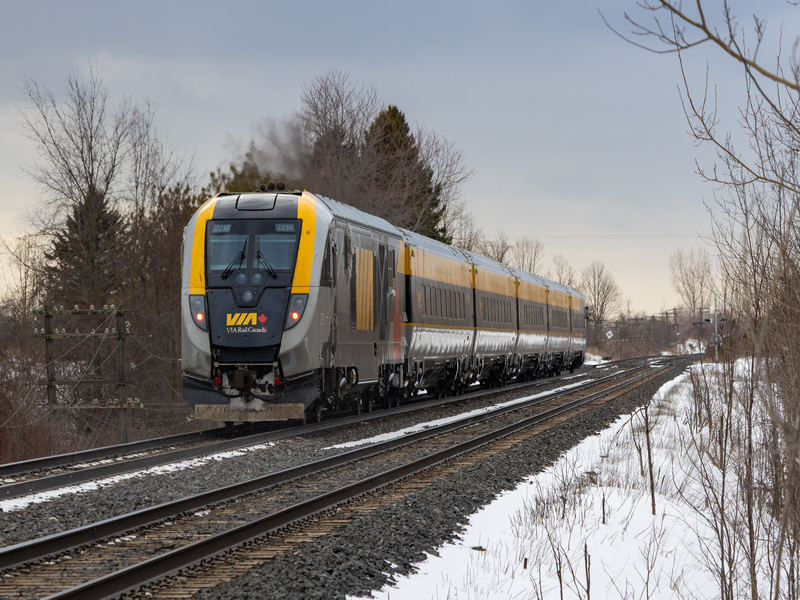
For most Canadians, passenger rail is not a topic of great everyday importance. Canadians made only 4.4 million journeys with Via Rail (the country’s national rail operator) in 2025, compared to almost 160 million passengers passing through Canadian airports in the same year.
Canada’s passenger rail network is underdeveloped and unreliable. Canada is the only G7 country without high-speed rail, and existing rail travel times between major cities are rarely competitive with driving, let alone air travel. This is caused by a combination of severe weather events, outdated rolling stock, and Via Rail’s reliance on track owned by freight companies, all of which result in frequent, hours-long delays for rail passengers. In 2025, only 35 percent of Via Rail’s passenger trains were on time.
Beyond a hardship for Canadian travellers, the state of Canadian passenger rail also jeopardizes Canada’s national resilience. NATO’s Baseline Requirements for National Resilience call for resilient transport systems which “[ensure] that NATO forces can move across Alliance territory rapidly and that civilian services can rely on …, even in a crisis.” Though Canadian cities from east to west are investing heavily in better local rail transport, inter-city passenger rail provided by Via is incredibly lacking. When inter-city trains are either cancelled or late two-thirds of the time, civilians cannot rely on rail as a viable inter-city transportation mode.
Rail as a National Priority
The Government of Canada has committed to building the country’s first high-speed rail line, dubbed Alto, in recognition of the declined state of Canadian inter-city rail. Beyond referring to only Alto as a nation-building project, the federal government should frame rail expansion as a critically necessary upgrade to Canada’s outdated passenger transport system while pursuing more rail projects across the country. Aside from an improvement to transit capacity, such an effort simultaneously contributes to Canada’s NATO national resilience commitments.
Though Canada boasts the fifth largest rail network in the world with 48,150 kilometres of track, Canada ranks near the bottom in terms of passenger-kilometres – the total distance travelled by all passengers in a year – with 536 million. By contrast, Germany (which has a rail network of 33,401 kilometres), had 58.8 billion passenger-kilometres in 2021. This discrepancy illustrates the priority given to freight rail traffic in Canada. Although freight traffic is necessary and highly efficient at moving large amounts of goods over a continental-sized country, both freight and passenger trains benefit when high-speed passenger tracks are built. Freight corridors are freed up, allowing for more frequent service, and passenger trains no longer need to compete with freight traffic on crowded, poorly maintained freight lines.
Skeptics of rail in Canada point to the country’s large size and dispersed population. Though it is true that Canada’s population density cannot match that of the European and Asian high-speed rail powerhouse countries, there are several clusters of population density across the country that present attractive cases for high-speed rail. Alto will serve Canada’s most densely populated region, the Quebec City-Windsor Corridor, with high-speed trains running from Toronto to Quebec City via Peterborough, Ottawa, and Montreal. Existing conventional Via Rail service on the Quebec-Windsor Corridor accounts for 95 percent of all passenger rail trips in Canada and 79 percent of Via Rail’s revenue. Though travel times on Alto will be marginally longer than flying, the lack of a lengthy check-in and security screening process, combined with the central location of train stations, means high-speed rail usually beats flying in overall journey time.
Alto’s main limitation is not its speed, but its scope. Other Canadian urban regions have cities separated by distances too short to justify flying yet too long to regularly drive comfortably, like the British Columbian Lower Mainland and Alberta’s two major cities of Edmonton and Calgary. Unlike the Corridor, these regions have no inter-city rail service, making them prime targets for additional passenger rail expansion.
Indeed, Alberta’s government is already independently pursuing a high-speed rail line between Edmonton and Calgary, having launched a Passenger Rail Master Plan in early 2026 after initial announcements in 2023. Though British Columbia has no plans to introduce passenger rail within the province, provincial politicians and rail advocates have in recent years pushed the provincial government to consider such a policy.
In Ontario, the provincial government is also pursuing passenger rail expansion by re-establishing the Northlander service, a passenger train connecting Toronto with rural communities in Northern Ontario, while undertaking major expansions to Greater Toronto’s commuter rail network. Despite the Ontario government scrapping a previous plan to build a provincial high-speed rail line connecting London and Toronto, Ontario municipalities have called for establishing cross-border passenger rail in southwestern Ontario and the Detroit area.
Provincial governments taking the initiative in rail expansion is a positive trend, but the federal government should accordingly identify passenger rail as a national priority. Alto will only serve one part of Canada, but its landmark status will create the expertise required to build more high-speed rail more efficiently across Canada in the coming years. The lessons already learned from Alto’s construction, like the potential for opposition from landowners affected by track construction and expropriation, would greatly benefit future high-speed rail projects in other regions of Canada. The federal government would be prudent to begin studies into additional future high-speed rail projects and provide Alto’s expertise to provincial projects like Alberta’s Passenger Rail Master Plan. Bringing high-speed rail to the rest of Canada and providing knowledge transfer would also create goodwill between the federal government and the Western provinces at a time of heightened western alienation.
Transportation in Times of Crisis
Modern high-speed passenger rail infrastructure strengthens Canada’s national transport links by creating an additional viable transport option. Canada’s current reliance on road and air links for passenger transport could quickly become a vulnerability in times of crisis. Ontario’s Highway 401, which crosses the province east to west from the American border in Windsor to the provincial border with Quebec, is the busiest highway in North America. Highway 401 provides critical connectivity for the Corridor, but is simultaneously a single point of failure.
Indeed, times of crisis frequently test the reliability of transport systems and render one or more of them unviable. Since the onset of the full-scale Russian invasion of Ukraine in 2022, commercial passenger aviation into Ukraine has been suspended due to ongoing aerial combat and the threat of drone warfare in Ukrainian airspace. All travellers in and out of Ukraine, be they refugees or foreign leaders on official visits, have had to enter by trains, which have become “a symbol of Ukrainian resistance” and Ukraine’s “second army.” Without its robust rail system, Ukraine would lose a logistical lifeline.
Air travel, which dominates the Canadian passenger transport market, can also prove fickle. Shocks in global oil prices caused by the intermittent closure of the Strait of Hormuz amid the ongoing Iran War have led to massive increases in commercial airfares across the world. Major Canadian airlines have been forced to cut services and cancel routes, including short-haul and domestic routes, which could be viably served by reliable passenger rail. Electrified passenger trains, which Alto will be served by, can continue to provide reliable service even amid disruptions to the global oil supply.
In the 21st century, high-speed rail promises to be more than just another failsafe for Canada’s transport networks. It promises greater people-to-people connectivity, it creates the impetus for greater government-to-government collaboration, and it enhances Canada’s national resilience. Rail literally ties a country together. Canada’s founders knew this when they built the Canadian Pacific Railway as part of a vision for a continental country. When Canada’s most populated regions become more interconnected within themselves and with each other, greater national resilience and national cohesiveness will surely follow.
Image credit: VIA 45 at Glovers Road, February 26 2026 (03) by Dilian Payne via Flickr. Licensed under CC BY-SA 4.0.
Disclaimer: Any views or opinions expressed in articles are solely those of the author and do not necessarily represent the views of the NATO Association of Canada.