On 9 June 2025, all NATO countries committed to achieving a 5% defence expenditure by 2035, with 3.5% allocated directly to military spending and 1.5% to defence-related industries, marking a jump from the previous 2% benchmark. Canada has not historically been a significant military spender within NATO — in 2024, for example, Canada allocated only 1.39% of its GDP to defence, lagging behind other middle powers like Estonia (2.7%), Poland (3.9%) and Greece (3.0%) — making the 5% pledge quite ambitious. Prime Minister Carney, however, has emphasized defence as a top priority and noted that progress was underway to meet the 1.5% component. Carney further pledged to hit 2% by the end of 2025, which would require an additional $9.3 billion. Increasing to the full 3.5% would effectively double the existing defence budget by adding $50 billion per year.
Canada’s decision comes amid a global shift toward isolationist foreign policy and growing tensions with previous allies, which have forced NATO’s middle powers to fight for individual interests through alignment with a major power bloc. While Canada has long served as the alliance’s “moral ally,” its lack of substantial military strength has limited its decision-making power. By demonstrating that it can commit to and sustain a higher defence budget, Canada stands to improve its standing and show — both to Canadians and international powers — that it is willing to back rhetoric with decisive action.
Structural Reforms: Building Defence Infrastructure
As per NATO guidelines, at least 20% of this increased budget will go toward new equipment purchases such as “new submarines, aircraft, ships, armed vehicles and artillery, as well as new radar, drones and sensors to monitor the seafloor and the Arctic” with the additional 1.5% going toward “ports, airports, infrastructure to support the development and exportation of critical minerals, telecommunications and emergency preparedness systems.”
Since June, Canada has made significant progress on its new defence commitment. In September, Canada rebranded the Coast Guard as an instrument for national defence and maritime security by transferring it from the Department of Fisheries and Oceans (DFO) to the DND. A month later, Carney announced the creation of the Defence Investment Agency (DIA) that effectively combines the roles of the Department of National Defence (DND) and Public Services and Procurement Canada in defence procurement. In addition to eliminating bureaucratic redundancy and inefficiency, the DIA aims to increase job opportunities by fostering domestic manufacturing and supply chains. And to address the problem of overreliance, the DND has pledged an additional $2 billion to diversify Canada’s defence partnerships beyond the United States into Europe, Asia, and other regions.
The Economic Trade-Off: Guns vs. Butter
But how feasible and sustainable is this target? With the government already running a deficit, the $110 billion annual defence budget must either come from raising taxes or cutting spending in other areas. Given that taxes create all sorts of negative economic incentives — combined with the reality that Canadians already struggle under heavy tax burdens — curbing government spending in other areas seems to be the only viable option, creating a macroeconomic trade-off best known as “guns vs. butter.” Defence spending takes away from social spending, such as welfare, healthcare, and education, and vice versa.

Figure 1. Kiel Institute.
The general trend after 1945 is the notion of a “peace dividend,” which has led Western countries to trade guns for butter; social welfare programs in exchange for defence spending — which made sense in a relatively stable post-war world. However, for the past three years, NATO’s European allies have begun rearming their militaries, essentially abandoning peace dividends as impractical in light of Russian aggression. Though Canada is not under the same immediate threat due to its geographic location, tensions in the Arctic and a possible trade war with the United States add pressure to follow suit and adopt similar policies. But Canada, simply put, is a “butter” nation. Since the end of the Cold War, Canada has enthusiastically adopted the peace dividend concept, resulting in a dramatic reduction in defence spending in favour of expanding social programs and implementing tax cuts. Over time, social safety nets have become woven into the Canadian identity and culture, almost to the point of federal overreach. In recent years, for example, the government has devoted considerable funds to programs and areas that are technically under provincial jurisdiction, such as national dental care, pharmacare, and daycare.
An increase to 5% now likely means that well-loved programs will have to go — at least temporarily. To put this into perspective, the new defence budget exceeds half the value of the Canada Social Transfer, which supports provincial education and social assistance programs. It surpasses federal spending on research and development and is equivalent to one percentage point of the GST. The best alternative option, of course, is having both guns and butter. Prime Minister Carney has affirmed the feasibility of such an outcome, asserting that investment in national defence will open up new industries, create new jobs and grow the economy. In the worst case, the defence budget will be unsustainable: costs could crowd out social programs, fuel public dissatisfaction, and leave the CAF still struggling with delivery inefficiencies.
Ultimately, it is not only about fiscal management, but also about Canada’s ability to transform its defence spending into long-term economic gains, as well as the infrastructure in place to support the influx of dollars. Failure to meet the dual challenge of sustaining economic stability while delivering tangible defence outcomes risks repercussions both domestically and internationally: reallocating resources toward defence at the expense of healthcare, education, and social welfare could fuel public discontent, weaken political consensus, and jeopardize the long-term viability of the policy. On the world stage, the inability to follow through on this defence commitment would diminish Canada’s credibility within NATO. Avoiding these pitfalls depends on institutional coordination. The Carney government’s best course lies in transforming defence spending from a zero-sum trade-off into a driver of national growth. This means aligning the DIA with domestic industries to ensure that new defence outlays generate jobs, strengthen supply chains, and expand dual-use sectors such as shipbuilding, telecommunications, and critical minerals. Transparent budget management and measurable procurement outcomes will be essential to maintain public support and investor confidence. If Canada can meet these dual challenges, it will demonstrate that guns and butter can coexist and successfully shift its role in NATO from moral ally to credible partner; if not, this 5% defence expenditure risks becoming another costly political experiment.
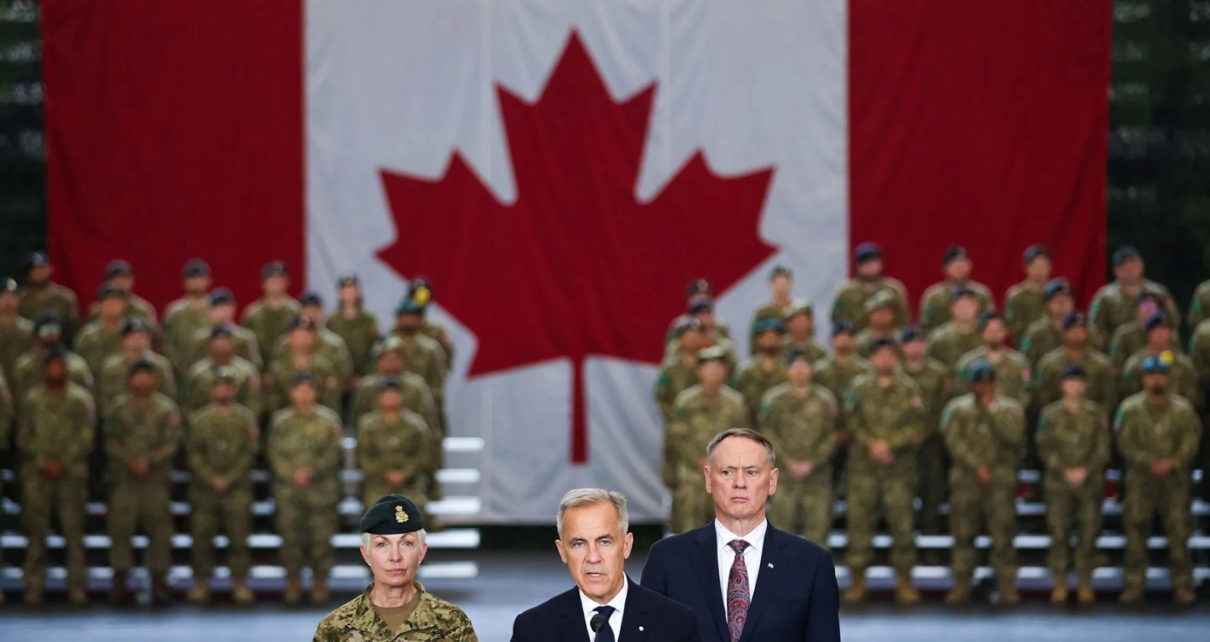
Photo: Shows PM Mark Carney with Chief of the Defence Staff Gen. Carignan and Minister of National Defence David McGuinty. Credit: COLE BURSTON/AFP via Getty Images
Disclaimer: Any views or opinions expressed in articles are solely those of the authors and do not necessarily represent the views of the NATO Association of Canada.