Deepening Ties
On June 23, 2025, Canada made history. For the first time, it entered the European Union’s defence ecosystem not as a supporting partner, but as a formal participant in a shared political framework: the EU–Canada Security and Defence Partnership (SDP). Building on the foundations of the Comprehensive Economic and Trade Agreement (CETA) and the Strategic Partnership Agreement (SPA), the SDP marks deeper Canada–EU cooperation and reflects Canada’s commitment to reduce U.S. reliance and increase NATO spending. Moreover, it institutionalizes Canada’s role in annual security and defence dialogues, establishes new thematic working groups, and expands Canada’s involvement in key Permanent Structured Cooperation (PESCO) projects. The agreement also paves the way for Canadian participation in EU defence procurement, particularly through the financial instrument of Security Action for Europe (SAFE) and its flagship initiative, ReArm Europe, a multi-billion-euro effort to scale up the continent’s defence industrial capacity.
But behind the celebratory headlines lies a more complicated reality: Canada is entering institutions built for EU member states, not third-country partners. If Ottawa wants to make the most of this new relationship and move from participant to influencer, it will need to do more than send representatives to Brussels and engage in high-level dialogues. It must adapt to the EU’s complex, slow-moving, and multi-layered governance structures.
Caught In The EU’s Process
The Security and Defence Partnership is sweeping in its ambition, but participation is not straightforward. Access to these tools is neither automatic nor equal. Each mechanism, from SAFE to PESCO to the European Defence Agency (EDA), operates within a distinct institutional and legal framework. Canada’s ability to participate in EU defence governance depends on navigating a multilayered system that includes working parties led by the Council of the European Union, as well as the European External Action Service (EEAS), the EU’s diplomatic service.
In this context, Canada’s formal commitments under the SDP, such as participating in EEAS, Commission-led expert meetings, or pursuing an Administrative Arrangement with the EDA, are just the starting point. Meaningful engagement requires project-specific invitations, observer or third-party status, and compliance with stringent conditions: non-disclosure agreements, legal liability clauses, and industrial eligibility thresholds that often prioritize EU-based firms. Even in working groups Canada is invited to join, participation is typically limited to listening and technical contributions; speaking, voting, or drafting roles remain reserved for EU member states.
This fragmented governance landscape poses a real challenge: Canada must coordinate responses among GAC, DND, and its EU Mission, as well as adapt to EU procedural rhythms that differ significantly from Canada’s more stable administrative structures. Without voting rights or consistent access, Canada risks being involved in name, but peripheral in practice.
The PESCO Puzzle
Canada’s PESCO participation is often cited as a hallmark of cooperation with Europe. Since 2021, Canada has joined two PESCO projects: Military Mobility and the Network of Logistic Hubs. These initiatives are strategically aligned with Canadian and NATO priorities, facilitating the rapid deployment across the continent. But beneath this operational synergy lies a complex governance architecture that limits the scope of third-party participation. PESCO is governed by strict Council-approved frameworks, and third countries may only join individual projects under “exceptional circumstances.” Canada’s earlier inclusion required formal authorization by the Council and was contingent on meeting project-specific terms, such as industrial eligibility thresholds that restrict non-EU firms from full participation.
While the SDP signals an ambition to pursue additional PESCO initiatives, future involvement remains conditional. Each project has its own governance board composed of EU Member States, and Canada’s role, even when invited, is non-voting and subject to limitations. Furthermore, Canada lacks representation in the broader PESCO Coordinated Annual Review on Defence (CARD) and other capability planning mechanisms, placing it downstream in strategic decision-making. The possibility of establishing an Administrative Arrangement with the EDA could address some of these gaps, particularly by granting Canadian officials access to expert working groups on capability development and R&D coordination. Still, without treaty-level agreements or institutionalized representation, Canada’s engagement in PESCO will continue to depend on ad hoc invitations and negotiated exceptions, reflecting both the promise and procedural constraints of third-party integration into EU defence governance.
Barriers To Buy In
Beyond governance challenges, Canada’s participation in EU defence industrial programs like ReArm Europe and SAFE creates new opportunities in transatlantic procurement, though not without hurdles. These initiatives aim to boost European production, with SAFE as the financial base. Under the SDP, Canada is pursuing a bilateral agreement to join SAFE, but strict eligibility rules present barriers: at least 65% of a product’s value must originate in the EU or select partners, limiting opportunities for Canadian firms unless they collaborate with EU-based manufacturers.
In addition, while EU-based subsidiaries of non-EU firms, such as Canadian branches of U.S. companies, may be eligible to lead EU-funded projects, they must first undergo EU screening and prove that their involvement does not compromise EU security interests. This scrutiny may limit Canadian firms to subcontracting roles unless exemptions are secured. Even then, Canada would remain outside the strategic governance of these programs. Thus, Canadian officials must balance ambition with regulatory realism to avoid asymmetrical access under the banner of cooperation.
Conclusion
The EU–Canada Security and Defence Partnership represents a bold new chapter in transatlantic cooperation, but its success will hinge less on mere participation and more on strategy and integration. For Canada to move beyond a passive role and help shape European defence governance, it must invest in institutional literacy, dedicate resources to its EU Mission, and negotiate mechanisms for sustained representation inside critical working groups and project boards. Canadian industry must build deep partnerships with EU-based firms and adapt to stringent eligibility criteria if it hopes to benefit from programs like SAFE and ReArm Europe.
This will be a difficult, incremental process that demands long-term political will and consistency. But, if managed well, Canada’s engagement could help lay the groundwork for a truly transatlantic defence architecture. To reach that point, Canada must show it is not just a reliable ally, but a capable and constructive actor within Europe’s evolving defence ecosystem.
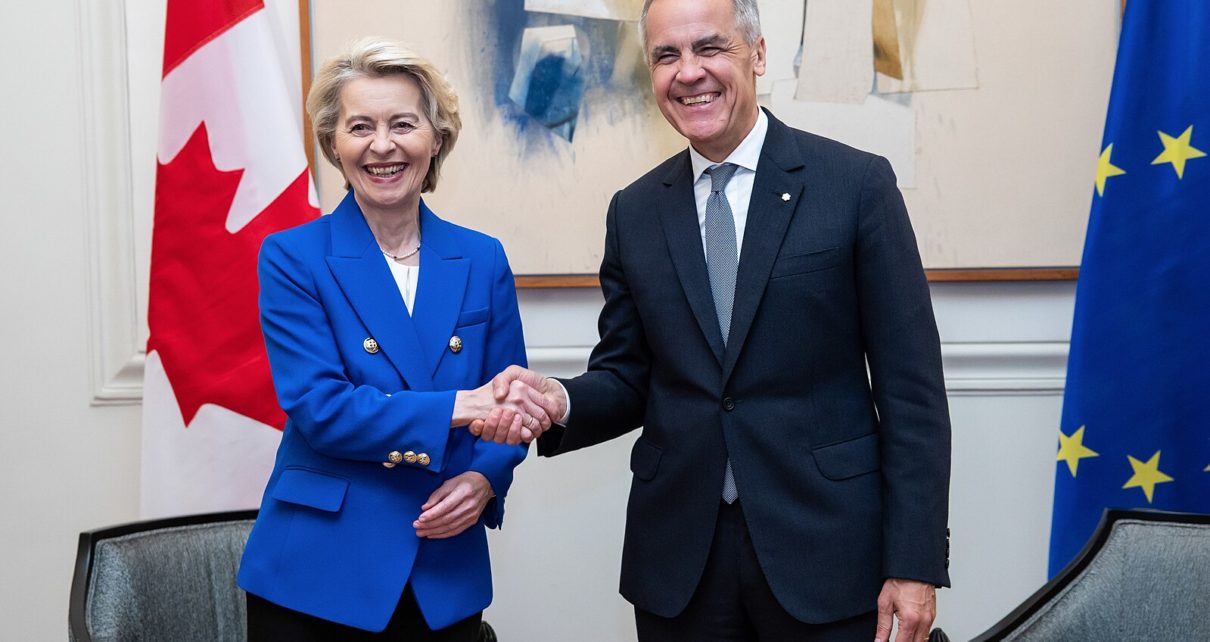
Photo: Mark Carney (right) and Ursula von der Leyen (left) during meetings in Vatican City, May 2025. © European Union, 2025, CC BY 4.0, via Wikimedia Commons.
Disclaimer: Any views or opinions expressed in articles are solely those of the authors and do not necessarily represent the views of the NATO Association of Canada.