In June of 2025, Hong Kong Youth Activist Joshua Wong was brought in front of West Kowloon court to face more charges under China’s 2019 ‘National Security Law,’ which caused the 2020 protests so brutally repressed by the Chinese Communist Party. Accused of conspiring with fellow activist, and exile, Nathan Law to promote sanctions against China, Wong, like many Hong Kong democrats, faces extended prison sentences and torturous conditions. Likewise, Jimmy Lai’s recent conviction under the same draconian law signals the risk placed upon media and free debate when the Chinese government is able to exert pressure on their organisations. As one of Hong Kong’s most recognizable businessmen and media figures, having founded Apple Daily, he played a significant role in Hong Kong’s democracy movement. The message that even activists in exile convey is the fear they have, even whilst living in the West, from spying, threats and violence by Chinese government officials. This personal concern is matched by their calls for greater circumspection in Western policies towards China, for which Hong Kong represents an example of CCP repression against a free society.
In the UK, two cases illuminate the significance of Hong Kong’s plight and lessons for NATO countries. The first is the 2022 on-video battery of Hong Kong protesters at the Chinese consulate in Manchester, where plain-clothed Chinese policemen dragged a protester onto consulate grounds and assaulted them. The second is more incredible, where a restaurant in Glasgow has been shut down under an ongoing police investigation that it (among other cases nationally) was being used by Chinese state officials and businessmen to spy on Chinese and Hong Kong dissidents, an espionage tactic. The Chinese government’s response to this last case is a denial of espionage and the claim that these restaurants are ‘service centres’ for Chinese nationals abroad. The Hong Kong case, and its resemblance to other cases in the West, highlights concerns that Western countries, especially NATO and NATO-aligned countries like Australia, ought to have for these tactics and their threats to their way of life.
Other parallels that Hong Kong has with NATO members apply to the current state of affairs vis-à-vis China. For example, Hong Kong is a tiny nation bordered by a gargantuan neighbour with a history of interference. This is the case for almost all of the former Eastern Bloc states with Russia, although, unlike Hong Kong, they have the actual security guarantees of an alliance which protects them from aggression. But they can still be subject to similar pressures from their much larger neighbours, and this includes China, which is at Eastern Europe’s gates. Beijing interferes in Hong Kong’s domestic politics and local economy, creating business opportunities for mainland Chinese. Similarly, NATO members like Greece have participated in the Chinese Belt and Road Initiative (BRI) infrastructure projects, which have led those members to defer to Chinese interests in the region, such as vetoing the EuropeanUnion’s annual report into Chinese Human Rights abuses in 2017.
If the treatment of Hong Kong dissidents means anything to those observing from the West and within NATO, it should mean that the warnings it gives about ever-encroaching Chinese government influence should be heeded. That is to say, the image China crafts of itself as a benevolent and peaceful alternative to the United States and a bastion of solidarity with those countries economically less fortunate should be questioned – and countered more directly. The evidence of what has happened to Hong Kong since 2020 can serve to underscore this. Hong Kong has dropped significantly in the CATO Institute’s Human Freedom Index, which scores states on the collective data of economic, civil, political, social and technological freedoms. It has also lost its reputation as a global financial hub which attracted businesses that were not under the thumb of the mainland Chinese government. This is reflected in the economic hits it has taken since the full Chinese takeover, marked by a 3.5% contraction in GDP in 2022 and a plummet in tourism, since beforehand it could present itself as a free society.
Similar to the fear Chinese exiles have is the fear dissidents have from countries with similar authoritarian governments, like Russia.NATO members like Germany and the UK are familiar with the danger posed to those perceived as enemies these states, including the 2019 assassination in Berlin of Second Chechan war veteran, Zelimkhan Khangoshvili by recently swapped FSB agent, Vadim Krasikov. Other examples include the poisonings of Alexander Litvinenko and Sergei Skripal in the UK. These examples signify the reach that malign countries like Russia and China pose to dissidents, even in exile, where they are supposedly “safe.” The safety of these dissidents ought to be a high priority for NATO’s policymakers, especially given their value to intelligence. Until now, thetactics Russia and China have employed are different in regard to dissidents in the West. Whilst both utilize pressure on dissidents’ families still based in the escaped-from country, China has not been so brazen as to conduct high-profile assassinations in NATO countries – yet.
A final lesson from China’s absorption of Hong Kong is that treaties have been shown to be ineffective in deterring aggression from a powerful country determined to achieve an ideological goal. When the 1984 Sino-British joint declaration was signed, which provided a roadmap in 1997 to transfer Hong Kong back to China, promises were made for a 50-year period to allow Hong Kong to function as a sovereign entity with greater economic and civil freedoms than mainland China. However, this promise was kept for less than half that time, as Lord Patten, the last British Governor General of Hong Kong, reflected upon the conviction of Jimmy Lai. Defence policy ought to reflect this skepticism towards China.
For Canada, which has a similar experience with Chinese government interference as Australia has had, more stringent investment is required in the vetting process for those who work with political candidates and the elections apparatus due to recent concerns over corruption of local candidates by Chinese agents. Beijing’s subterfuge has been done through conventional means like bribery, but also through hybrid warfare tactics like disinformation, as former Conservative leader Erin O’Toole highlighted, to sow mistrust in the Canadian political system. This is a tactic that all NATO countries have to grapple with, especially in Europe, with Russian disinformation tactics. However, some NATO countries (the UK, US and Canada) are home to large Hong Kong and Chinese diasporas. These can serve to counter Chinese narratives. Dissidents like Nathan Law, a Hong Kong youth activist and former legislator, argue that Hong Kong was the litmus test for what happens when democracies cannot defend themselves. This should influence assessments of what areas of security are most important to counter Chinese government interference.
When reflecting on how extreme the 2020 crackdown was, NATO countries’ first goal ought to be resistance to any attack on their political systems by a country with a vested interest in those countries’ undoing. They must architect intelligence and defence policies that take into consideration China’s ability to attack on both military and non-military fronts, kinetically, but also in the domestic and information spaces. The loss of a free, more democratic and free-market Hong Kong is a warning for all NATO countries that neglecting security and alliances that can protect them from subjugation could lead to the same brutality inflicted upon Hong Kong.
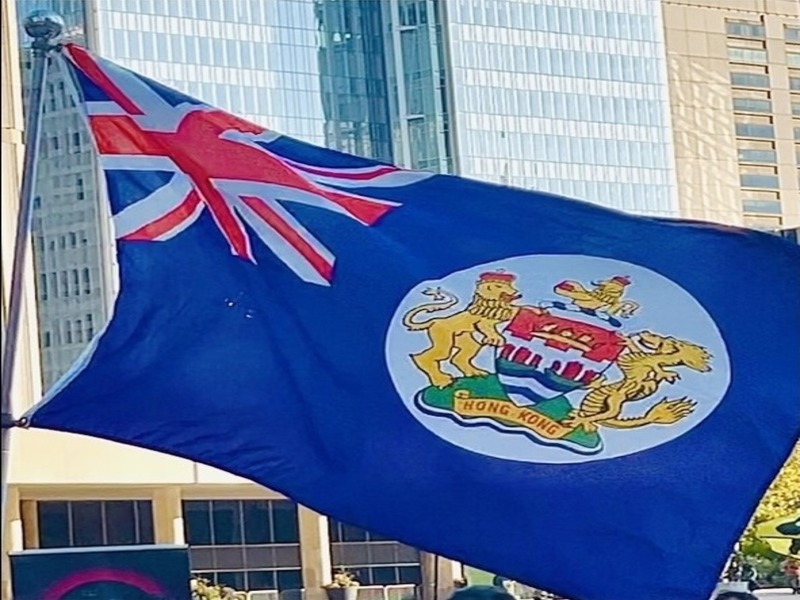
Photo: A protester waving a pre-1997 Hong Kong flag in Nathan Phillips Square, Toronto (2025). © Dai Johnson. All rights reserved.
Disclaimer: Any views or opinions expressed in articles are solely those of the authors and do not necessarily represent the views of the NATO Association of Canada.