Nuclear weapons are many things. Their fearsome power provokes millenarian musings of humanity’s penchant for self-destruction. They are a great force multiplier in international relations, raising the relevance of marginal states and confirming the dominance of powerful ones. They form a key part of NATO’s strategic rationale by serving as a deterrent against aggression.
Though only three NATO members – the United States, the United Kingdom, and France – are nuclear armed, the US partakes in a “nuclear sharing” arrangement with several European NATO members including Germany, Italy, and the Netherlands.
In this arrangement, the US provides the weapons and maintains the final say over their use, but other states provide the facilities and aircraft for delivery. This contributes to a perception of a ‘nuclear umbrella’ which covers all NATO states, reinforcing beliefs within NATO about how secure the Alliance is, and the beliefs of NATO’s enemies regarding how far allies would go in defence of each other.
Culturally speaking, however, nuclear weapons regularly provoke anxiety, despair, and anti-military sentiment. Cultural anxieties around nuclear weapons first emerged as part of the advent of the atomic age in the 1950s. Works of literary fiction including the bleak and futurist, A Canticle for Leibowitz or the alarmist alternate history, On the Beach imagined post-apocalyptic worlds and lamented humanity’s eventual fate of self-destruction, which the advent of nuclear weapons was supposed to herald. The intensification of the Cold War and high-profile nuclear incidents, such as the Cuban Missile Crisis, only served to highlight these cultural fears.
These cultural fears, reflected in fiction, gave rise to tangible political organizations. Anti-nuclear movements in NATO countries intersect with pacifist and environmentalist groups, with anti-nuclear protests routinely emerging in response to nuclear power developments or wars involving nuclear powers.
The election of Ronald Reagan to the American presidency in the early 1980s proved an especially dynamic time for the anti-nuclear movement, eager to criticize him as a catalyst for a potentially disastrous nuclear arms race. A million-strong demonstration in New York City in 1982 brought together religious leaders, progressive movements, and anti-colonial movements in opposition to nuclear weapons during the UN’s Second Special Session on Disarmament. In October 1983, the Campaign for Nuclear Disarmament (CND) organized massive demonstrations across Europe just days before the then-unknown nuclear close call of Able Archer 83, a NATO combined arms exercise initially interpreted by some Soviet officials to be the start of a genuine nuclear first strike.
These anxieties also emerge in connection with questions of nuclear sharing. Strategically speaking, nuclear sharing occupies a necessarily murky space short of nuclear proliferation, but this inherent uncertainty directly provokes cultural anxieties. In Canada, one may recall the Bomarc Missile Crisis of the 1960s, when Prime Minister John Diefenbaker vacillated between agreeing to host American nuclear missiles or declining to take part amid mounting public anti-nuclear demonstrations and the emerging Cuban Missile Crisis. Diefenbaker’s failure of leadership on the nuclear issue contributed to his defeat in the 1963 election spurring George Grant’s infamous, Lament for a Nation which among other points, described American missile deployments as a sign of the supposed demise of Canada as a distinct nation.
When Spain held a referendum in 1986 on continued membership in NATO, one of the attached conditions was that Spain would never host allied nuclear weapons in response to the ongoing nuclear tensions of the 1980s.
In Germany, whose non-nuclear status formed a key factor in the stability of the Cold War international system in Europe, the mere use of nuclear power remains highly contested, to say nothing of nuclear weapons. Former Chancellor Angela Merkel, responsible for committing to a complete German nuclear power phase-out in 2011, maintains in her memoir that “Germany remains the only industrialized country worldwide to have drawn conclusions from the Fukushima nuclear disaster,” a sentiment pervasive in a society with a broad and profound opposition to nuclear technology.
Despite all this, nuclear weapons and power have informed more than just existential anxiety and apocalyptic visions. In France, nuclear prowess served to offset cultural concerns about the country’s diminished postwar international power. Rayonnement, French for radiation, also translates to radiance, and France’s postwar identity as articulated and shaped by Charles de Gaulle placed great emphasis on a radiant, grandiose global vision. To de Gaulle, the ignominy of occupation during the Second World War and France’s humiliation during the 1956 Suez Crisis elucidated the necessity of nuclear weapons for preserving France’s independence within the Atlantic alliance, where American nuclear commitments to Europe could never be absolutely assured. His view of the French nuclear program as a long-term guarantee for French independence on the world stage appears increasingly salient today, with the French nuclear program continuing to enjoy broad popular support from all political parties.
Nuclear anxieties have re-emerged since Russia’s full-scale invasion of Ukraine in 2022, amid mounting global uncertainty about the shape of the changing international order. The potential threat of a nuclear escalation in Ukraine, whether it be through a tactical or strategic strike or even a nuclear accident, remains salient.
In November 2024, Russia officially amended its nuclear doctrine, which now outlines that an attack on Russia by a non-nuclear power with the backing of a nuclear power will be treated as a “joint assault.” Aside from this overt sabre-rattling, the possibility of Russia detonating a “dirty bomb,” reinforced by its feckless handling of the Zaporizhzhia Nuclear Power Plant, continues to heighten nuclear concerns.
In October 2025, Russia tested two nuclear-powered, nuclear-capable weapons. In response, the US announced that it too will resume nuclear testing. These contemporary nuclear anxieties have also taken the form of high-level discourse re-evaluating the present global nuclear configuration.
With the recent rapprochement between the US and Russia, along with public statements from the US administration, the credibility of the US’s extended nuclear deterrence for European allies has come under closer scrutiny. After the 2025 German federal election, the incoming Chancellor, Friedrich Merz, publicly mused on the possibility of a Franco-British nuclear umbrella for Europe to compensate for any potential American wavering on European defence. This prompted input from the Polish Prime Minister, Donald Tusk, who has expressed serious interest in any European nuclear sharing scheme.
For NATO, nuclear weapons are as salient now as they ever have been. The fundamental contradiction of nuclear weapons, which threaten universally catastrophic total war and thereby keep the peace between great powers, will surely continue to inspire cultural works and generate intense social discussion on their morality.
And yet, the nuclear calculus continues to hold. Since 1945, no state has dared to break the nuclear taboo or challenge the logic of mutually assured destruction. A testament, perhaps, to the degree of cautious reverence for nuclear weapons in the public imagination. Any nuclear reconfiguration in the 2020s will, as in decades past, undoubtedly face intense public examination and social critique, heightened by the context of global uncertainty.
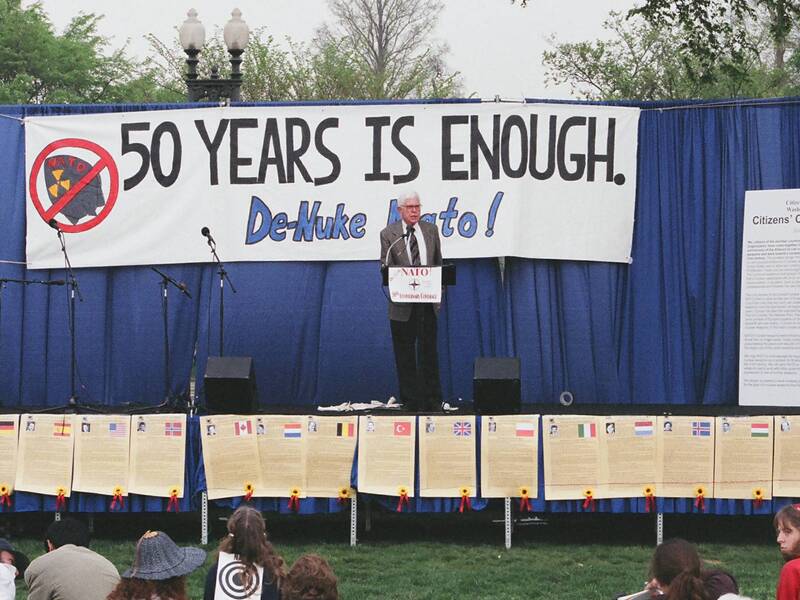
Image credit: 06.07a.DeNukeNATO.WDC.23apr99 (1999) by Elvert Barnes via Flickr. Licensed under CC BY-SA 2.0.
Disclaimer: Any views or opinions expressed in articles are solely those of the authors and do not necessarily represent the views of the NATO Association of Canada.