In early March 2026, Chinese military activity around Taiwan appeared to slow unexpectedly. For nearly two weeks, Beijing’s warplanes stayed out of Taiwan’s airspace, a rare pause that surprised defence analysts in Taipei. However, the lull ended abruptly on March 15, when Taiwan reported 26 Chinese military aircraft operating in the Taiwan Strait.
This temporary absence followed by a sudden resumption has prompted speculation that China is deliberately calibrating its pressure campaign. Some analysts suggest the pause was intended to reduce tensions ahead of a potential diplomatic engagement between U.S. President Donald Trump and Chinese leadership, while others point to internal adjustments within the People’s Liberation Army (PLA). Regardless of the explanation, Taiwanese officials emphasized that the threat never disappeared. Chinese naval vessels remained active in surrounding waters throughout the lull, reinforcing that the shift was tactical rather than strategic. As Beijing adapts its tactics to ramp pressure up and down on Taiwan, NATO allies must remain vigilant and avoid being lulled into a sense of complacency.
At the same time, Taiwan has moved to strengthen its deterrence capabilities. On March 13, its legislature approved $9 billion in U.S. arms purchases, including HIMARS rocket systems, Javelin and TOW anti-tank missiles, and upgraded artillery. Additional packages, potentially exceeding $14 billion and including advanced air-defence systems such as PAC-3 interceptors, are expected to follow. These developments reflect a broader U.S. strategy of ensuring Taiwan maintains sufficient defensive capacity to deter escalation.
The episode matters because it illustrates how Beijing is increasingly using military pressure around Taiwan in a calibrated rather than constant fashion. The pause did not reflect de-escalation in any durable sense. In other words, the lull itself may have been strategic messaging. Its end is a reminder that Beijing retains the initiative and can raise or lower visible pressure when it chooses.
This is precisely why NATO should not treat Taiwan as a distant regional issue. A Taiwan contingency would not remain confined to East Asia. It would stretch U.S. military resources across two major theatres, place additional pressure on already strained Western defence industrial capacity, and test whether the Euro-Atlantic and Indo-Pacific security environments are truly being treated as interconnected rather than rhetorically linked. NATO has increasingly acknowledged this reality. During her March 2026 visit to Tokyo, Deputy Secretary General Radmila Shekerinska stated that Russia’s war against Ukraine demonstrates how Indo-Pacific and Euro-Atlantic security are “closely interconnected,” and she explicitly pointed to China’s support for Russia’s defence industrial base.
That link is not theoretical. China’s role in supporting Russia’s war effort has already undermined the idea that Europe and Asia can be managed as separate strategic compartments. If Beijing can materially sustain Russia while simultaneously coercing Taiwan, then NATO cannot assume that a crisis in one theatre will leave the other untouched. A Taiwan conflict could pull U.S. naval, air, missile-defence, and logistics assets away from Europe at precisely the moment adversaries may seek to test allied cohesion elsewhere. The strain is not only about limited resources. It also creates opportunities for rival powers to exploit gaps between regions.
This is where NATO’s partnership network becomes more important. The alliance has been deepening practical ties with Japan, not as a symbolic gesture but as part of a broader effort to reduce strategic fragmentation. NATO and Japan held their first dedicated dialogue on defence industrial cooperation and capabilities in October 2025, focusing on issues such as supply-chain security, standardization, uncrewed systems, and capability development. NATO has also used recent high-level engagements to stress that cooperation with capable Indo-Pacific partners is now essential to resilience in a more volatile security environment.
For NATO policymakers, the main lesson is straightforward: deterrence in Europe can no longer be planned in isolation from escalation dynamics in the Taiwan Strait. That does not mean NATO needs to seek a formal role in Taiwan’s defence, nor does it mean importing Pacific commitments wholesale into the alliance’s mandate. But it does mean that NATO should prepare for the indirect consequences of a Taiwan crisis with much greater seriousness than before.
First, NATO should strengthen contingency planning for simultaneous theatre stress. European deterrence assumes a certain level of U.S. availability. If a Taiwan crisis were to absorb key American assets, the alliance would need to know in advance which capabilities European allies could surge, which stockpiles would become critical, and where industrial shortfalls would appear fastest. The lesson from Ukraine is brutal but clear: production timelines matter as much as battlefield plans. At the same time, rising tensions involving Iran demonstrate how U.S. resources can be diverted to additional theatres, underscoring that NATO can no longer assume consistent American capacity across all regions simultaneously.
Second, NATO should accelerate defence-industrial coordination with Indo-Pacific partners, especially Japan. The emerging Japan-NATO defence industrial dialogue is a useful start, but it should evolve beyond consultation into practical cooperation on supply chains, munitions resilience, and dual-use technologies. If NATO and its partners are serious about interconnected security, then industrial preparedness must become transregional too.
Third, the alliance should improve cross-theatre intelligence integration. Warning indicators from the Taiwan Strait, the Korean Peninsula, the South China Sea, the Middle East and the European theatre should not sit in separate analytical silos. The ongoing war involving Iran further illustrates this dynamic, as the diversion of U.S. military assets to the Middle East has raised concerns among Indo-Pacific partners that crises in one region can weaken deterrence in another, reinforcing the increasingly interconnected nature of modern theatres of conflict. NATO does not need to become an Indo-Pacific alliance to recognize that modern coercion is multi-domain, simultaneous, and often coordinated politically even when it is not formally coordinated militarily.
Finally, NATO should continue investing in political messaging that reduces ambiguity about allied cohesion. One of the clearest dangers in today’s environment is the perception that allied responsibility can be neatly divided by geography. Analysis from the Atlantic Council on South Korea’s long-standing caution toward Taiwan has warned that overly compartmentalized “division of labour” frameworks can create exploitable seams in deterrence, particularly when adversaries increasingly act across connected theatres. That warning applies more broadly to the transatlantic alliance as well.
The return of large-scale Chinese military flights around Taiwan after an unusual lull is not just another routine headline in the Indo-Pacific. It is a reminder that Beijing’s coercion is adaptive, political, and timed for strategic effect. For NATO, the significance lies not in whether the alliance would fight over Taiwan directly, but in whether it is prepared for the systemic consequences if the Strait becomes a major flashpoint. The security of the Indo-Pacific and the Euro-Atlantic are no longer adjacent problems. They are increasingly part of the same strategic picture. NATO’s task is to start planning like it.
Disclaimer: Any views or opinions expressed in articles are solely those of the authors and do not necessarily represent the views of the NATO Association of Canada.
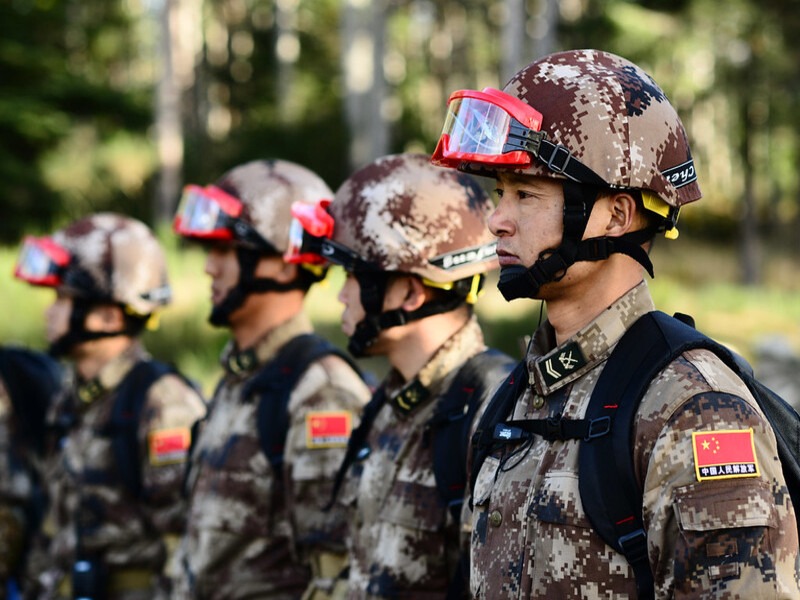
Soldiers from the People’s Liberation Army (PLA) listen to a briefing during the U.S.–China Disaster Management Exchange at Camp Rilea Armed Forces Training Center in Warrenton, Oregon, November 17, 2017. Photo by Sgt. 1st Class April Davis, Oregon Military Department Public Affairs, this image is in the Public domain, accessed via the Oregon National Guard (Image ID: 171117-Z-OT568-017). Image dimensions adjusted.