Why Territorial Movement Is Not Enough
Territorial gains alone do not tell us enough about military conflict dynamics. As in the ongoing Russo-Ukrainian war, you can gain territory, but if you pay for it with people, military vehicles, and other destructive resources, the gain may amount to a loss.
Though territorial movement is not irrelevant, it should not be examined alone. It should be studied together with (1) the people and military vehicles expended, (2) the information available from independent sources, and (3) the extent to which the territory can be used in a meaningful way. Bringing such data together makes comparison easier and reveals the unobservable dynamics behind territorial change. Much of this information today is open-source intelligence (OSINT).
However, from a researcher’s point of view, one of the most difficult parts of OSINT-based research is accessing hundreds of dynamically updated web pages to gather data. Even if researchers have access to those sites, downloading the data, filtering it, and preparing it for analysis is extremely time-consuming.
Integrating OSINT therefore creates an opportunity to reveal more of the dynamics behind the fog of war.
Launching the Agentic-AI-Driven 3D OSINT Research Prototype
Given this problem, Zsolt Lazar created the 3D OSINT research prototype introduced here. The prototype is intended to gather and filter data automatically, support analytical pipelines, and bring information from various sources into one map for comparison.
This 3D OSINT map (https://osint.zsoltlazar.se/) is a research prototype for exploring territorial change, verified equipment losses, optical satellite imagery, satellite-derived thermal activity and terrain in a single interactive analytical environment. The platform renders large geospatial datasets, interactive analytical layers and 3D terrain directly in a browser.
The 3D OSINT platform collates data from the following sources: EOxCloudless, NASA FIRMS, NASA DEM, WarSpotting and DeepStateMap. While the platform may be accessed through a desktop or laptop, the prototype is currently not optimized for mobile devices. A modern desktop browser, hardware-accelerated graphics, broadband, at least 8 GB of RAM, a minimum screen resolution of 1280 x 720, and 1920 x 1080 are highly recommended. The benefit of consolidating these materials into a single platform lies not only in convenient retrieval, but also in the insights their synthesis may uncover.
Integrated Data & Disciplined Agentic-AI Architecture
While integrated OSINT cannot reveal conflict dynamics completely, combining datasets may provide a clearer analytical lens.
As an illustration, NASA FIRMS data used together with NASA Black Marble nighttime-radiance data can provide much more than either dataset can provide alone. NASA FIRMS and its thermal-anomaly data do not, by themselves, establish the war’s impact on populated areas. But if we combine the datasets so that we know where the frontline was and the populated area’snighttime radiance, then we can make observations about the war’s impact on specific populated areas. Combining datasets may also help us understand gaps. If we do not know what to look for, we cannot really explain the phenomenon.
Briefly, the agentic-AI architecture functions as follows. Once a user provides a set of natural-language questions, the agent maps those questions to server-side commands. The AI agent does not perform the calculations; the server executes the commands.
This is one way to constrain the risk of AI hallucination. The OSINT architecture is designed this way to ensure that the research process is as reproducible as possible. For example, we may want to compare last year’s losses with those seen today. The server executes the comparison and returns the answer.
Clearly, there are limitations to this approach. However, our design is intended to limit the AI’s role in adding unsupported interpretation to a numerical result, particularly when decisions may affect human life during a conflict or another dynamic shock condition. This disciplined architecture allows different users to investigate the same integrated information while asking different questions.
From Territory to Meaningful Control
The aforementioned disciplined architecture supports different users and questions. Media users may need accessible analysis, while researchers may ask more complex spatial and longitudinal questions. Specifically, we use the 3D OSINT map as empirical infrastructure for investigating the underlying phenomenon and decision problem.
Researchers may want to know what exactly is being exchanged here: territory, or control over territory? If control means being able to resettle people or rebuild after occupation, that form of control may not be present in contested or heavily damaged areas. You may hold territory without being able to use it meaningfully. The frontline is better understood not as a single line, but as a zone with territorial depth, where residence and agricultural work may not be possible. Even after territory is conquered or liberated, it may not be usable at that moment. Meaningful control implies utilization of territory after seizing it.
The contrast between physical holding (territorial possession) and substantive governance (meaningful control) raises a core question: what impedes capabilities and interventions from yielding meaningful control? We tentatively investigate transaction friction under dynamic shock conditions as a plausible explanation.
Transaction Friction under Dynamic Shock Conditions
Our central organizing question is: how might dynamic shock conditions and transaction friction help explain why resources and actions do not necessarily result in meaningful control over territory?
By dynamic shock conditions, we mean scenarios in which an initial disturbance sparks ongoing reactions, retaliations, and changes in the conditions facing subsequent decisions. By transaction friction, we mean the evolving operational, informational, technological, organizational, institutional, or environmental circumstances that hinder meaningful control or increase the resources required to achieve it.
Here we offer a provisional explanation. Wars and conflicts provide a dynamic shock context in which an initiating shock, such as an attack or invasion, is generally exogenous but generates a series of endogenous responses and counter-shocks, including defence and counterattacks. A candidate proposition is that this exogenous-endogenous shock hierarchy triggerstransaction friction.
In this dynamic shock setting, actions, reactions, and adaptations continuously alter operations, information, resources, technology, and the organizational, institutional, or environmental conditions under which meaningful control is pursued. Transaction friction or resistance to exchanges materializes once fluid circumstances thwart effective governance or increase the budgeted resources needed to achieve meaningful control. Because these unfolding parameters and states are somewhat influenced by prior interventions and reactions, the process becomes recursive: the consequence of one phase alters the circumstances and alternatives inherited by the next.
Conflict as a Recursive Multi-Shock Process
In an ongoing war, baseline constraints constantly change. These constraints concern munitions, depletion of troops and resources, territorial movements, political assistance from domestic and foreign stakeholders, and technological adaptation. These factors do not accumulate autonomously or stack up side by side. They interlock and collide, reshape the decision space and choice architecture, and reset the status quo governing the next iteration.
Because the cascading, multi-shock process is recursive, no individual parameter, indicator, or trend line is sufficient to infer the fallout of competing interventions and countermoves. A baseline crisis from an initial shock can spark reactions that manifest as new shocks: counterattacks reshape the theater, a protracted stalemate upends strategy, and a retreat redefines command and control. An outcome in one stage becomes an input into the next, fueling a sequential loop, a path-dependent process.
Such a recursive framework has immediate consequences for NATO’s data-gathering and intelligence, decision-making, and procurement.
Why This Matters for NATO
If a NATO policymaker remembers one implication from this article, it should be to use open-source intelligence data to complement military intelligence as a double-checking tool.
Open-source intelligence can help researchers and analysts examine what foes might glean from public information. However, unrestricted access does not equal awareness, interpretation, integration, or operational deployment.
That specific fluid landscape also has consequences for sourcing and procurement.
Another ramification of deploying this Agentic-AI-driven 3D OSINT research prototype is that flexible capacity matters more than a static deliverable. In both business-to-government (B2G) and business-to-business (B2B) environments, decision-makers must strive to secure the competency, not just the solution.
For example, a straightforward response may be to purchase uncrewed craft or drones. However, a nuanced response is to secure competencies essential to build, alter, and tailor such solutions as technology advances amidst an unfolding emergency. Such assets may include 3D printers, fabrication tools, and other applications.
The aim is to safeguard and retain the capability and competence to adapt, develop, and build while information, knowledge, and systems evolve in the course of an emergency. That insight and learning have the potential to endure beyond the current upheaval.
The significance of such cyclical, iterative, and recursive configurations and versatile abilities may extend beyond combat and warfare to alternative dynamic shock conditions.
Beyond Warfare: Dynamic Shock Conditions and a Broader Management Science Agenda
Dynamic shocks are not confined to the war zone, although military action and warfare offer a notably illuminating context in which to examine such phenomena.
These jolts and shocks also emerge through earth-related (geophysical) and atmospheric (weather) events; organic (biological) and economic emergencies; industrial, digital, and technological disruptions; hacks and cyberattacks; and other ecological or institutional changes.
Such shocks and disruptions may yield vast quantities of spatial, locational, and time-based data that could be integrated and scrutinized through an automated, algorithmic, and AI-based research infrastructure. Warlike environments stand out because a solitary exogenous shock or jolt may impair facilities and trigger endogenous responses, such as runaway inflation and rationing. Such outcomes may spark strategic adjustments, reprisals, and counterattacks, establishing a response circuit.
An adversary can potentially monitor and adapt to endogenous responses before unleashing a fresh exogenous shock. This recursive interplay renders the resulting process hard to predict and dissect, and therefore worthy of sustained scientific inquiry.
This recursive intricacy generates both a scientific challenge and a knowledge-synthesis problem.
Although the war zone serves as the proximate setting, the 3D OSINT architecture powered by Agentic AI unlocks the possibility of studying knotty questions amidst dynamic shock conditions.
Our stance does not require treating the theater of war literally as a “market.” We question how resources (information, technology, and other capabilities) are transformed into outcomes under shifting circumstances.
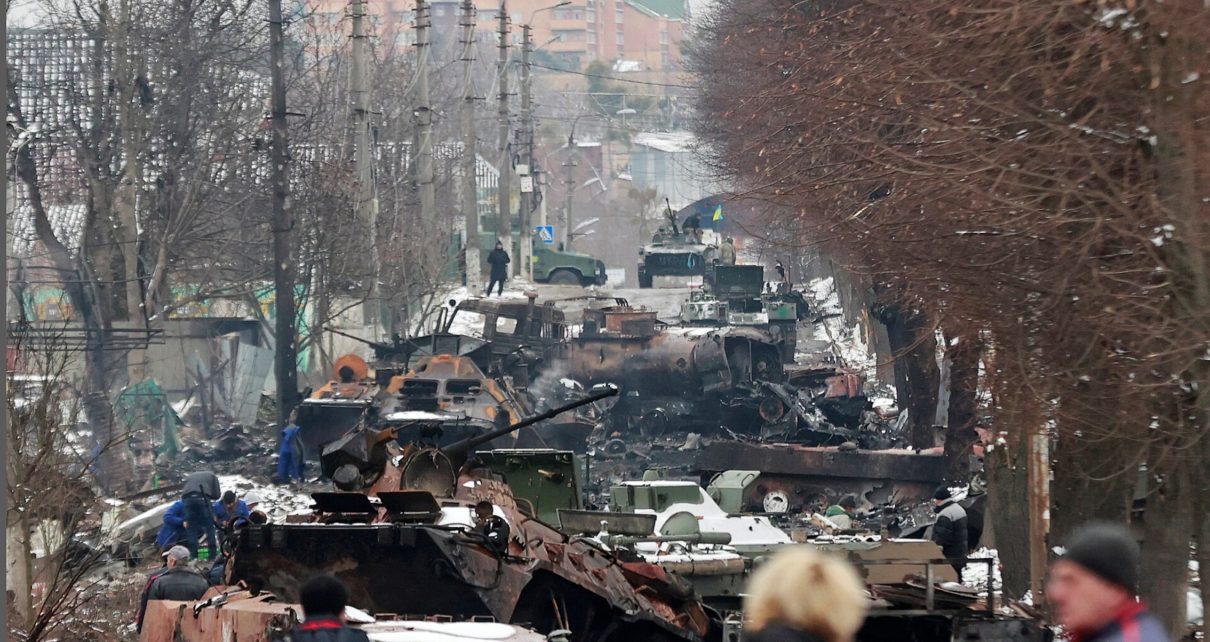
Photo: Destruction in Bucha (2022), REUTERS Serhii Nuzhnenko via Wikipedia Commons.
Disclaimer: Any views or opinions expressed in articles are solely those of the authors and do not necessarily represent the views of the NATO Association of Canada.