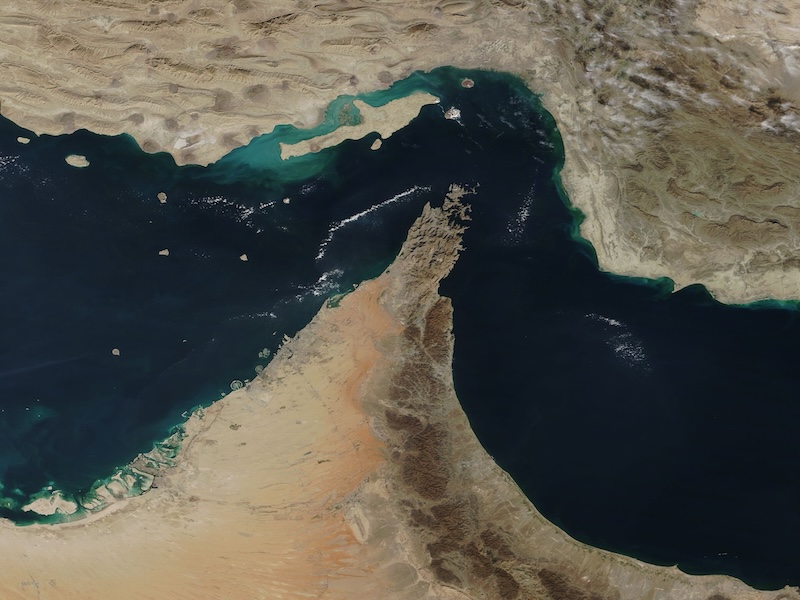
When the US and Israel launched strikes against Iran on the 28th of February, Iran not only retaliated through military actions in the region, but it also closed the Strait of Hormuz, sending shockwaves through the global economy. Located between Iran and the Arabian Peninsula, the Strait of Hormuz is a narrow maritime chokepoint connecting the Gulf region to the Arabian Sea. It is a critical transit route for global energy trade, allowing the passage of some of the world’s largest crude oil tankers. Thus, it came as no surprise that closing the strait attracted global attention as global fuel prices became volatile. However, the impact has extended beyond oil markets, affecting entire global supply chains, including pharmaceutical supply chains. The potential disruption of pharmaceutical supply chains through instability in the Strait of Hormuz highlights a growing reality of modern conflict: health security is no longer limited to protecting hospitals and healthcare workers, but also requires safeguarding the global systems that deliver essential medicines.
Global Pharmaceutical Supply Chains: Built for Efficiency, Not Necessarily Resilience
The efficiency of global pharmaceutical supply chains has come at the cost of greater vulnerability to external shocks. Understanding this trade-off requires examining how these supply chains are structured, why pharmaceutical production has become increasingly globalized, and how this creates efficiency but strategic vulnerabilities as well.There are multiple stakeholders involved in supply chain operations, including government agencies, raw material suppliers, manufacturers, distributors, health care providers, and patients. An efficient supply chain matches supply with demand in a responsive and cost-effective manner.
The first stage in the pharmaceutical manufacturing process begins with the acquisition of raw materials, such as solvents, reagents, and other chemicals. These materials undergo a series of chemical processes and purification steps designed to produce the required active pharmaceutical ingredients (APIs). The U.S. Food and Drug Administration (FDA) defines APIs as substances used in the manufacture of a drug product that develop into the active ingredient responsible for producing the drug’s intended effect. The APIs are then combined with other materials to create the final product. Whether this process occurs in the same facility that manufactured the APIs or is outsourced to other drug manufacturing facilities depends on the manufacturer.
However, production of APIs tends to be concentrated in a few countries. For example, India, the world’s largest provider of generic medicines, acquires 70% of its APIs from China. This shift towards relying on foreign manufacturing is largely motivated by the need to control costs.
Although globalization made pharmaceutical production more efficient by allowing countries to specialize, it also created dependence on a small number of suppliers. When production is concentrated among a limited number of suppliers, disruptions in one location can cascade through the supply chain, making the availability of essential medicines vulnerable to geopolitical and logistical shocks.
The Iran Conflict as a Case Study in Supply Chain Vulnerability
The Strait of Hormuz is one of the world’s most critical maritime chokepoints for international trade. Approximately a quarter of all crude oil that travels through international shipping lanes passes through this waterway, in addition to large amounts of LNG and fertiliser. Due to the ongoing military escalation, shipping flows through this narrow passage have been disrupted. And the impacts of this disruption extend far beyond the region, affecting global supply chains, energy markets and maritime transport.
Geopolitical instability in the region creates increased uncertainty for shipping, which then leads to higher transportation costs. The Iran conflict demonstrates this chain reaction through a combination of restrictions in key shipping lanes and rerouting costs, in addition to higher insurance premiums and fuel costs. For instance, since the beginning of the war, global container shipment rates increased by 144%. In fact, trade itself does not need to be entirely disrupted for vulnerabilities to arise. Uncertainty leads to increased costs and delays, straining supply chains that depend on predictable conditions.
Disruptions in the Strait of Hormuz also impact an upstream input that pharmaceutical production depends on: petroleum. Nearly all medicines depend on petroleum in their manufacturing process. Alongside APIs, petrochemical inputs, petroleum-based packaging materials, and logistics systems are all vital components of pharmaceutical supply chains. These inputs are all tied to the free flow of energy and goods through the Middle East. A prolonged disruption results in cascading risks for both the production, packaging, and delivery of medicines.
Furthermore, the global pharmaceutical supply chain has been globalized in a way that creates efficiency. Costs are lower when production is sourced from specialized countries. However, this efficiency has come at the cost of resilience. Supply chains have limited redundancy, and dependencies often lie multiple tiers upstream. Additionally, diversification away from single-source suppliers, especially raw material suppliers, can be time-consuming.
Why Pharmaceutical Supply Chains are a Global Health Security Concern
Medicines are essential goods, with generic medicines making up 90% of U.S. prescriptions. Demand for pharmaceutical products is usually inelastic, meaning demand persists regardless of price. This is mostly due to the fact that limited substitutes exist and patients cannot simply postpone taking them. If demand remains the same even when prices increase, shortages that are difficult to resolve can arise. The impact of such shortages extends far beyond individual patients, affecting healthcare providers and hospitals that depend on reliable access to medicine. As a result, disruptions to pharmaceutical supply chains become serious health security concerns rather than just commercial ones. Governments then face challenges in preparing for the continued provision of healthcare services during crises or periods of uncertainty.
Lessons can be drawn from the COVID-19 pandemic, which exposed the vulnerabilities of pharmaceutical supply chains. Supply disruptions and constrained logistics networks created shortages by disrupting the balance between supply and demand. At one point, the Food and Drug Administration’s shortage database had over 100 drugs listed, demonstrating how quickly supply disruptions can cascade through the healthcare system. Since pharmaceutical supply disruptions can impact healthcare delivery and patient outcomes, strengthening supply chain resilience requires policies that improve visibility, diversification, and preparedness.
Although the Iran conflict has garnered significant international attention, it represents a case study rather than an isolated event. The closing of the Strait of Hormuz disrupts supply chains and reveals weaknesses that could also emerge from other crises. Geopolitical instability can impact reliable access to medicine across interconnected economic systems. Therefore, building resilience means balancing the efficiency gained from globalization with the quality invested in pharmaceutical supply chains. The cheapest system is cheap until it is no longer able to operate under unpredictable circumstances. For organizations such as NATO, strengthening resilience against strategic dependencies and external shocks is increasingly important, as the ability to maintain essential services during crises contributes to collective security.
Disclaimer: Any views or opinions expressed in articles are solely those of the authors and do not necessarily represent the views of the NATO Association of Canada.
Image credit: Strait of Hormuz and Musandam Peninsula (MODIS 2018-12-10) (6 December 2018), depicting the Strait of Hormuz and Musandam Peninsula as seen by NASA’s Terra satellite, by the MODIS Land Rapid Response Team, NASA GSFC, via Wikimedia Commons. Licensed under public domain.


.jpg)
