Since 2022, Kyrgyzstan (officially the Kyrgyz Republic) has been one of the fastest-growing economies in the world. On paper, the case is puzzling; the landlocked former Soviet republic is home to just over seven million people, is ranked 124th globally in nominal GDP, and has built its economy on gold, the remittances of migrant workers, and agricultural commodities like potatoes. For a country with no productivity revolution or sudden discovery of resources to point to, the country’s economic boom seems inexplicable. Yet, it’s now being described as a “tiger economy,” with GDP expanding by more than nine percent a year over three years and official figures showing just over eleven percent growth in 2025. So how has Kyrgyzstan done it?
If you step away from the statistics and instead look at a map, a simple explanation becomes apparent. Kyrgyzstan’s surge in economic growth tracks almost exactly with Russia’s full-scale invasion of Ukraine and the Western sanctions that followed. In their efforts to impair Russia’s ability to wage war by exerting economic pressure, Western countries prohibited all transactions involving Russian foreign exchange reserves, property, goods, and services; and imposed export controls on critical goods that supported military capabilities. As those measures cut Moscow off from Western suppliers, Russia instead looked to route its purchases through friendly neighbours; and few were better placed than Kyrgyzstan. As a member of the Eurasian Economic Union, Kyrgyzstan can move goods through Central Asia and into Russia with minimal border formality. Kyrgyzstan’s exports to Russia have nearly tripled to roughly C$1.5 billion compared to pre-2022 invasion levels, and the International Monetary Fund estimates that roughly thirty percent of Kyrgyzstan’s imports are unrecorded re-exports destined chiefly for Russia. These flows have been large enough to push Russia’s share of Kyrgyz exports to around seventy-seven percent, and illustrate how Kyrgyzstan has become a “broker” for re-exporting sanctioned Western goods to Russia.
The composition of the goods makes these trade flows impossible to dismiss as standard commerce. Let us consider cars to illustrate why. As mentioned, Kyrgyzstan is a country of just over seven million people, and as of 2021 had an average monthly salary of 19,330 soms (equivalent to ~C$307). EU exports of automotive products to Kyrgyzstan climbed from €19 million in 2021 to €762 million in 2024 — a roughly fortyfold increase. Yet, average monthly salaries only increased to 36,047 soms (equivalent to ~C$573) over the same period. No domestic market, regardless of how impressive Kyrgyzstan’s economic growth has been, could absorb that.
Western governments have reached the same conclusions that sanctioned goods are still reaching Russia, and their responses are beginning to shift from punishing Russia directly to cracking down on intermediaries. In April 2026, the European Union activated its anti-circumvention tool for the first time against Kyrgyzstan over concerns of surging re-exports in “common high-priority” items such as computer-controlled machine tools, radio equipment, and other items with dual-use or military applications. Consequently, the following month, Kyrgyzstan’s Ministry of Justice acted swiftly to suspend the activities of fifty companies that the US, UK, and EU had flagged for elevated sanctions risk. This was the first measure taken under a new mechanism built specifically for identifying such firms, and for a government that has long denied any role in circumvention, issuing suspensions for fifty entities that operate on its territory represents cooperative progress. “We take information received from our Western partners seriously concerning possible sanctions-related risks for the national economy,” Ayaz Batyrkulovich Baetov, Minister of Justice of the Kyrgyz Republic, said in a statement, “and the Kyrgyz Republic will act within the framework of its national legislation to remain in line with its international obligations.” Kyrgyzstan’s decision to crack down on circumvention using tools and intelligence provided by Western partners signals at least some willingness to cooperate (although independent assessment will be needed to gauge just how durable that compliance proves to be).
Canada, in comparison to its allies, has been limited in enforcing sanctions. Although Ottawa has one of the world’s most expansive sanction regimes under the Special Economic Measures Act (SEMA) — the primary legislative framework for imposing sanctions — results have so far been minimal. Not until May 2025, more than three years into the war, did the Royal Canadian Mounted Police (RCMP) lay the first-ever charges under Canada’s Russia sanctions regime. The three-year gap demonstrates a flawed system that the government itself has had to acknowledge, namely through an internal evaluation by Global Affairs Canada that found that the administrative authorities needed to enforce its own sanctions do not exist under SEMA. This means that even if the government wanted to enforce its regimes, Canada does not have the dedicated investigative and administrative resources to efficiently pursue bad actors — leaving slow, high-threshold criminal prosecution as the only real route for action.
The disconnect between Canada and its allies reflects a structural gap in the West’s institutional architecture. NATO, the alliance that binds many Western states together for security, was built for collective defence against tangible threats and is largely limited in addressing the economic dimensions of security. The body that was meant to fill this gap was the Wassenaar Arrangement through coordinated export controls for conventional arms and dual-use goods and technologies. Created in 1996 as a successor to the Cold War-era Coordinating Committee for Multilateral Export Controls (COCOM) — which had excluded the Soviet bloc — the Wassenaar Arrangement has an expanded membership that includes Russia and operates only by consensus. Since Russia’s invasion of Ukraine in 2022, Moscow has exploited the consensus rule by using its position to single-handedly block all proposals related to updating the export control list, essentially freezing the primary forum that monitors the growth and use of dual-use technology. Members have since splintered into loose plurilateral coordination of controls; and the United States and the European Union have floated a “Wassenaar minus one” to recalibrate the coalition without Russia. Such a grouping would lean heavily on NATO members but could not be NATO itself, since the strength of export control regimes has relied on including capable non-NATO allies such as Japan and South Korea.
For Canada — a Wassenaar participant and NATO member — helping to stand up that successor framework would turn sanctions rhetoric into truly enforceable action that the Kyrgyz case suggests might work. But first, Canada needs to address its own limitations — namely by building the civil enforcement machinery that it currently lacks. A dedicated authority would be able to pursue penalties on the basis of civil liability when goods support Russia’s war effort, rather than under the current onerous practice of relying solely on criminal prosecution. This follows the Senate’s 2023 review that pressed the government to strengthen its sanctions regime and align it with allies that already wield such tools, and would allow Canada to take advantage of the capacity it already has. The RCMP already works with Global Affairs Canada, the Canada Border Services Agency, FINTRAC and allied counterparts around the world, providing Canada with an opportunity to become a more active contributor of the trade and financial intelligence that moves from the West to intermediary states.
The Kyrgyz action against firms in their own markets suggests that pressure on intermediaries could work, even when the state may be benefitting substantially from the trade. While Canada’s Russian sanctions may not be as effective as anticipated, they have contributed, as part of the West’s broader sanctions effort, to the delays, expenses, and risks that reroute Russia’s war economy. But this friction will only hold if there is continuous pressure applied. The case of Kyrgyzstan demonstrates how intermediary states expose the limits of Western sanctions, but also how much of their effectiveness depends on every member of the coalition enforcing them. A multilateral sanctions regime is only as strong as its weakest enforcer, and Canada has an obligation to its allies that it does not become that soft spot. Moving from rhetoric to action means closing the gap between what it wants its sanctions policy to do and how it actually works.
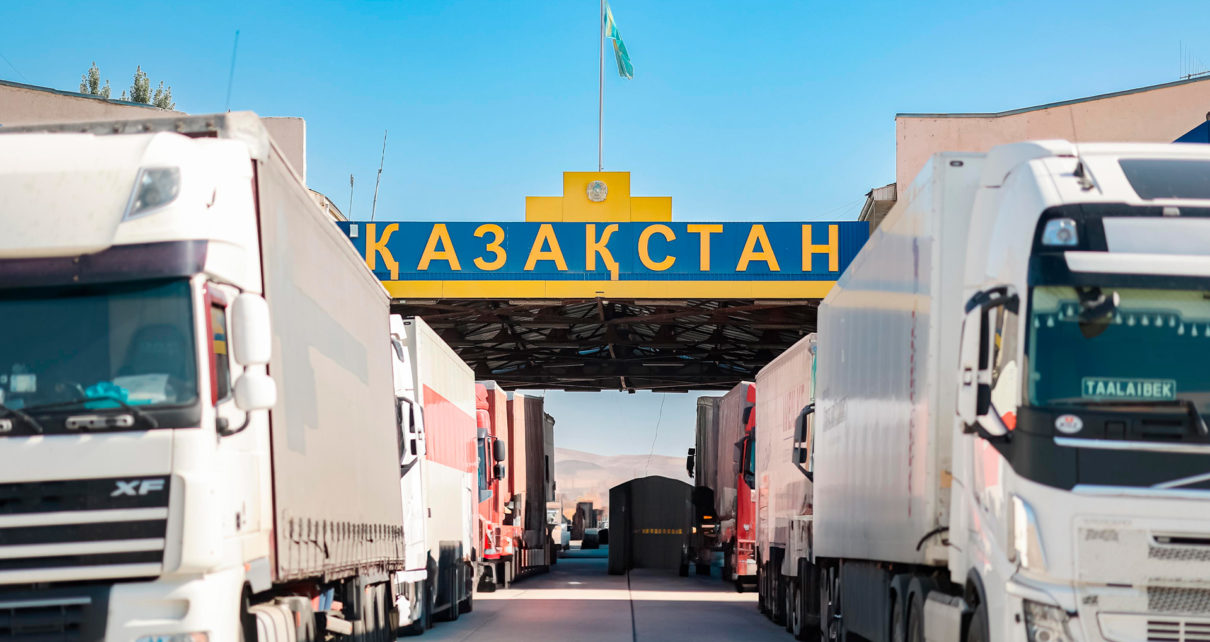
Photo: Trucks stand idly on the Kazakh–Kyrgyz border (2025), by the Office of the Prime Minister of the Republic of Kazakhstan (Primeminister.kz) via Wikimedia Commons. Licensed under CC BY 4.0.
Disclaimer: Any views or opinions expressed in articles are solely those of the author and do not necessarily represent the views of the NATO Association of Canada.