In April 2025, U.S. Defense Secretary Pete Hegseth announced the elimination of the Pentagon’s Women, Peace, and Security program. This shift in policy occurred despite the Women, Peace, and Security (WPS) program having been introduced by the first Trump administration. When President Trump signed the WPS Act in 2017, the U.S. became the first country to codify such legislation. At the time of its introduction, the WPS Act enjoyed broad support among senior Congressional Republicans who would go on to play major roles in the second Trump administration. The law was authored and introduced into congress by Kristi Noem, who later became Homeland Security Secretary at the time of the WPS policy removal, among others. Likewise, the current Secretary of State, Marco Rubio, co-sponsored the Senate version of the legislation at the time.
In recent years, support for gender equality has been on the decline, along with diversity, equity, and inclusion (DEI) initiatives. Despite WPS as a policy being distinct from DEI, U.S. departments across administrations have often conflated the policies, with terminology like “gender” and “inclusion” being blurred into broad conceptions of diversity initiatives.
The example of the U.S. rollback demonstrates that even after the successful adoption of WPS policy, reversals can occur in response to social movements motivated by anti-feminist backlash. This holds the potential for negative implications on NATO’s efforts at large. NATO uses WPS to increase societal resilience through promoting the meaningful participation of women, to tackle hostile information strategies that weaponize gendered narratives, and use WPS-informed analytical perspectives to understand conflict factors, security vulnerabilities, and promote deterrence. The crucial nature of the WPS agenda presents a paramount responsibility for other NATO states to reassert support for WPS domestically and within NATO. Canadian WPS policy, including Canada’s National Action Plan (NAP) on Women, Peace and Security, provides an example of how NATO member states can make WPS an enduring policy. The rollback of the U.S.’s Women, Peace, and Security program creates newfound responsibility for NATO member states to emphasize gender equality in their national policies and work towards building durability in NATO’s WPS agenda. Canada provides a leading example of this, reflecting how member states can work towards making WPS implementation a thoroughly integrated part of federal policymaking.
As a response to cultural pushback against gender equality, the Trump administration scrapped many existing federal DEI policies. Many of these policies are implemented internally, focusing on hiring and building gender parity in the federal government workforce. WPS as an embedded policy for defence is significantly distinct from this, as its focus is widespread and inclusionary: WPS supports the participation of women in conflict prevention and resolution and countering violent extremism. With challenges such as conflict-related sexual violence remaining prominent, the protection of women and girls in conflict zones remains a paramount element of the global security agenda. Part of NATO’s promise to defend its citizens and promote global peace and security must include the prevention of gendered violence.
Despite this and emphasis by numerous U.S. military officials that WPS actually enhances military operational effectiveness, WPS has become increasingly perceived as ineffective, superficial, or irrelevant to defence policy. In this environment, the WPS agenda has found lasting support elsewhere. Canada has taken a leading role in this effort, and presents a model for nations with like-minded goals to follow.
Canada’s current NAP on Women, Peace and Security (2023-2029) consists of an overarching framework and implementation plans stretching across 10 federal partner agencies, including the Canadian Armed Forces, Global Affairs Canada, and the Royal Canadian Mounted Police. The focus areas of Canada’s National Action Plan on WPS include building and sustaining peace through increasing support for women peacebuilders and women’s rights organizations, preventing sexual and gender-based violence in conflict zones, and prioritizing the needs of women in international crisis response. Such efforts are crucial in building the societal resilience required to maintain NATO states’ standing. In light of heightened challenges faced by democratic states, including digital disinformation, terrorism, and social polarization, the WPS agenda elevates readiness by targeting gaps in existing policymaking, recognizing that each threat weaponizes gender in its own way and affects women and girls uniquely. By promoting gender equality and gender-informed policymaking, WPS strengthens readiness against such threats to democracy, peace, and security.
Canada’s NAP is exemplary in two respects: its establishment of Ambassador Jacqueline O’Neill (2019-2025) for Women, Peace, and Security, and the establishment of a national advisory group, the Women, Peace, and Security Network. Canada was the first country to appoint an Ambassador for Women, Peace, and Security in 2019, and is one of few countries with an NAP for WPS, which has created an official capacity where civil society representatives can advise on its implementation.
After the tenure of Ambassador O’Neill concluded in 2025 without a planned replacement, Minister Anita Anand announced in April 2026 that a new one would be appointed in the near future. With a rapidly changing international landscape and growing challenges to gender equality, this was celebrated as a welcome decision by the federal government.
The meaningful participation of women is indispensable to fostering global peace. Research has shown that peace agreements are more durable when women are present and considered in negotiations. Having a dedicated ambassador for WPS allows Canada to make its policy goals a more tangible reality: the ambassador acts as a “watchdog” and an advocate within the federal government, providing advice to ministers, bringing recommendations of civil society to the federal government, and engaging with women peacebuilders in conflict-affected and crisis contexts. This is vital to ensuring the longevity of the WPS agenda and ensuring it is not sidelined, for WPS presents a critical pillar to long-term conflict prevention and sustainable peacebuilding.
Similarly, Canada’s Women, Peace, and Security Network co-chairs the national advisory group for WPS along with the federal government. The network makes policy recommendations for Canada’s WPS agenda, discusses policy and funding allocation, and publishes reports on Canada’s progress and room for improvement in its WPS implementation. Since the establishment of the WPS agenda, Canada has also launched programs like the Elsie Initiative for Women in Peace Operations in collaboration with UN Women, which builds on Canada’s tradition as a leader in peacekeeping to increase the meaningful participation of women.
Canada’s commitment to WPS has been made clear by the tangible space within policymaking provided to WPS experts: through appointing Ambassador O’Neill, committing to the appointment of a subsequent ambassador, and through the establishment of the Women, Peace, and Security Network. As the current political climate reflects increasing conflict, inequality, and geopolitical tension, Canada plays a vital role in reinforcing the values of the WPS agenda on the world stage.
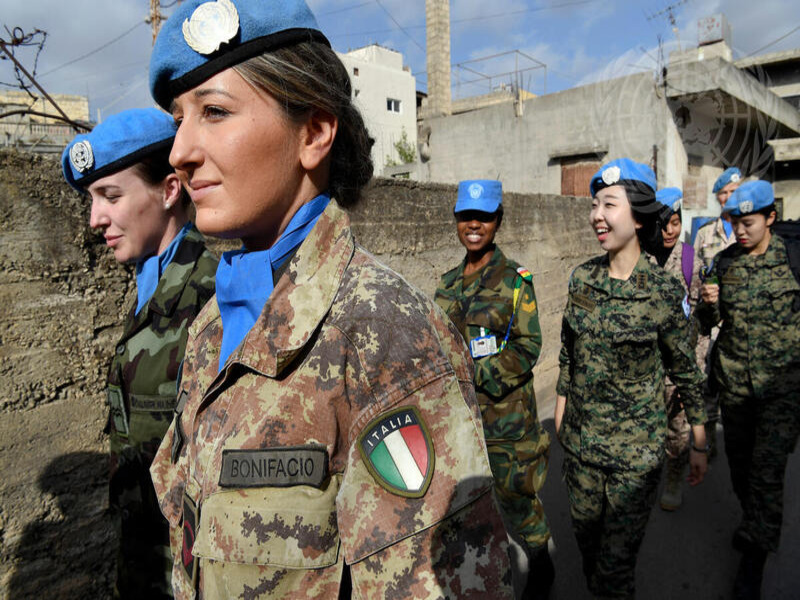
Photo: The first all-female foot patrol of the UN Interim Force in Lebanon patrolling in 2017. Source: Pasqual Gorriz via UN Photo Library.
Disclaimer: Any views or opinions expressed in articles are solely those of the authors and do not necessarily represent the views of the NATO Association of Canada.