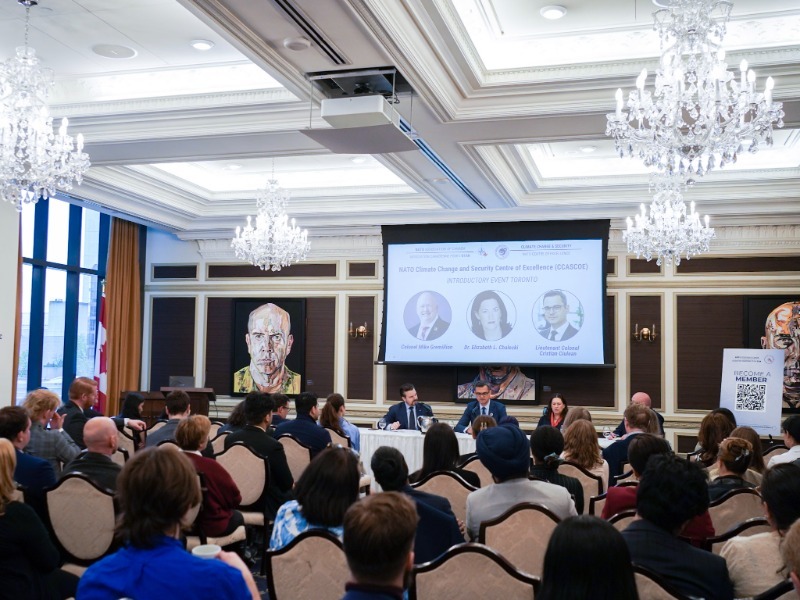
On May 5, 2026, the NATO Association of Canada (NAOC) hosted the introductory Toronto event for the NATO Climate Change and Security Centre of Excellence (CCASCOE) at the Royal Canadian Military Institute. The event brought together military officials, policy experts, academics, students, and members of civil society to explore the growing intersection of climate change and security, and to introduce CCASCOE’s work to the Toronto community.
The evening opened with remarks from NAOC President and CEO Robert Baines, who framed the nexus of climate and security as one of the defining challenges of the coming decades. He emphasized that resource scarcity, infrastructure resilience, and the security implications of a warming planet are present realities already shaping military planning and challenging NATO cohesion. Mr. Baines also highlighted the importance of engaging younger generations in climate security conversations, noting the strong student presence in the room. He underscored NAOC’s commitment to ensuring that the youth, who will be the most affected by the future climate challenges, is already engaged in the institutions working to address them.
The keynote address was delivered by Francesco Sorbara, former Member of the House of Commons of Canada. Mr. Sorbara made a straightforward case: climate change is no longer just an environmental issue but a strategic, economic, and security one. He argued that Canada’s military is now learning to operate in a fundamentally different world. He drew attention to the Arctic region, which is warming nearly four times the global average. This exposes coastal installations to severe erosion and opens new shipping routes that invite competition over sovereignty and resources. While Russia and China expand their strategic presence in the region, NATO’s readiness is threatened by thawing permafrost that damages military infrastructure. Mr. Sorbata emphasized that new equipment designed for a stable climate must withstand more extreme and unpredictable weather conditions. He closed on a personal note, speaking as a father of three daughters about the world they will inherit: a world in which today’s choices about adaptation, decarbonization, and Arctic preparedness will determine security, stability, and economic resilience of the next generation.
The event then transitioned into a series of panel presentations focused on operational and strategic implications of climate change for NATO. Moderated by Mr. Baines, the panel featured three speakers: Lt. Col. Cristian Ciulean, a Research and Analysis Officer at CCASCOE, Col. Mike Gremillion (Ret., U.S. Air Force), Director, Global Water Security Center, Alabama Water Institute, and Dr. Elizabeth Chalecki, Associate Professor of International Relations at the University of Nebraska Omaha and a NATO climate-security expert.
Lt. Col. Ciulean opened the presentations arguing that the Arctic region is where the climate-security nexus is most acute and urgent. He asserted that climate change must be understood as a primary force shaping military readiness, Arctic geopolitics, and NATO’s procurement decisions. He spoke about the “Arctic Climate Paradox,” which explains that global warming both opens new maritime routes and degrades the infrastructure necessary to operate them. He argued that building climate-resilient infrastructure in the Arctic is therefore a form of deterrence, a signal of NATO’s ability to sustain a credible presence in a region. He urged allies to act promptly and address lengthy military procurement cycles and slow Arctic infrastructure adaptation. Decisions made in the next few years will shape NATO’s Arctic posture decades into the future. Lt. Col. argued that allies are currently in a genuine decision window, one defined by the hard arithmetic of how long it takes to build, procure, and deploy in one of the world’s most unforgiving environments.
Col. Gremillion shifted the lens toward how ordinary people experience climate change, and what that means for security. Drawing on various global case studies, Col. Gremillion illustrated how environmental stressors cascade into infrastructure failures and political instability. He spoke about the ‘instability inflection point,’ the threshold at which accumulated environmental stress tips a society toward either cooperation or conflict. He argued that identifying that threshold early creates opportunities for preventive action through diplomacy, development assistance, or infrastructure investment. Governments, he noted, tend to respond to crises after they erupt rather than anticipate them in advance, and bridging that gap is central to his center’s mission.
Next, Dr. Chalecki emphasized the importance of institutional adaptability and forward-looking policymaking. She argued that the security planning frameworks traditionally used by NATO and its member states were designed for a world of more predictable threats and are no longer suited to challenges shaped by climate instability, emerging technologies, and geopolitical fragmentation. She highlighted wargaming and strategic foresight exercises as valuable tools for testing assumptions and preparing for uncertain future scenarios. Referencing War Game, a simulation centered on political instability and democratic collapse, she argued that even unlikely scenarios are worth preparing for, as institutions caught unprepared may not have time to adapt once a crisis emerges. She also noted that future security planning must increasingly account for AI, cyber threats, and autonomous weapons systems alongside climate-related shocks and resource scarcity.
The event continued with a moderated discussion and Q&A, moderated by Mr. Baines. Communication emerged as a central concern: Col. Gremillion and Lt. Col. Ciulean both emphasized the persistent gap between scientific expertise and policy implementation, and the urgent need for translators capable of rendering climate data legible to decision-makers and the public alike. The panelists also addressed the challenge of institutional speed, noting that NATO doctrine cycles and government procurement timelines often lag behind the pace of climate change. Dr. Chalecki and Col. Gremillion agreed that climate policy is most effectively communicated not through ideological framing but through concrete human impacts, including food insecurity, water shortages, and energy instability, that resonate across political lines.
The event concluded with the closing remarks by Mr. Baines, who expressed gratitude to CCASCOE for choosing Toronto as the site of its first event outside Montreal and to the Royal Canadian Military Institute for hosting the evening. The event affirmed that climate change is no longer a peripheral concern for defence planners; it is central to the future of the Alliance, and to the resilience of the societies it serves.