Coyne, Andrew. The Crisis of Canadian Democracy. Sutherland House Books, 2025.
In the introduction to his recently published The Crisis of Canadian Democracy, Andrew Coyne declares his intention to end Canadians’ confidence and “collective comfort” in the fate of our democratic institutions. The alarms that this book sounds raise important questions. What are the crises in Canadian democracy? What can and should be done about them? This review seeks to provide both critique and possible answers to the necessary questions Coyne poses.
The first “crisis” Coyne identifies is the least convincing. Coyne denounces the election of party leaders by the rank-and-file party membership and its upshot, that party leaders, not the caucus, hold the mandate to determine the party’s candidates and policy platform in elections. Coyne’s book presents this system as both a hive mind of Canada’s political elite and unique among comparable democracies. It is, in fact, a widespread, and I would argue necessary, evolution of Western electoral democracy, inseparable from the mass extension of the franchise from the 1880s to the 1920s.
Westminster democracy was originally based on a system of government selection by members of the elite and landed aristocracy. These were small segments of society who elected representatives of their constituency to the royal house. Versions of this system began with the Magna Carta of 1215 and the creation of the first parliament in 1295 and crystalized in the modern electoral system with Britain’s Act of Union in 1801. As late as the early decades of the 19th century, a small cohort of gentry and aristocracy selected representatives to form the electoral caucus, which in turn determined the makeup of government.
The ideas of popular mass participation-based democracy were introduced to the West following the French Revolution of 1789. Most Western European nations would continue to restrict the franchise in significant ways throughout the 19th century. The aftermath of the First World War, however, saw a steadily widening consensus that the whole of an expanding civil society should be involved in determining who governs it. While the system of elected presidents and separately elected legislative houses is most associated with republics, the idea that the whole of society can elect the government in a parliamentary system, with the legislative body functioning to shape its policy aims and hold it accountable, is unquestionable. As books like Why Nations Fail (2012) exemplify, within the academic literature in political science and economic history this is broadly seen both as a necessary component and result of Western European societies shifting to widespread and ideally universal economic mobilization and then widespread military mobilization drives. Andrew Coyne’s critique of this evolution, exclusively in Canada, ignores this history.
The 2024 American election provides a recent example of the process Coyne appears to favour: a (party) elite effectively anointing a candidate with no serious primary or electoral process that members could participate in. This process removed the best and most obvious forum for the American public to question then-President Biden’s mental capacity to stand as a candidate again. It then handed the nomination to Kamala Harris, whose poll numbers had never indicated an ability to win a primary contest. This exclusion of party membership from the nomination of candidates led to the widespread and justified accusation that the Democratic Party had not respected democratic values and had turned its back on its voter base, two claims that significantly damaged it in November. In contrast, in Canada’s most recent party leadership elections, Mark Carney and Pierre Poilievre presented clear visions for their leadership, faced consistent scrutiny, and won with overwhelming electoral endorsements from party members and party caucuses working to support them. The election this produced was a contest between two-popularly supported, well-constructed teams and visions of Canada, with the slightly more popular one governing according to the mandate it received. Coyne would be virtually alone in citing the Canadian election as indicative of a crisis in democracy. The 2024 American election, which conformed quite closely to the model he advocates, has widely been viewed as indicative of such a crisis.
The remainder of Coyne’s critique is both well founded and cogently argued. Coyne’s foundational observation is that party caucuses vote with their leader on average 99% of the time. Coyne eloquently and effectively presents this as both a symptom and a cause of most of the other dysfunctions he identifies. These include excessive party leader control over committee selection and assignments and super-sized cabinets. Both keep MPs constantly vying for cabinet positions instead of working to hold the government to account and reduce the functional value of cabinet. Coyne also singles out the phenomenon of unilateral prime ministerial control over parliamentary sitting time and functions, parties gifting nominations for riding candidates to the biggest party donors, either within the constituency or nationally, after assigning them “safe” districts, special interests and foreign rigging of riding nominations, and the most unequally representative parliamentary riding map of all comparable democracies.
Parliamentary committees, as Coyne correctly points out, were designed to be the primary means of non-executive MPs shaping policy and holding policy initiatives and government members to account. Instead, in Canada they have become yet another means of the Prime Minister making patronage appointments to reward loyalty. Committees, as they are currently constituted and mandated, lack even the most basic legal power to conduct inquiries. Prime Ministers maintain the exclusive right to prorogue parliament in order to prevent non-confidence votes they will lose or politically embarrassing investigations. Prime Ministers Martin, Harper, and Trudeau II have done this.
Coyne also engages in great detail with the inequities of Canada’s first-past-the-post system. Among democracies with single member parliamentary districts, Canada has by far the largest disparities of population between constituencies. Worse yet, the disparities correlate strongly to region and party, with Western and Conservative seats on average several times larger than Atlantic Canada’s heavily Liberal seats. The most unsettling aspect of the first-past-the-post system, as Coyne presents it, relates to the previously mentioned current practices of riding nominations. These practices are made possible by rules allowing people below the age of 18 and non-citizens to vote in these meetings, as well as the convention against any form of federal oversight of party candidate selection.
As Coyne’s analysis makes plain, there is no reason why Parliament should not have to vote on prime ministerial requests for prorogation. A law requiring this should include provisions defining when Parliament must resume sitting after an election, the number of days between prorogations, a time limit on the duration of prorogation, and require the end of prorogation date to be included when prorogation is first proposed. This review adds the proposal that if, during prorogation, a majority of MPs present the Speaker and/or Governor General with a letter asking for parliament to be recalled for a certain vote, they are obliged to do so within a defined amount of time, for example between 72 hours or one week. Some of such regulations exist in other parliamentary democracies, such as Israel. When the Lapid-Bennett government was inaugurated, Netanyahu tried keeping the Knesset in recess to prevent the replacement government’s inauguration, but a letter signed by 61 MKs presented to the Speaker required that new government to be voted on and inaugurated. Such a law in Canada would prevent leaders in similar situations from incapacitating government for a year. Such a change would significantly improve both democratic legitimacy and government function. Any new rules here could come with a caveat that in the event of an emergency, like a global financial or public health crisis and a hostile parliament, a Prime Minister could appeal to the governor general for unilateral prorogation, with the final decision resting on the governor general and their legal advisors.
Coyne is right to suggest that changing the way parliamentary committees are chosen and function could be transformative. The Conservative MP Michael Chong has tried to do this, but the amendments Coyne proposes go further. One fundamental change is a procedural amendment requiring committee assignments to be the result of in-caucus secret written ballots. This review goes further, proposing these secret ballots be held only among backbenchers in which no members of either the federal cabinet or shadow cabinet are allowed to participate. Committee leadership would be decided among secret written ballots within committee. This review offers another proposed amendment, the creation of a legally defined role in proposing amendments to bills which must be included in their final vote and a right of subpoena that the government must respect. These changes would prevent legislation being the sole domain of the prime minister and a small group of prime ministerial staffers. It would recreate a role for non-executive MPs in shaping legislation and holding the government to account, functions which Westminster parliaments were first designed for and Britain maintains. This would also significantly reduce the necessity of being a cabinet minister to have any impact, however small, on the legislative process, freeing MPs of the need to vie for cabinet posts. This last aim can be supported by an easy amendment imposing a legal limitation on the size of the federal cabinet, for example, fixing it at between 13 and 26 ministers.
Coyne’s most compelling and necessary proposed reform is for federal legal involvement in the process of candidate selection in ridings. Federal law should bar people below 18 and non-citizens from voting in those meetings. Federal law should also prevent parties from rewarding donors with control over riding nominations. This can be done by imposing time standards on how long one must have been a member before voting in riding nomination contests. This requirement would prevent privately wealthy prospective candidates or outside groups from making last-minute bulk purchases of “members” who then vote for the chosen candidate and subsequently disappear.
Coyne also proposes ending Canada’s current system of single member, first-past-the-post (FPTP) elections. It is his most radical and least convincingly argued reform. His alternative would see urban and suburban ridings electing multiple members through a single ranked ballot with transferable votes, while rural ridings maintain single member elections. There are three main problems with this, none of which Coyne addresses. Firstly, in multiple member ridings, it is not clear how Elections Canada would draw a cutoff within a candidate, to determine which votes would be counted as part of the 10% necessary to get the candidate elected, and which would transfer to other candidates. Coyne also did not specify if this electoral model would mean that voters instead only vote for one candidate in a riding that elects 10 MPs, and then candidates agree prior to an election about whose votes transfer to whom. Secondly, votes in the multi-member ridings would elect multiple candidates, while single-member riding voters would only be able to elect one candidate. Therefore, some voters are inherently more represented and more able to determine the makeup of parliament than others. Thirdly, this shift would also create an electoral landscape that would approximate proportional representation in urban ridings and first-past-the-post in rural ones. This would result in the 30-35% of Conservative votes in urban ridings being proportionally represented with 10 seats, and a comparable Liberal minority vote in rural ridings not being represented at all. Therefore, Coyne’s proposed new system would replicate two of the most significant dysfunctions of single member FPTP.
There is a better way: a hybrid electoral system, combining FPTP and actual proportional representation. Parliament would expand to and be legally set at 500 seats, 300 elected via single member FPTP with seat allocation accounting for balancing different regions. 200 would be elected strictly proportionately, with a separate set of proportionally represented, much larger multi-member ridings, potentially ranging from 10 to 20 members. Competing parties would be required to present lists for each available seat, voters would select their preferred party lists, and parties would receive seats in direct proportion to their vote share, with a 5% cutoff. This proposal has the benefits of approximately proportionally representing the mainstream parties that make up Canadian politics, without creating the destabilizing possibility of fringe parties squeaking into an otherwise evenly divided Parliament with 1.1% of the total vote and holding the balance of power.
As Andrew Coyne repeatedly observes, any of these reforms would only be possible if a government benefiting from the current system were willing to implement changes to it. There is no reason to think of this as impossible, especially if popular calls for such changes become more widespread and gain perceptions of urgency among the Canadian electorate. Coyne’s introduction of these issues into Canadian political discourse is a necessary first step. If his analysis does not provide all the answers, the critique it articulates and the questions it raises are invaluable contributions to a necessary debate. If recent events have proved anything, it is surely that we can never take the institutions of democracy for granted, no matter how strong they appear. Andrew Coyne has not, and Canadians owe him great thanks.
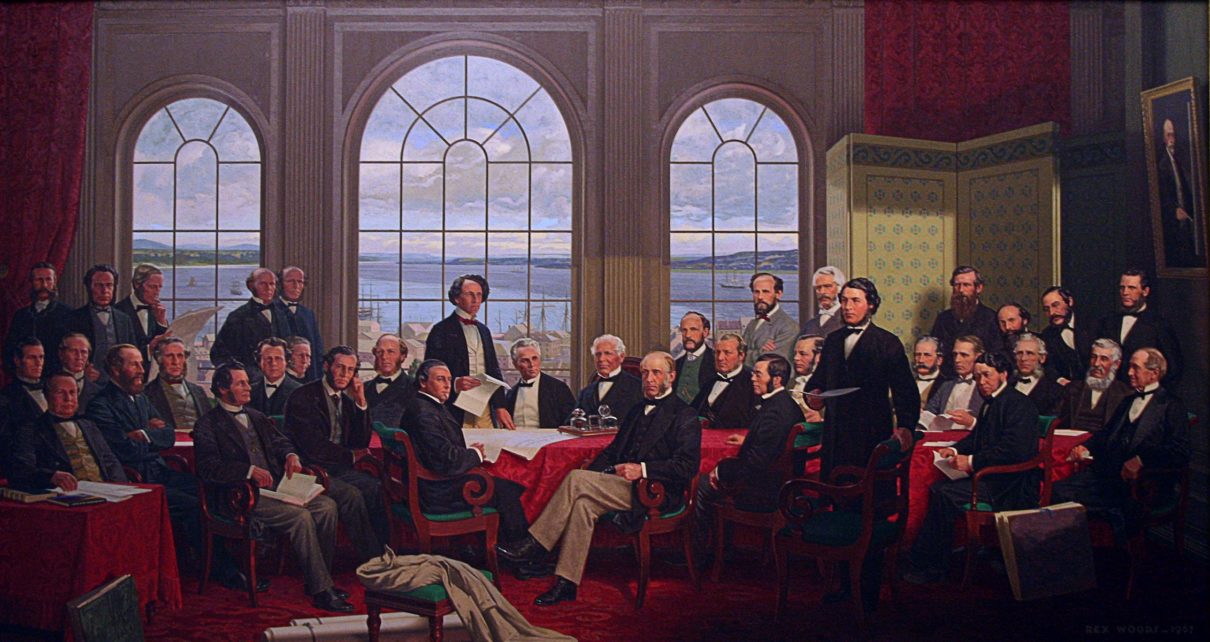
Cover Photo: The Fathers of Confederation (2011), by HCCanada via flickr.
Disclaimer: Any views or opinions expressed in articles are solely those of the authors and do not necessarily represent the views of the NATO Association of Canada.