At the Spring Policy Hackathon, organized by the Canadian International Council in partnership with the Munk School of Global Affairs & Public Policy and the NATO Association of Canada, four interdisciplinary teams were tasked with navigating complex national security scenarios. The critical minerals team tasked with recommending one of two options that exemplify the strategic and political trade‑offs embedded in Canada’s critical minerals policy: Canada can either commit to a 15‑year exclusive uranium supply deal with an allied nation or sell raw ore to a Chinese buyer at an attractive price.
The team’s first move was to challenge the framing. A long‑term exclusive deal would limit Canada’s future flexibility with allies by locking strategic resources into a bilateral channel, while selling to China would contradict Canada’s Critical Minerals Strategy by deepening reliance on a non‑allied state that already dominates global processing. The team proposed that a more balanced and strategically aligned alternative existed, which leveraged Canada’s uranium abundance and policy commitments without ceding control or its commitment to democratic cooperation. Using Venford Technologies’ policy simulation and digital twin platform, the team designed and stress tested a model that reflected these priorities, grounding their approach in uranium profit trend datasets.
The Case for Prioritizing Uranium
The simulation prompt was deliberately left open about which critical mineral to prioritize; of the 37 minerals deemed critical for Canada, the team selected uranium for both its economic weight and its geopolitical relevance.
Canada is one of the world’s largest producers of uranium, with Saskatchewan’s Athabasca Basin containing deposits capable of supplying more than 20 percent of global output. That said, Canada went over two decades without approving any new uranium mines, and nearly 85 percent of Canadian uranium is exported in raw or minimally processed form, limiting domestic capture of downstream value. Uranium prices in early 2026 continued the sharp upward trend seen in 2025, as tightening global supply meets accelerating demand for new nuclear capacity.
The geopolitical context adds further urgency. The G7 has recently underscored the need to secure critical mineral supply chains among trusted partners, and Canada reinforced this direction domestically with the launch of its Nuclear Energy Strategy, signalling uranium policy as both a national and multilateral priority. Against this backdrop, the team argued that Canada’s strategic advantage lies in supplying democratic allies within rule‑of‑law frameworks, consistent with the partnerships Canada already maintains through multilateral institutions like NATO.
The Proposal: Shared Ownership, Shared Benefit
Rather than a simple buyer‑seller arrangement, the team proposed a Tri‑Partner Joint Venture (TPJV): a co‑ownership model in which Canada, a host First Nation, and vetted democratic allies all hold equity stakes and share the project’s revenues. Under this structure, the Government of Canada holds 35 percent, giving it majority control and the ability to make strategic decisions about how the resource is used. Democratic allied partners collectively hold 30 percent, ensuring they have a financial stake without granting any single country exclusive access. The host First Nation holds 25 percent as a direct equity owner plus veto power over environmental and employment standards, reflecting both their legal rights to the land and their role as full partners in the project.
An additional 10 percent is allocated to a newly created Crown‑Indigenous Development Fund (CIDF), held by the host First Nation as a community infrastructure vehicle. Originally unallocated and flagged as a structural risk during review, the team established the fund as a mechanism that both stabilized the project model and strengthened its commitment to Indigenous reconciliation.
Putting the Numbers to Work
For its part, the financial case for the project is built on conservative estimates . Building the mine and processing facility requires roughly $2.2 to $2.5 billion upfront in construction capital, with Canada’s 35 percent stake translating to approximately $770 to $875 million of the total. Once producing 27 to 30 million pounds of uranium per year, the project is projected to generate between $1.7 and $2.6 billion in annual profit after expenses and taxes, depending on price conditions. Over the full life of the project, the estimated total value in today’s dollars is between $6.3 and $8.5 billion.
On the output side, 20 percent of production is reserved for Canadian domestic use to support energy security. The remaining 80 percent is sold through competitive, time‑limited agreements to allied partners, with TPJV co‑investors receiving preferred access in the bidding process.
Simulation Testing & Risk Mitigation
The team used a policy simulation and digital twin software provided by Venford Technologies to test their model across 100,000 simulated market, political, and operational conditions over a 10‑year horizon. The simulation highlighted both strengths and pressure points, particularly the timing of First Nation equity negotiations and the risk of weak contract execution.
In response, the team introduced the CIDF, moved First Nation negotiations to the beginning of the process, and added an annual review mechanism to adjust the model as real‑world data emerges. Even under uncertainty, Venford consistently showed the TPJV outperforming the 15‑year exclusive supply deal – identified as the more likely selection between the two original options – across metrics of revenue growth, sustainability, market share, and equity finalization. Furthermore, the platform returned an overall confidence score of 45 percent, which the team concluded as reasonable for a first‑of‑its‑kind, multi‑party resource model.
The Road to Production
The implementation timeline is built around a construction licence that was already issued by Canada’s nuclear regulator in March 2026. The TPJV mirrors this through a phased approach:
Phase 0: Decline & Bridge (Now-Aug 2026)
Canada rejects both offers, provides a short interim arrangement to the ally, and begins First Nation co‑ownership negotiations.
Phase 1: Joint Venture Constitution (Q4 2026)
Finalize the TPJV charter, close First Nation and CIDF equity allocations, issue the democratic‑ally co‑investment call, and appoint the JV board.
Phase 2: Construction (2027-2030)
Begin site preparation, mine development, and mill construction using committed federal infrastructure funding and fast‑track protocols.
Phase 3: First Production (2030-2031)
Commission the facility, initiate first ore production, activate offtake agreements, and begin domestic reserve allocation.
Phase 4: Scale & Annual Review (2031-2036)
Ramp up to full production, conduct annual model reviews as ownership and offtake data update, and establish the TPJV precedent framework for future deposits.
First production is expected at a time when the World Nuclear Association projects existing uranium supply will meet less than 50 percent of demand. As countries accelerate the clean energy transition and expand nuclear capacity to meet climate targets, the project is designed to come online exactly when the global need for stable, low‑carbon power is at its peak.
Implications & Takeaways
At its core, the critical minerals team’s brief is an argument that Canada need not choose between short-term financial gain and long-term control over its strategic resources. By structuring uranium development as a co-ownership model that shares both risk and reward, the proposal turns restrictive starting conditions into a platform Canada can build on. Data-driven simulation added significant value by projecting long‑term outcomes across thousands of market and political conditions, providing a structured avenue to test and refine the team’s model. The uranium case is compelling on its own terms, but the cooperative framework it demonstrates for democratic resource development without surrendering sovereignty resonates well beyond a single project.
Original policy brief authored by: Azim Lila; Ashley Smith
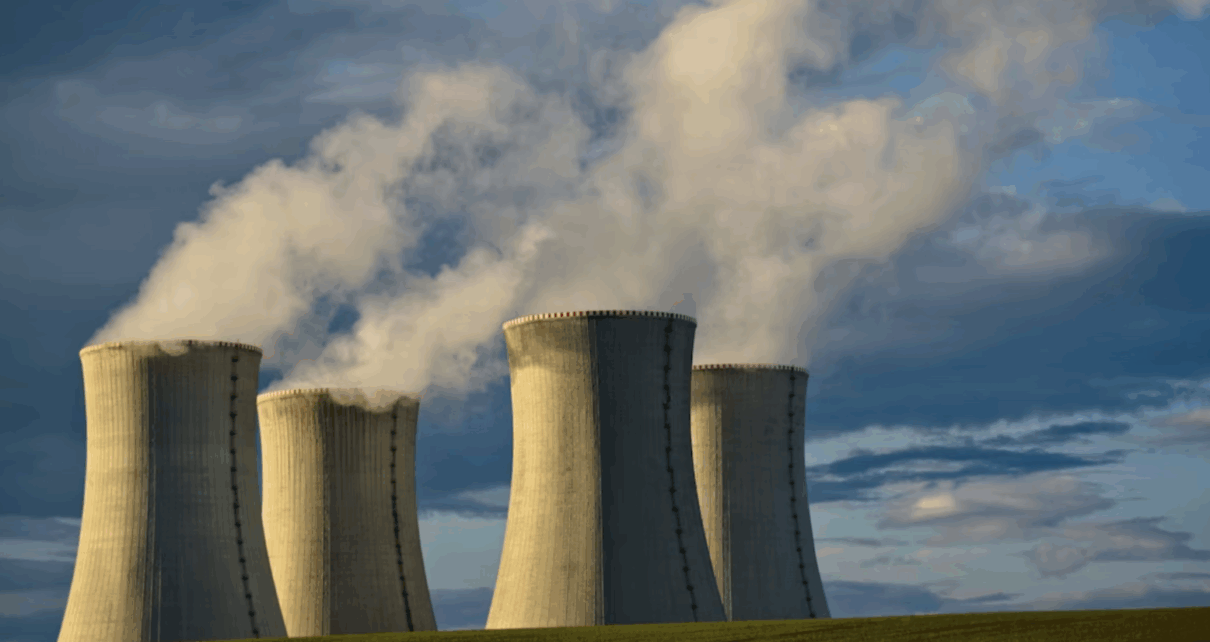
Photo Citiation: “Gray concrete towers under white clouds and blue sky during daytime” (2021), Lukáš Lehotský via Unsplash. Unsplash License.
Disclaimer: Any views or opinions expressed in articles are solely those of the authors and do not necessarily represent the views of the NATO Association of Canada.