
On November 4, 2025, Canadians witnessed a redirection in federal policy efforts with the release of Budget 2025: Canada Strong, signaling a shift toward economic growth, national resilience, and long-term global stability. While the budget aims to strengthen economic sovereignty, the subject of climate change and the health of the environment must be considered, since overlooking this risks undermining the resilience and prosperity the budget seeks to build. The budget frames climate change not, “just as a moral obligation–it’s an economic necessity”, and formally introduces a Climate Competitiveness Strategy. In this strategy, Canada’s natural wealth through critical minerals and investment, which are directed towards clean power and low-carbon infrastructure, such as nuclear, hydro, wind, energy storage, and grid infrastructure, will create lasting prosperity. This reflects the economic integration of climate change, where the reframing of an environmental action as an economic project is justified based on its contribution to national economic performance.
The David Suzuki Foundation notes that the budget provides some support for clean-economy initiatives, but still leaves major gaps in biodiversity protection, conservation funding, and climate-resilient infrastructure. As a result, significant questions remain about whether Canada can achieve genuine climate resilience while relying primarily on market-driven climate action. The Canadian Climate Institute, in its recent commentary on Budget 2025, notes that the new Climate Competitiveness Strategy is, “a good first step,” but emphasizes that “swift implementation” is essential, highlighting persistent policy gaps and the urgent need for stronger climate-resilience investments. Climate change is a critical factor in Canada’s economic and policy landscape. This makes it essential to see how Budget 2025 illustrates what the federal government has articulated about its environmental transition, analyzing the implications for Canada’s security, climate, and environmental impacts.
Budget 2025 reflects Canada’s global climate role and strategic interests, since climate policy is framed as being central in the global clean-energy transition. The Climate Competitiveness Strategy is designed to utilize Canada’s natural resources to deploy, “Canada’s unique strengths…to attract investment, create good jobs…and ensure Canada continues to be competitive on the world stage”. This approach reflects a broader global economic context where demand for clean energy technologies and supply-chain resilience is expanding rapidly. For instance, global investments in clean energy reached nearly $2.8 trillion in 2024, and the clean technology market is expected to triple by 2035, highlighting the scale of markets Canada seeks to compete in. The security implications of this strategic framing extend beyond economics and into environmental security. Canada has positioned itself as a competitive producer by reducing its dependence on foreign fossil fuels and unstable markets by investing in its own energy.
Climate change itself is recognized by Canadian security planners as a threat multiplier that exacerbates risks to national stability, infrastructure, and public safety. Canada’s Department of National Defence identifies climate change as impacting critical infrastructure, supply chains, as well as increasing the likelihood of extreme weather events, resource scarcity, and population vulnerabilities, which can strain government resources. This is seen in the Arctic region, where warming temperatures increase access to strategic shipping routes and natural resources. Investments in climate-resilient infrastructure, early warning systems, and emergency preparedness are essential components of the budget’s clean-economy measures, ensuring that Canada’s economic and environmental strategies ensure national security.
Environmental security concerns are also evident in the growing frequency and severity of climate-driven disasters. Canada has seen nearly $8.5 billion in 2024 alone due to wildfires, hailstorms, and floods, illustrating how climate impacts lead to economic and environmental strain. This highlights that climate change threatens ecological systems, economic stability, human security, and institutional preparedness. This calls for the need for mechanisms to be set in place to ensure that the effects of climate change are reduced. In response, Canada’s 2025 federal budget introduces Clean Economy Investment Tax Credits, such as a 15% credit for clean electricity projects and expanded credits for critical clean technology manufacturing to make the low-carbon transition more affordable.
Altogether, Budget 2025’s climate-economic strategy addresses these security dimensions by aiming to enhance Canada’s resilience in a changing world. The Budget 2025 represents an important first step toward integrating climate change into Canada’s economic and security planning. However, for it to truly reinforce national and environmental security, the strategy must be paired with climate adaptation investments and governance frameworks that directly mitigate climate risks.
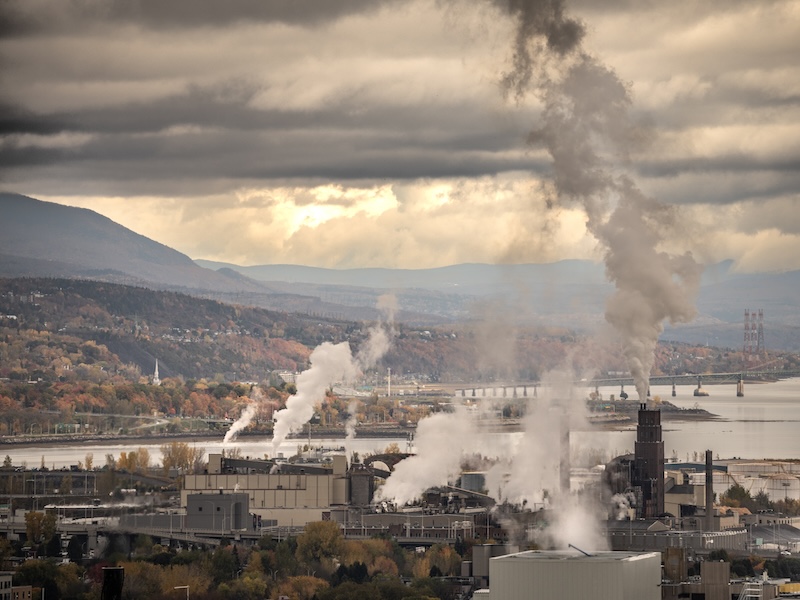
Image credit: Air Pollution in Quebec City (date unknown), depicting air pollution over Québec City, by Welp.sk via Wikimedia Commons. Licensed under CC BY-SA 3.0.
Disclaimer: Any views or opinions expressed in articles are solely those of the authors and do not necessarily represent the views of the NATO Association of Canada.


