Should NATO Treat Climate Data as Strategic Intelligence?
Climate change is recognised as a major threat that is shaping global security. Rising temperatures and extreme weather patterns are affecting economic stability and infrastructure resilience. As these risks become more frequent, climate data has become an important tool for anticipating these threats.
Climate data is long-term information on environmental conditions, such as temperature trends, sea-level rise, and the frequency of extreme weather events, and it provides predictive insights into operational disruption and emerging security risks. For example, meteorological data can be used to forecast droughts in the Sahel and Arctic climate monitoring data can track sea ice melt. However, NATO lacks a structured approach to integrating climate analysis into its intelligence framework, creating a gap between risk recognition and actionable responses.
This article explores how NATO can leverage climate data strategically by embedding climate analysis into early warning systems (EWS), infrastructure planning, and intelligence frameworks. With climate data, NATO could anticipate risks, strengthen operational readiness, and improve long-term security planning.
Climate Data and EWS
EWS is used to generate timely and meaningful warning information that allows individuals, communities and organisations vulnerable to hazards to prepare and act quickly. These systems have four components: risk information, risk monitoring and warning services, risk distribution and communication, and response capability. These components form an integrated system that enables early identification, assessment and management of risks, providing a clear framework for integrating climate data into NATO’s predictive capabilities.
According to NATO, climate change is having a “…profound impact on Allied security”, reinforcing the need for improved early warning and predictive capabilities. Integrating climate data can help predict severe weather events before they escalate into a crisis. In practice, EWS would allow NATO members to anticipate any instability in regions such as the Sahel, where drought and resource scarcity contribute to migration pressures, and to monitor environmental changes in the Arctic that could change military activity. Prolonged drought and water scarcity can act as early signals of economic stress, and by analysing these patterns, security actors can respond proactively rather than reactively.
However, significant gaps remain in how climate data is used within early warning systems. NATO has been slow in incorporating climate change into its core security agenda, reflecting a broader lag in adapting its intelligence and strategic frameworks to emerging non-traditional threats. Additionally, differences in data collection and analytical capacity across member states lead to fragmented and inconsistent risk assessments, limiting NATO’s ability to have a unified understanding of climate-related risks.
This fragmentation is compounded by the alliance’s reactive approach, which focuses on adaptation and resilience rather than predictive risk analysis. While the Alliance acknowledges that climate change interacts with traditional security threats, these linkages are not systematically incorporated into threat assessments. Furthermore, geopolitical constraints and uneven data availability, particularly in regions such as the Arctic, limit the accuracy of climate modelling.
Climate Data and Military Infrastructure Planning
Climate data plays a critical role in military infrastructure and maintaining operational readiness. For NATO, military bases, transportation networks, and weapons systems are exposed to environmental risks such as extreme heat and rising sea levels, all of which can reduce military effectiveness.
The UK Met Office states that rising temperatures and extreme weather events influence key military activities, including equipment design, mission planning, and sensor performance. For example, rising temperatures can reduce air density, limiting the aircraft’s lift and payload capacity. As extreme weather events become more frequent, military planners must account for these in infrastructure design and operational planning.
These challenges are profound in the Arctic region. Canadian defence policy discussions highlight that melting sea ice and permafrost thaw are reshaping the region’s strategic landscape. Research shows that climate-driven extreme weather events threaten military infrastructure such as ports and airfields while increasing the demand for military disaster response operations. These developments illustrate the need for climate monitoring in defence planning across Canada and its NATO allies.
Despite growing awareness, climate data isn’t systematically integrated into NATO’s infrastructure planning at the alliance level. Risk assessments are often conducted at the national level, resulting in uneven resilience and limited coordination across member states. In addition, climate projections are not consistently incorporated into long-term defence investment and infrastructure design, so military assets may still be built on outdated environmental assumptions.
This reflects a broader limitation: climate data is used for adaptation in isolated cases, but is not fully embedded as strategic intelligence to guide infrastructure planning across NATO. Strengthening this integration would enable more coordinated and forward-looking defence planning. NATO can benefit from climate data in its military infrastructure, as airbases can be redesigned to withstand heatwaves, naval infrastructure can be made more resilient to rising sea levels, and climate data can help NATO optimise logistics routes to ensure reliable force deployment across member states.
Integration into intelligence systems
For NATO, intelligence is central to decision-making, and climate data can act as core intelligence. However, persistent gaps in analytical capabilities, including limited use of predictive modelling, weak integration of intelligence into climate-based threat assessments, and a lack of standardised frameworks for evaluating climate-security risks, still exist.
NATO already has extensive analytical and intelligence capabilities, including data-sharing and strategic foresight systems, which could be leveraged to integrate climate data more effectively into security assessments. NATO uses strategic foresight analysis and EWS through its Climate Change and Security Action Plan, which emphasises improving situational awareness. In addition, NATO’s intelligence-sharing architecture and geospatial analysis capabilities provide a foundation for incorporating environmental and climate-related data into threat assessments.
A major barrier to integration is fragmentation across member states. NATO relies on national governments to collect and analyse intelligence; differences in how climate data is generated and used are highlighted. For example, countries like the United States and the United Kingdom have advanced climate monitoring and modelling systems, with institutions such as the UK Met Office incorporating this data into defence planning. However, smaller NATO members prioritise immediate geopolitical threats and have limited analytical capacity, leading to less integration of climate risks into their planning. Geographic differences widen these disparities as Canada focuses on Arctic environmental change, while European countries focus on heatwaves and migration pressures.
As a result, this makes it harder for NATO to produce a standardised intelligence assessment of climate-related risks across the alliance. This weakens coordination, slows response times, and reduces NATO’s ability to react proactively.
Recommendations
To address these challenges, NATO needs to implement institutional and technological changes, as climate data is complex and must be translated into actionable insights. Firstly, by using a standardised Climate Intelligence Framework, NATO can reduce fragmentation across member states, thereby enabling the successful integration of climate data into the intelligence cycle. Using AI-predictive analytics would allow NATO to process large datasets quickly, improving its forecasting accuracy. By implementing such technologies, NATO’s intelligence systems would enable the alliance to convert raw climate data into decision-relevant insights, enhancing its predictive and strategic capabilities.
In conclusion, climate data already supports EWS, infrastructure planning, and threat assessment, performing many of the core functions of intelligence. However, fragmentation, limited coordination, and institutional constraints have limited integration. Using climate data would move NATO towards a proactive response system and would be essential for maintaining operational readiness, improving decision-making, and ensuring long-term security across the alliance.
Disclaimer: Any views or opinions expressed in articles are solely those of the author and do not necessarily represent the views of the NATO Association of Canada.
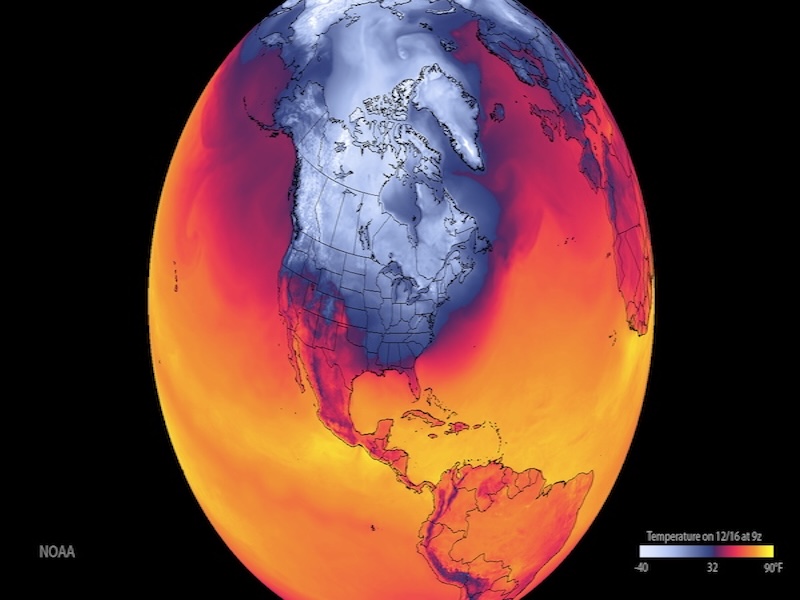
Image credit: GFS Model Forecasts a Cold Start to the Weekend for Most of the U.S. (NESDIS 2016-12-14) (14 December 2016), depicting a Global Forecast System weather model forecast for the United States, by NOAA/NESDIS via Wikimedia Commons. Licensed under public domain.



.jpg)
