
In the northern regions of Canada, climate change is not a distant threat. It is disconnecting the roads that Canadians depend on to survive. Ice crossings that once carried trucks providing goods to these remote communities are now thinning or failing to freeze at all. For many northern and Indigenous areas, the loss of these winter roads means more than inconvenient travel. It means delayed food delivery, growing prices, and a growing sense of uncertainty on the future of a sustainable supply chain. As climate impacts intensify, the question is no longer whether northern transportation networks need to change, but how quickly Canada is willing to act. Furthermore, the expansion of rail infrastructure into the northern regions of Canada is a strategy for climate adaptation and tackling food security issues.
The expansion of railway networks to Canada’s northern regions would strengthen transportation infrastructure at a time where the changing climate is making travel less reliable. Winter roads and ice crossings were once seasonal lifelines that provided over 10 000 kilometers of access between communities. However, these roads are now opening later, closing earlier and failing more often as temperatures rise. Some communities such as Cat Lake First Nation in Northern Ontario are experiencing the impacts of the instability of these winter roads. Residents are witnessing the roads failing to freeze altogether, which has forced supply trucks to delay deliveries or abandon routes entirely. This growing unpredictability disrupts the delivery of goods and leaves communities such as Cat Lake First Nation vulnerable to supply shortages and increased pricing.
The majority of goods entering the territories are transported by truck, airplane, or seasonal routes, all of which are expensive, carbon-intensive, and becoming less dependable due to climate change. Therefore, the delivery of non- traditional foods to northern communities is expensive, and difficult to access. This results in irregular delivery of groceries, which drives higher food prices, such as a box of cereal in Nunavut reaching the average cost of $18 CAD. These high costs are not simply an inconvenience, but contribute directly to food insecurity, health disparities and economic strain in northern communities. Expanding Canada’s railways further north would provide reliable and low emission transportation infrastructure which could aid in stabilizing supply chains and reduce transportation costs over the long term. This would improve access to affordable food while also lowering greenhouse gas emissions.
In this context, the Northern Corridor appears as a comprehensive solution to the interrelated problems of food insecurity, climate vulnerability, and unreliable transportation in Canada’s northern regions. The Northern Corridor suggests a coordinated expansion of permanent, all-season infrastructure linking the southern regions of Canada to the north. The proposal includes the construction of railways alongside energy and digital networks instead of depending on dispersed and climate-dependent supply routes.
This proposed project creates the framework for nation-building in Canada that envisions a continuous, strategically planned network of utilities and transport spanning the country’s northern and remote regions. The Northern Corridor proposal would increase long-term supply chain resilience and lessen reliance on winter roads and carbon-intensive air freight by establishing a shared corridor for utilities and transport. It is a coordinated approach to building ports, roads, railroads, energy transmission, and digital connectivity within a shared corridor. In addition to lowering greenhouse gas emissions and bolstering resilience against climate disruption, a contemporary rail connection such as the Northern Corridor proposal would offer a year-round, lower-emission alternative for moving necessities. Canada can support territorial communities, maintain its sovereignty, and develop climate-resilient infrastructure by investing in northern rail.
A potential issue that may arise in terms of the construction of rail networks further north is the way in which the cold climate may impact the delivery of efficient rail services. To address this concern, a recent NRC innovation has proposed a solution to “keep Canada’s railways moving” in extreme cold temperatures. Researchers from the National Research Council of Canada’s Automotive and Surface Transport Research center constructed a Cold Weather Air Break (CWAB) to mitigate the potential hazard of brake system failure as a result of extreme cold temperatures. This innovation has the potential to transform the railway industry, and makes the Northern Corridor project a viable option for improving connectivity, national trade and climate resilience.
As climate change continues to transform Canada’s northern regions, it is no longer feasible to maintain the status quo in terms of infrastructure and transport. The urgent need for long- term and climate resilient solutions is highlighted by the growing unreliability of winter roads and growing supply chain disruptions. Through improving connectivity and stabilizing the delivery of essential goods, rail infrastructure expansion through projects like the Northern Corridor provides a way to address these growing concerns. Therefore, this infrastructure investment provides a commitment to sustainable nation building through equitable access and climate adaptation in Canada’s territories.
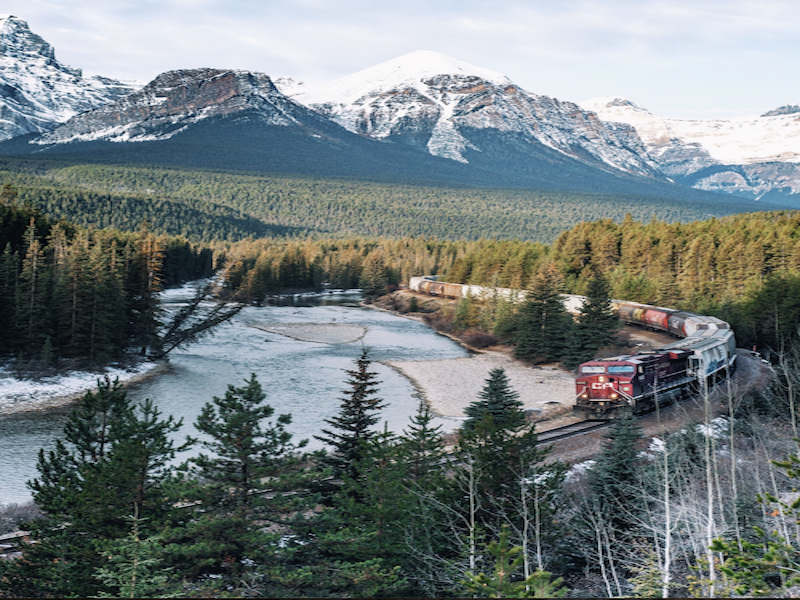
Image credit: Morant’s Curve (photo ID 10119621), depicting Morant’s Curve in Banff National Park with the railway winding through the valley, by wirestock via Freepik. Licensed under the Freepik License.
Disclaimer: Any views or opinions expressed in articles are solely those of the authors and do not necessarily represent the views of the NATO Association of Canada.