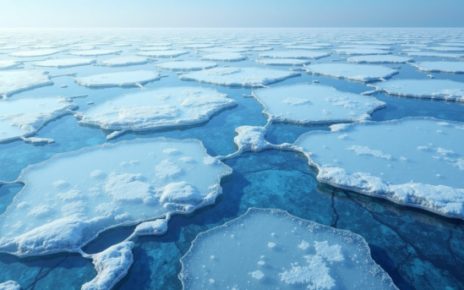
As the Arctic transforms from a frozen frontier into a contested geopolitical arena, questions of sovereignty, environmental responsibility, and security have converged into one of the most pressing challenges in the 21st century. Once referred to as a remote, ice-covered expanse, the region is now a stage where the impacts of climate change intersect with shifting power dynamics, resource ambitions, and emerging security threats. The rapid warming of the Arctic, occurring at nearly four times the global average, has melted sea ice, opened new maritime routes, and exposed vast reserves of oil, gas, and minerals. These developments have intensified global interest and competition, especially among Arctic states seeking to expand their influence and stake their claim in a transforming geopolitical landscape.
Climate change has redefined the very concept of sovereignty in the Arctic. The melting of sea ice is not only an environmental issue but also a geopolitical catalyst. The opening of the Northern Sea Route along Russia’s coast and the potential accessibility of the Northwest Passage through Canadian waters have drawn international attention, creating new opportunities for trade and energy transport. Yet, these same opportunities have intensified disputes over control and jurisdiction. For Canada, the Arctic is an integral aspect of national identity, heritage, and environmental responsibility. Along with Canada, Arctic states such as Russia, the United States, Denmark, and Norway are asserting overlapping claims and ramping up strategic investment. Thus, the competing interests for access, extraction, and navigation have escalated the risk that environmental change may lead to increased securitisation in the region.
The challenges to Canada’s Arctic sovereignty are multidimensional. It must uphold territorial integrity and Indigenous rights, protect fragile ecosystems, and balance the growing presence of global powers in the region. In its 2019 Arctic Foreign Policy, the Government of Canada emphasized the need to integrate Indigenous leadership, environmental responsibility, and secure infrastructure in the North. Canada maintains that the Northwest Passage constitutes internal waters, giving it the right to regulate transit and protect environmental standards. However, the United States and several European states regard the same passage as an international strait, subject to freedom of navigation, which illustrates the divergence with Arctic governance. Thus, Canada has invested in surveillance systems, Arctic patrol ships, and military exercises such as Operational NANOOK. Ultimately, these measures reflect Canada’s attempt to navigate a complex strategic environment while protecting sovereignty, stability, and sustainability in the Arctic.
While the Arctic Council has served as a model for cooperation among Arctic states, the strategic environment is becoming competitive. Russia’s military modernisation in the Arctic, including new bases, airfields, and ice-breakers, reflects a clear intent to dominate northern navigation and resource extraction. Meanwhile, China has positioned itself as a, “near-Arctic state”, and expanded its presence through research expeditions and infrastructure initiatives, including its “Polar Silk Road” concept. The United States has, “made clear that it wants the passage to be international waters and not require Canada’s permission to travel in it in 2019”, to which Canada’s claim to the route was seen as “illegitimate” for then-US Secretary of State Mike Pompeo. If the United States were to send ships through the route then it, “would open the door for Russia and China to use the passage as well if it were declared international water.” For Canada, these circumstances pose serious security and environmental challenges, which signal that it must urgently strengthen its Arctic governance, defence capabilities, and environmental protection to protect its sovereignty and northern front.
One way Canada has invested in Arctic security is through the Federal Budget 2025, in which Carney issued $81.8 billion in defense funding over the next five years, a defense investment that is described by analysts as the most consequential in decades for Canadian security. In this environment, the role of NORAD, an early-warning and aerospace-defence system that detects long-range missiles, tracks bomber activity, and monitors northern approaches, becomes strategically decisive. As geopolitical pressures and climate-driven changes converge, NORAD’s renewal is essential to protecting Canada’s security in a rapidly transforming Arctic environment. Yet, military investment is inefficient without integrating Indigenous knowledge, climate-resilient infrastructure, sustainable economic development, and environmental protection practices built into Canada’s broader security strategy.
As mentioned previously, climate change is reshaping the Arctic security landscape. The CCS/NUPI report highlights that as climate change leads to the thinning of ice sheets in the Arctic, this leads to the accessibility of shipping, drilling, mining, and other extractive activities, in addition to various state actors attempting to gain access to utilize this region. This creates a dangerous feedback loop in which the thawing Arctic facilitates new waves of resource extraction, which leads to exacerbating climate change, further leading to the very environmental changes that opened the Arctic in the first place. The report warns that this surge in extractive and shipping activity will dramatically increase demand for state security, infrastructure maintenance, and environmental response. It is clear that unless global emissions are rapidly curtailed and new climate-aware governance measures are adopted, the Arctic risks becoming a focal point of ecological collapse, resource-driven competition, and geopolitical instability. The warming Arctic should not be seen solely as an opportunity for resource exploitation, economic opportunity, or strategic competition; it should be seen as an indicator that is leading up to a disastrous global reality.
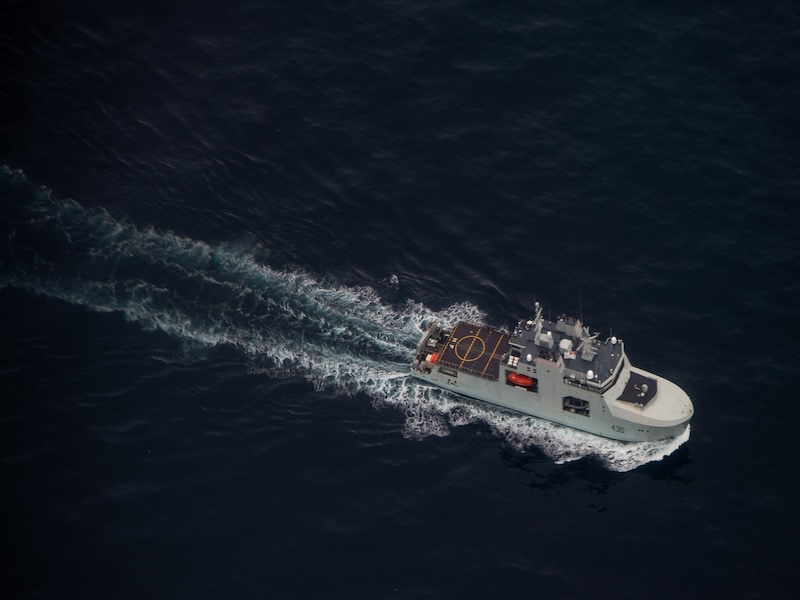
Image credit: HMCS Harry DeWolf (AOPV 430) during Operation Nanook, 2023 (photo ID 230829-N-AD347-1001), depicting the Royal Canadian Navy Arctic offshore patrol ship HMCS Harry DeWolf participating in a photo exercise for Operation Nanook on August 29, 2023, by Lt. Alexander Fairbanks via Wikimedia Commons. Licensed as public domain.
Disclaimer: Any views or opinions expressed in articles are solely those of the authors and do not necessarily represent the views of the NATO Association of Canada.