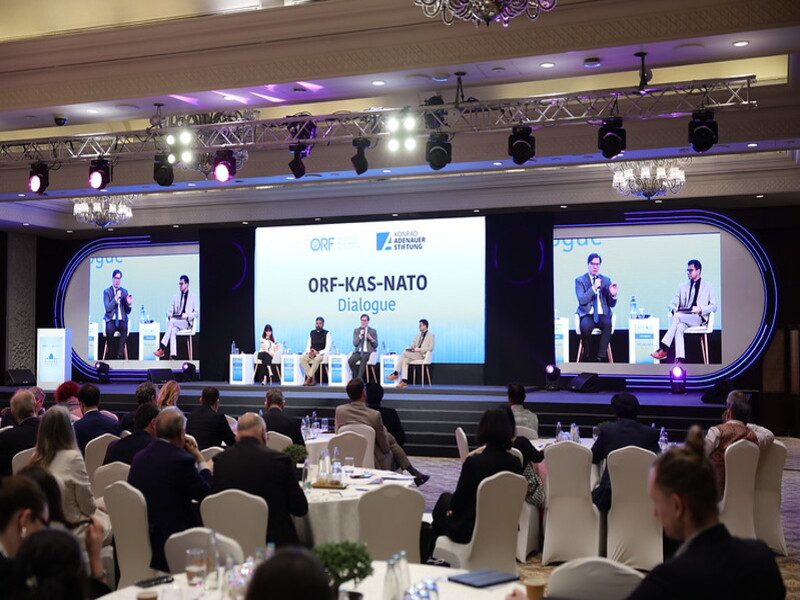
Co-led by NATO Parliamentary Assembly President (PA) Marcos Perestrello and Sub-Committee Chairperson Lorenzo Cesa, roughly twenty parliamentarians from across the Alliance spent the week in Mumbai and New Delhi meeting local officials, military leaders, and think tanks. The visit saw roundtables and policy discussions to “deepen understanding of India’s strategic outlook and explore opportunities for more sustained parliamentary engagement between the NATO PA and the Indian Parliament.” Current NATO-India dialogues are focused on flexible and practical cooperation, and are characterized by the pursuit of common ground over shared interests, namely maritime security, counterterrorism, and digital connectivity.
The PA’s emphasis on strengthening ties with India signals recognition that the world’s most populous country and a leading Indo-Pacific military power shouldn’t remain on the periphery of NATO’s strategic conversations. “Dialogue with key international partners is more necessary than ever before,” Perestrello said of the symbolic visit. NATO has increasingly recognized the Indo-Pacific’s importance, and this brief argues that a more formal relationship with India is achievable through a non-bloc dialogue built on functional cooperation. Aside from India’s growing status, it is also a member of the Quadrilateral Security Dialogue (“the Quad”), alongside the United States, Japan, and Australia, the latter two of which are NATO’s closest Indo-Pacific partners. As the Quad is not a formal military alliance, strengthening India’s relationship with NATO would not detract from the Quad. On the contrary, a deepened relationship between India and NATO could complement India’s position within the Quad.
India sits at the intersection of the Indian Ocean and Pacific maritime corridors, making it geographically indispensable to the Indo-Pacific security framework. Currently, there is no formal NATO-India partnership comparable to NATO’s relationships with the Indo-Pacific 4, which consists of Japan, Australia, New Zealand, and South Korea. NATO offers its Indo-Pacific partners mutual awareness of security developments in the Euro-Atlantic and Indo-Pacific regions. This dialogue matters more now given deepening military ties between Russia and other Asian partners, including North Korea’s provision of troops and munitions for the war in Ukraine.
The challenge between India and NATO is not a lack of shared interests, but a clash due to India’s foreign policy commitments. As a founding member of the Non-Aligned Movement, strategic autonomy has anchored India’s foreign policy identity for over sixty years, evolving from Cold War non-alignment into “multi-alignment”. This means India is maintaining flexibility, often including simultaneous ties with competing powers rather than picking a camp. NATO, being a formal military alliance, carries an institutional commitment that India has historically avoided. Despite being a founding member of the Quad, India actively resists the Quad being defined as a collective or “bound security community,” and avoids framing it as a formal alliance.
India’s oscillation between strategic neutrality and the role of an active regional security provider extends into global politics as well. It is not explicitly pro-Russia, nor explicitly pro-NATO, yet its military ties and voting record still reflect its historically deep relationship with Russia. Throughout the Russia-Ukraine War, India has continued to maintain strong ties with Russia. Russian crude has made up roughly a third of India’s oil imports since 2024, at times exceeding 40 percent. U.S. sanctions in late 2025 briefly pushed that share below 25 percent, before purchases climbed again through the spring of 2026, as the U.S.-Iran war drove oil prices higher, prompting India to return to discounted Russian crude. Since 2022, India has abstained on almost every UN General Assembly resolution condemning the Russian invasion, including a February 2026 resolution as the war continued into its fourth year.
With that said, it is important to recognize that India has made important strides in reducing its dependence on Russia and has actively sought to move away from Russia in favour of closer ties with the West. Russia’s share of India’s arms imports dropped from roughly 70 percent in 2011–2015 to about 40 percent in 2021–2025. The decline also reflects Russia’s own strained capacity to deliver amid its invasion of Ukraine, even as New Delhi has simultaneously diversified toward France, Israel, and its own defence industry. The question now is whether NATO can work with India’s ambiguous positioning rather than around it, and whether a strengthening NATO-India relationship would be conducive to shared interests. A formal NATO-India strategic dialogue is both warranted and achievable, especially in shared maritime security interests such as in freedom of navigation in Indo-Pacific sea lanes, and consultative mechanisms on China’s naval expansion and grey-zone activities. Considering NATO and India share concerns about China’s role in maritime security, the common ground exists to negotiate a practical, interest-based framework to safeguard the region. India’s own 2025 maritime initiative, MAHASAGAR, signals an appetite for this kind of cooperation within maritime domain awareness, defence-industrial ties, and undersea surveillance across the Arabian Sea and Bay of Bengal. However, it remains an initiative without treaty commitment.
The realistic path forward is one where India is not compelled to choose sides. A NATO-India channel is better suited to a longer-term conversation about energy diversification, instead of pressing India to cut Russian oil purchases outright. Alignment should be framed as mutual interest rather than a condition of partnership. Approaching this partnership around an “anti-Russia” or “anti-China” bloc would misread both India’s history and its incentives, and would likely collapse the dialogue before it starts. NATO should instead pursue functional cooperation on the areas above and let shared interest, not shared alliance membership, do the work.
Visits like this are a starting point, as Perestrello himself identified, “This visit is an opportunity for us to listen, learn from each other, and to identify shared security priorities.” Understanding India’s relationships with major powers, and their stakes in geopolitical competition for global stability and economic development, will help NATO build stronger ties with a crucial, growing power. For a Canadian audience, the timing is also notable. The NATO PA visit landed in the same week Prime Minister Mark Carney concluded his own trip to New Delhi, which is Canada’s first bilateral visit by a Canadian prime minister since 2018, following soured relations after the 2023 killing of activist Hardeep Singh Nijjar. This shift suggests India is open to rebuilding networks with Western partners on its own terms, provided the relationship is framed as cooperation between equals rather than a request to align. For western institutions like NATO, this is the opening worth pursuing. Whether the recent visit becomes more than symbolic may hinge on concrete next steps, such as an Individually Tailored Partnership Programme (ITPP) offer to India, the same model NATO already uses with the Indo-Pacific 4.
By Anastasia Crook
Disclaimer: Any views or opinions expressed in articles are solely those of the authors and do not necessarily represent the views of the NATO Association of Canada.
Image: Photograph of NATO Parliamentary Assembly’s first committee visit to India, photo by Raisina Dialogue. Accessed via the NATO Parliamentary Assembly Flickr page.