By Narayan Srivastava
Program Editor, Security, Trade, and the Economy — NATO Association of Canada
The international order upon which NATO was formed has undergone a foundational shift. What began as a transatlantic defensive alliance in 1949 now finds itself navigating an environment in which many of the world’s most consequential military, economic, and geopolitical developments are unfolding well beyond its transatlantic boundaries. The rise of the Global South, particularly actors like India, Brazil, Indonesia, Saudi Arabia, and Iran, has been propelled by their inflating wealth, regional influence, and diplomatic ambition that has expanded their influence intra-regionally, actively seeking to reform international institutions.
While NATO’s treaty commitments remain geographically confined to the North Atlantic, the political, economic, and security consequences of events occurring well outside that space have never been more acute. The war in Ukraine has displayed this vividly. Though the conflict is centred in Eastern Europe, its reverberations have caused a spike in energy prices, with Europe scrambling for alternatives. They have also rerouted global trade flows, with vessels avoiding the Black Sea and Red Sea, redirecting logistics via Africa and driving famine-level hunger in North Africa to South Asia, as Ukrainian grain exports plunged. India and China which are neither members of NATO nor its partners in collective defence now sit at the fulcrum of global diplomacy on sanctions compliance, grain‑deal negotiations, and arms‑technology proliferation. In the Red Sea, Iranian‑backed Houthi attacks on maritime traffic, slashing traffic by 75%, have exposed vulnerabilities in critical infrastructure that lies far from Brussels while having immediate implications for Euro‑Atlantic economies. In this environment, NATO’s ability to shape outcomes depends on its capacity to collaborate with influential actors in the Global South, and not just merely around them.
The central factor in this issue is trade. According to UNCTAD, over 80 % of global trade by volume is carried by sea, and the majority of this transits through narrow maritime chokepoints that are largely controlled by non‑NATO powers like the Strait of Hormuz, the Bab‑el‑Mandeb, the Malacca Strait, and the Suez Canal. Amidst the Iran-US tensions, Iran’s parliament formally endorsed a resolution signaling Tehran’s intention to close the Strait of Hormuz in retaliation for U.S. military strikes. This act would instantaneously threaten roughly 20% of global oil and LNG flows, potentially sending Brent crude surging from ~$75 to over $110 per barrel. Thus, these arteries now sustain global energy markets and manufacturing chains, linking European prosperity to Asian security. India, one of the few democracies with nuclear capabilities has strategically placed itself to be the net security provider in the Indian Ocean, and commands both the will and capacity to ensure maritime stability. But it does so outside of any formal NATO framework. Similarly, China’s Belt and Road Initiative and its control of dual-use port infrastructure in Djibouti, Gwadar, and Piraeus expand Beijing’s influence over very critical trade junctures, which are of importance to several if not all NATO member states. This raises strategic questions about economic coercion and access denial. Meanwhile, the Gulf states, led by Saudi Arabia and the UAE, have emerged as indispensable players in global energy diplomacy, humanitarian relief, and even mediation in conflicts from Sudan to Ukraine. This shift forces a reevaluation of the role these states play in shaping the geopolitical landscape, revealing that they are no longer peripheral actors but increasingly central to the architecture of global stability and strategic decision-making in 2025.
Yet, despite their significance, many of these countries remain outside NATO’s core consultative and operational framework. The challenge now is not whether NATO should include the Global South, but how it can engage these actors in ways that bolster, rather than dilute, its strategic focus of being the upholder of the rules-based international order. NATO’s existing partnership models provide a useful template. Colombia, the alliance’s first partner in the south and United States’ closest partner in Latin America has contributed to counter-narcotics efforts and gained access to NATO training programs. Japan and South Korea, through the “Partners Across the Globe” framework, engage NATO on cyber defence and strategic foresight. These arrangements respect sovereignty, preserve autonomy, and allow for issue-based cooperation without invoking collective defence commitments. They also signal that NATO’s identity as an Atlantic alliance is compatible with a global scope of relevance.
Expanding this model towards India, Brazil, Indonesia, or the Gulf Cooperation Council (GCC) states could enable a broader coalition of actors aligned not by geography, but by mutual interest in maintaining stability. For NATO, the benefits would be profound, including but not limited to early-warning capabilities in volatile regions, resilience in critical supply chains, shared intelligence on hybrid threats, and greater legitimacy as a global custodian of norms. For partners in the Global South, access to NATO’s planning capabilities, cyber infrastructure, crisis response architecture, and capacity-building tools offers tangible benefits as many of these states contend with climate-related instability, terrorism, or gray‑zone threats.
Moreover, such engagement reinforces NATO’s posture against near-peer competitors. Russia’s outreach to Africa through Wagner Group operations, China’s security deals in the Solomon Islands, and Iran’s UAV proliferation across Middle Eastern proxy networks all underscore the need for counter-influence strategies that extend beyond the alliance’s borders. Partnerships with the Global South serve not merely as symbolic diplomacy, but as geostrategic mechanisms through which NATO can prevent adversarial footholds in sensitive regions. This is especially salient in deterring Russian aggression, as the Kremlin increasingly looks to build alternative trade and security alliances with powers in Asia, the Middle East, and Africa, offsetting Western sanctions and international isolation while fueling and funding its aggression against Ukraine.
Needless to say, engagement with the Global South is not without its own complexity. Many of these nations, such as India, maintain strategic ambiguity and prioritize non-alignment, while others like the Islamic monarchies of the Middle East hold domestic governance models that diverge significantly from NATO’s democratic values. Still, engagement does not necessarily require endorsement. It demands a nuance and shared understanding that peace and security are no longer bounded by regional treaties but require transregional architecture. Therefore, NATO’s task is not to transform itself into a global alliance, but to act globally with the tools and alliances it already possesses, while adapting its frameworks to new strategic realities of an emerging multi-polar world order.
In today’s increasingly interconnected global landscape, it is clear that the NATO alliance’s long-term relevance may depend on the scope and depth of its engagement beyond the North Atlantic. The growing influence of the Global South cannot diminish NATO’s identity, but it invites a measured reflection on how that identity can adapt to contemporary security realities. While NATO has not formally sought deeper involvement with these emerging actors, the shifting geopolitical environment makes such engagement increasingly worth considering. The best thing now would be to respond effectively with clarity of purpose, sustained commitment, and diplomacy of strategic finesse.
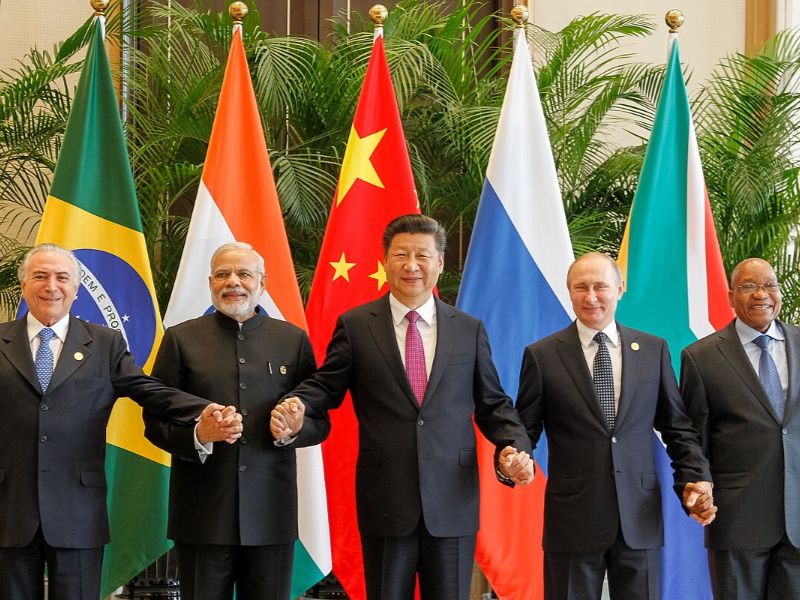
Image: Hangzhou – China, 04/09/2016. Leaders of the BRICS. Photo by Michel Temer. Accessed via Wikipedia Commons. (CC by 2.0)
Disclaimer: Any views or opinions expressed in articles are solely those of the authors and do not necessarily represent the views of the NATO Association of Canada