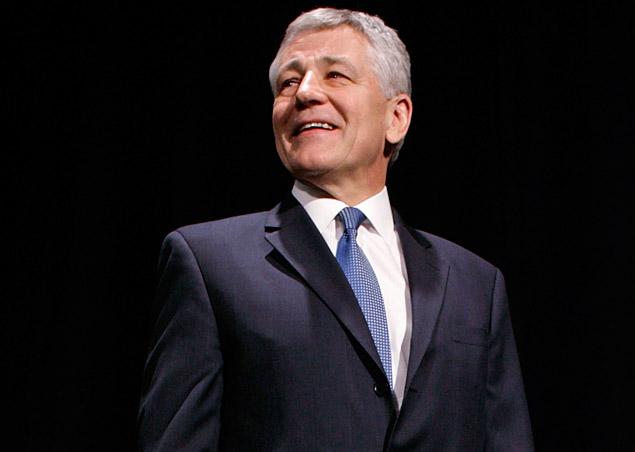
[captionpix align=”left” theme=”elegant” width=”250″ imgsrc=”http://nationalpostnews.files.wordpress.com/2012/12/obama-hagel.jpg?w=620″ captiontext=”Then Democratic presidential candidate Barack Obama speaks in Amman, Jordan while then-Republican Senator Chuck Hagel listens in this July 22, 2008″]
On 17 March 2003, Prime Minister Jean Chrétien announced, to the dismay of both American and British governments, that Canada would not be participating in the Iraq war. In retrospect, it was the right decision. The irony of the Iraq invasion is that order under Saddam Hussein, even of totalitarian dimensions, turned out to be more humane than the lack of order that followed, proving that war as an instrument of change can be counterproductive. The so-called ‘Bush Doctrine’ that set the framework for the Iraq war and its adherents― also known as neo-conservatives―is now in shambles. Their idealistic effort to use American power to promote democracy and human rights abroad have suffered setbacks and ignited international resentment towards American foreign policy, and more importantly, the American people.
Fast-forward to the present day. Once again, the neoconservatives are advocating for military action against Iran. The neoconservative position articulated by people such as Bill Kristol and Robert Kagan, believe history can be pushed along with the right application of power and will, an ideological argument proven not to work in both Iraq and Afghanistan. The belief that American power can be used for moral purposes in Iran seems almost cynical and has already failed in its application. A general concern for democracy, human rights, and the internal politics of Iran is warranted, but ambitious social engineering often leads to unexpected consequences and thereby undermines its own ends.
Universal hunger for liberty will not inevitably lead to liberal democracy as neoconservatives profess, and as Professor Francis Fukuyama points out,
“What is initially universal is not the desire for liberal democracy but rather the desire to live in a modern — that is, technologically advanced and prosperous — society, which, if satisfied, tends to drive demands for political participation.”
Liberal democracy is one of the by-products of this modernization process, but not a guaranteed outcome. Neoconservatives seem to continually overlook this imperative detail. Obama’s choice of former Republican Senator Chuck Hagel to replace the retiring Leon Panetta as his defense secretary is the right decision for both America and Canada. Senator Chuck Hagel is clearly opposed to squandering U.S. power, prestige, and wealth on misbegotten crusades. His well known opposition to wars and willingness to negotiate with opponents is much needed in U.S. foreign policy. Hagel is an independent thinker who wasn’t afraid to challenge his own party when he thought it started heading off the rails under President George W. Bush.
This appointment could affect U.S. policy toward Iran, insofar as Hagel’s past skepticism of the wisdom of using military force remains. Hagel is in opposition to the recent unilateral sanctions imposed by the American government, and is satisfied with containing Iran, as opposed to preventing it from obtaining a nuclear weapon at all costs. His pragmatic view on Iran is more in tune with the reality of Iran’s civilian nuclear ambition, than with fundamentalists who believe a nuclear Iran would spark a full-fledged war and a global economic crisis. A nuclear Iran, in fact, would probably help restore stability and the balance of power to the Middle East. If Iran goes nuclear, Israel and Iran might deter each other, as nuclear powers always have. The treaty signed by India and Pakistan agreeing not to target each other’s nuclear facilities is a prime example.
The appointment of Senator Chuck Hagel could be of great benefit to the Canadian people. Prime Minister Stephen Harper has repeatedly said his foreign policy would see us pick our friends and stand by them. Many Canadian scholars agree―including myself―that America is our most important ally, but this does not mean we should blindly flow them into every conflict they decide to engage in. Under the current regime, Harper has taken a strong principled position in our dealings with other nations and whether popular or not, appears to be unequivocally supporting U.S. military action without second thought. This is a break from previous Canadian governments who have taken a more pragmatic approach to American interventionism.
Canada might be spared from another costly war simply because Obama and Hagel oppose direct military action in Iran. Canada could not unilaterally intervene in Iran, and Prime Minister Harper would certainly join a coalition of allied powers lead by the U.S. for coercive regime change in Iran, given the harsh rhetoric and action from the Harper government taken towards Iran.
Chuck Hagel as the next Secretary of Defense is the best defense against another protracted and costly war that Canada cannot afford. Maintaining support for Israel’s right to exist and to live in peace with its neighbours should remain a strong state prerogative. But with war fatigue from Afghanistan still in effect, using economic and diplomatic penalties provides Canada with low-cost, low-risk alternative to military action. Military intervention will produce unforeseen consequences and further alienate the West from the rest.
With a 5 per cent budget cut to defense, Canada is hardly in the position to engage is another war. Instead, Canada should take to the diplomatic forum to persuade other nations the need to apply, collaboratively, harsher sanctions in order to steer Iran away from a nefarious nuclear ambition. Sanctions have been effective in isolating governments such as North Korea, Myanmar, Syria, and Iran.
It will remain to be seen if Hagel can resist the powerful proponents of military engagement with Iran. Détente is needed evermore during this polarizing era. The preservation of peace in the Middle East is at a critical low, and it will take somebody with strong will to prevent chaos from ensuing and order from evaporating. Hagel could be that someone. Hagel is Canada’s best bet to keep Prime Minister Harper’s ideological stance on Iran in check.