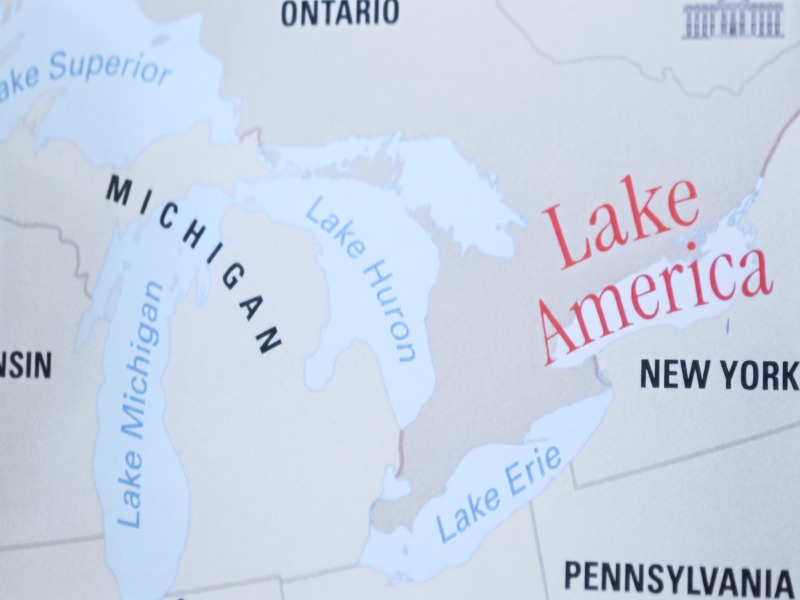
As of August 2026, Canada and the United States’ trade relationship has continued to deteriorate toward a new low. As trade negotiations continue to degenerate into an all out trade war, one of the immediate reactions by the United States has been to aggressively assert its dominance by officially renaming Lake Ontario to ‘Lake America’ in a White House executive order. A similar manoeuvre was conducted on January 20th, 2025 when the White House signed an executive order to rename the Gulf of Mexico to the ‘Gulf of America.’ The ongoing conflict between Canada and the United States was intensified because of Prime Minister Mark Carney’s rejection of a trade deal due to his reluctance to agree to conditions that he perceived could potentially weaken Francophone culture in Canada. Carney’s assertion that the United States’ terms involving the Francophone culture would weaken it to favour American companies have been contested by Jamieson Greer, an American trade representative, who took much offense when accused of Francophobia. With the deteriorating relationship between Canada and the United States, it is important to highlight the difference in perspectives between American and Canadian public officials regarding the ongoing trade negotiations, and the implications of the rename both within Canada and on the international stage.
The controversial aspect of Bill 109 that American negotiators wanted to amend was to remove the requirement of American companies to adhere to Canadian (Quebec) policy that streaming and online video companies must promote Canadian and French language content. Greer explains that American companies have issue with upholding this policy, specifically with regards to company spending, and the idea that Canadian companies benefit in exposure from American earnings. Despite the heavy defense of their trade negotiation, Greer changed his tone in his efforts to have the Bill amended, recognizing the “sensitive” nature regarding the French language in Canada. However, Greer’s acknowledgements were ineffective due to the retaliations by the Trump administration. These actions killed the trade negotiation as the executive order to rename Lake Ontario undermined any of Greer’s efforts to de-escalate the tensions between the two nations.
A worrisome aspect of the name change was that it highlighted Canadian technological dependence on the United States. Justin Li and Kevin Maimann of CBC note that “some Canadian websites, including for the federal government, displayed maps with Lake Ontario renamed as Lake America on [August 30th], a day after Google Maps announced the change to align with an executive order by US President Donald Trump.” The appearance of ‘Lake America’ on Canadian websites was the result of Canadian dependence on American technology. As a result, the geographic database of Canadian sites often reflects the United States’ display preferences. For reference, the Canadian Anti-Monopoly Project from May 2026 found that Amazon, Google, and Microsoft (three American companies) dominate the technology sphere in Canada with the three giants holding 85% of Canadian public cloud market share compared to the global average of 66%. Tech analyst Carmi Levy emphasizes Canada’s position by describing Canadians as “stuck”, given our technological disadvantaged position.
With that said, not every American map application immediately adhered to Trump’s rename. In fact, MapQuest, a competitor to Google Maps, saw a surge in popularity and downloads in both Canada and the US as a result of its firm stance to keep Lake Ontario. When asked about the decision, Doug Berger, the General Manager of MapQuest, explains that their choice to keep using Lake Ontario was to ensure their app used the names of places their users were familiar with. This decision caused a surge in popularity for the app as it reached the number one position on Apple’s U.S. App Store Free Chart on September 1st, 2026.
Though Berger’s approach to this situation appears diplomatic at first glance, the decision to change (or to not change) a name is political in nature, regardless if it is Lake Ontario, the Gulf of Mexico, or within broader imperial contexts. It is problematic for international organizations, including NATO, to allow a state to unilaterally rename any sort of international physical entity (for example, a body of water or territory) because it sets a dangerous precedent for allowing a state to spread its influence through names. This is especially concerning for international organizations, given there are no universally recognized international bodies for renaming international territory. Mexico argued against the actions of the United States’ on the basis that a single country cannot rename a shared body of water. With the United States’ decision to rename international bodies, these entities now possess regional names, though there is an emphasis on strengthening American influence, and weakening Canadian and Mexican sovereignty. This is reflected by Google Maps’ decision to show different users the various names depending on their regional locations. However, despite the efforts to respect the internationally accepted names, Google Maps still implemented and incorporated the names ordered by the United States in international contexts. For example, users in Mexico see “Gulf of Mexico,” users in the United States see “Gulf of America,” and other nations see “Gulf of Mexico (Gulf of America).”
Beyond the ongoing Canada-American trade conflict, the use of renaming campaigns have been used to reflect political stances regarding conflict. For example, in response to the Russian invasion of Ukraine in 2022, Western media popularized the Ukrainian spellings of cities. However, the Ukrainian government had been attempting to have the spellings popularized since 1991, with a state mandate in 1995. The decision to respect Ukraine’s official de-Russification process is denoted by adhering to these changes. For example, using Kyiv instead of Kiev, Lviv instead of Lvov, and Kharkiv instead of Kharkov. Alternatively, there are also media outlets and governments that intentionally use the Russified spellings to signal their animosity towards Ukraine. These bodies do so to contribute to the attempted validation of anti-Ukraine narratives such as “everyone in Ukraine speaks Russian” and “Ukraine is a former part of Russia.”
The significance of the name extends beyond simple vernacular. In the case of Lake Ontario, the White House’s justification for the rename neglects the historic origins of the name, and instead chooses to justify the change as a means of imposing influence. In Executive Order 14422, the White House Order to enact the name change, the document explains that their mission is to “recognize the extraordinary contributions of the American people and the rich heritage of our history by renaming the great natural landmarks for our shared achievements.” It neglects the proper origins of Lake Ontario’s name which predates both the Canadian Confederation and the United States’ Declaration of Independence, as Mark Carney argued following Trump’s decision. The word Ontario comes from the Wendat “Ontari’io” meaning “the lake is beautiful” or “the lake is big” as identified by The International Association for Great Lakes Research. The name was adopted gradually by settlers since their arrival in the seventeenth century, who ultimately opted to use the Indigenous name rather than their own initial names for the lake.
The decision of the United States to rename Lake Ontario to assert their dominance and power in the region threatens Canada’s current position, and the nation should continue to resist the normalization of the United States’ rename of the lake. It is difficult for a middle power, such as Canada, to resist the superpower of the United States, however Canada should continue to defend its sovereignty. It is especially crucial to do so in situations similar to the Lake Ontario rename because they are important acts of resistance within Canadian capabilities, and it reflects the unwillingness to be consumed by the United States’ ambitions.
Photo: “Photo of Lake Ontario at the Whitehouse during Executive Order renaming Lake Ontario to Lake America on August 27th, 2026” (2026), The White House, Public Domain.
Disclaimer: Any views or opinions expressed in articles are solely those of the authors and do not necessarily represent the views of the NATO Association of Canada.