The People’s Republic of China [PRC]’s growing soft power through the online ‘Chinamaxxing’ trend, has become a direct representation of young audiences’ disillusionment of the U.S.-led liberal international order [LIO]. This trend, which sees the popularizing of Chinese culture, gained traction towards the end of 2025 and became viral on social media platforms—such as X, TikTok, and Instagram—in Western countries in the first few months of 2026. The suffix of the word, ‘maxxing’ is slang which means ‘to fully embrace’ or “to go all in to something.” The trend features users posting videos and pictures of themselves enjoying and participating in everyday aspects of Chinese culture, such as drinking warm water in the morning and playing mah-jong, while describing themselves as being in a “very Chinese time in their lives.” This increased cultural popularity—largely sustained by non-Chinese creators in Western states rather than by Beijing itself—reflects the disillusionment of American-led liberal values rather than a direct appreciation of Chinese politics or policies. According to Alicja Bachulska, a policy fellow of the European Council on Foreign Affairs, the only change is the perception of China, not the country itself.
Behind the Trend
The LIO is the rules-based international system led by the United States, grounded in principles of open markets, human rights, and liberal democracy. It began following WWII, and experienced a significant expansion after the collapse of the Soviet Union in the early 1990s. In the last decade, scholars have warned of the end of the LIO, especially with the election of U.S. President Donald J. Trump and the Russian invasion of Ukraine.
Trump’s second election to power in 2024 has posed a greater threat, not only toward NATO’s integrity—through his criticism of Europe’s financial contribution for the Alliance and his implicit suggestion of withdrawing the U.S. from NATO—but also on Canadian sovereignty and territorial integrity. In response, Canadian attitudes have shifted from perceiving its neighbour as a close and historic ally to a “charged, almost militant” stance. U.S. Secretary of State Marco Rubio’s declaration of national interest taking precedence over the international order signified, for many Canadians, the departure of America’s “benevolent leadership” as the liberal hegemony.
Following the World Economic Forum in January of 2025, where he gained praise amongst Western powers for his call for middle powers to stand in solitary against great powers’ exploitation, Prime Minister Mark Carney has prioritized directing Canadian foreign policy to diversify its economic partners. Just days before 2026 Annual Meeting in Davos, Carney paid a state visit to Beijing, where he strengthened an economic partnership with China, including increasing the import of Chinese electronic vehicles to Canada, lowering Chinese tariffs on Canadian goods, and introducing visa-free access to the PRC for Canadians as part of its commitment for cultural exchange. The correlation between Carney’s trade deals with the PRC and the virality of the Chinamaxxing trend contributed to a new cultural discourse surrounding Canada-China relations. The start of 2026 saw the public support of Canada’s partnership with a nontraditional partner and the cultural distancing from the LIO and American culture.
However, the rise of the Chinamaxxing trend cannot be attributed as the causation of the cultural discourse for the support of partnership with the PRC in Canada. The face of the trend is the American-Chinese content creator Sherry Zhu, revealing the trend began in the United States on American social media platforms, and slowly popularized to Canada and Europe.
In contrast to Trump’s second presidency, which has seen the brutal crackdown of immigration and the subsequent decline of the U.S.’ global image, the PRC’s “strategic silence” to global events and crises has become “a pillar of stability,” fueling the favourability of ‘Chinamaxxing’ trend on digital platforms. As the polar opposite and rising power, China becomes the cultural ‘safe haven’ for discontented Americans. With 30 million Canadian users on Facebook and 14 million on X, Canadians are heavily influenced by U.S. media, and the new trend has unsurprisingly caught on and resonated for many Canadians.
Reducing Cultural Friction
The popularization of Chinese culture has come as an unexpected trend, with many Chinese-Canadian creators calling it “jarring” especially after experiencing strong xenophobic sentiments throughout the COVID-19 pandemic. Although many do not expect the trend and the excitement to be permanent, this temporary momentum can still reduce cultural differences between the Chinese diaspora and other communities in Canada and xenophobic sentiments.
Historically, as well as in prior years, Canada’s foreign policy and stance towards the PRC, a nondemocratic state, has almost always aligned with the U.S., NATO, and the European Union. Since the start of the twenty-first century, the PRC’s rapid economic growth and increasingly assertive foreign policy has been characterized as a threat to the post-Cold War, unipolar liberal international system. The majority of cultural discourse prior to the ‘Chinamaxxing’ trend have perceived Chinese culture as a threat to security and economics, and whose governance has resulted in human rights violations.
Although some have attributed the trend’s memes as cultural appropriation and orientalism, the new trend is instead pushing back against prior negative Western discourse through demonstrating another side of the PRC’s identity. For many young Chinese-Canadians, who have felt ashamed of their culture growing up, the trend does not feel as though “they’re laughing at us, but it’s almost like we’re laughing together.” Given the large Chinese diaspora in Canada, the reduction of friction between the diaspora communities within Canada as well as the Canadian public’s multifaceted perception of China, can result in the strengthening of Canada’s social fabric, resulting in stronger sovereignty strengthening through domestic cohesion.
The Trend as a Potential Threat
Although the virality of ‘Chinamaxxing’ can bridge the gap between the Chinese diaspora in the West and their respective host countries, experts also warn that the unchecked growth of the soft power can potentially lead to Beijing’s exploitation, further undermining the liberal international order.
The growing interest in the culture is not one that remains superficial. Whether the online jokes are cultural appropriation or not, interested social media users are actively choosing China as their next travel destination and learning more about the culture itself. This has not gone unnoticed by Chinese officials. Foreign tourists to the PRC have increased, reaching a record of 35 million foreign tourists in 2025. The government of Huangshan noticed a doubling in foreign tourism in 2025 compared to 2024, following the increase in the popularity of Chinese culture on Western social media platforms, which are not accessible through China’s Great Firewall.
Given the Chinese officials’ awareness of foreign interest, as well as their acceptance of many Western democratic states’ economic and strategic hedging against the United States, a lack of control over Beijing’s growing soft power can result in its convergence with hard power. Since many stable global democracies have begun to view the United States as a greater threat than the PRC, the PRC’s growing soft power can allow it to leverage diplomatic negotiations in their favour, and likely against the liberal international values.
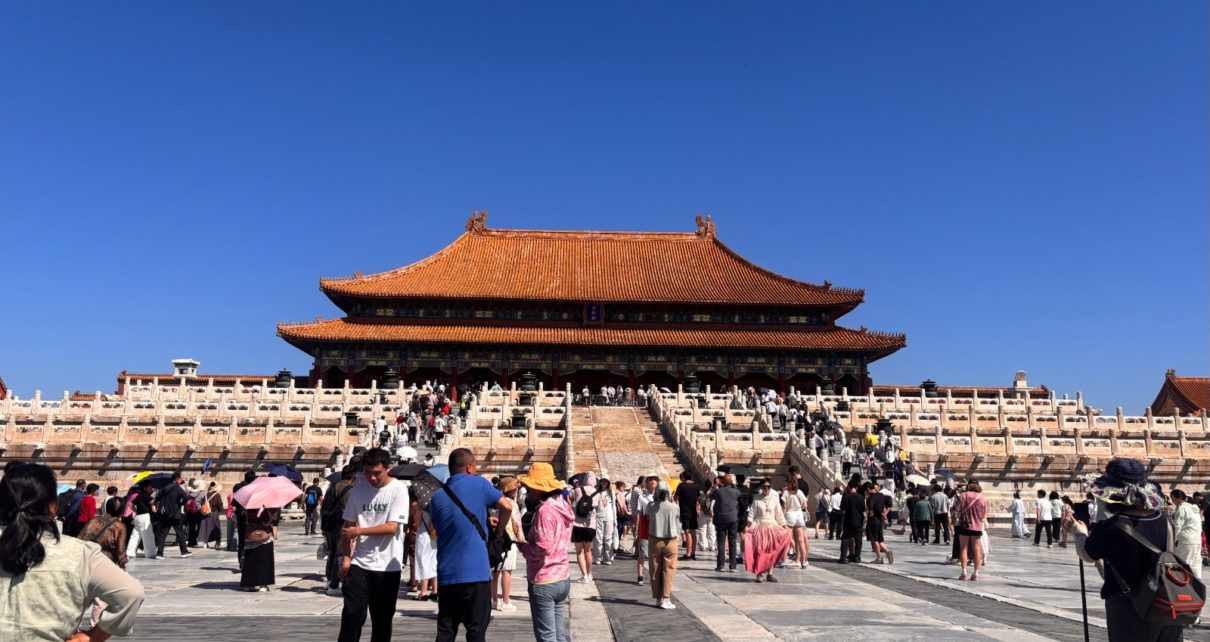
Photo: The Palace Museum in Beijing receives visitors from around the world every year. This photo was taken on September 1st, 2026, during one of its peak tourist seasons. (September 2026). Taken by and used with permission of the author.
Disclaimer: Any views or opinions expressed in articles are solely those of the authors and do not necessarily represent the views of the NATO Association of Canada.