Nepal’s rapid political upheaval has emerged less as an isolated event and more as a case study for a global trend. It covers the increasing fragility of democratic institutions in the face of popular mobilization, especially among digitally connected youth. This has important implications on political stability worldwide, as these events are not limited to developing nations and have large consequences on international security and foreign policy. To understand this further, let’s unravel what happened in Nepal first. On 4 September 2025, Nepal’s government imposed a sweeping ban on 26 social media platforms, including Facebook, Instagram, WhatsApp, YouTube, and X, citing non-compliance with new registration rules under the Ministry of Communications. The move sparked mass youth outrage predominantly among ‘Gen Z’, who saw the ban as part of a broader issue of corruption, nepotism, and authoritarianism of Prime Minister K.P. Sharma Oli’s government.
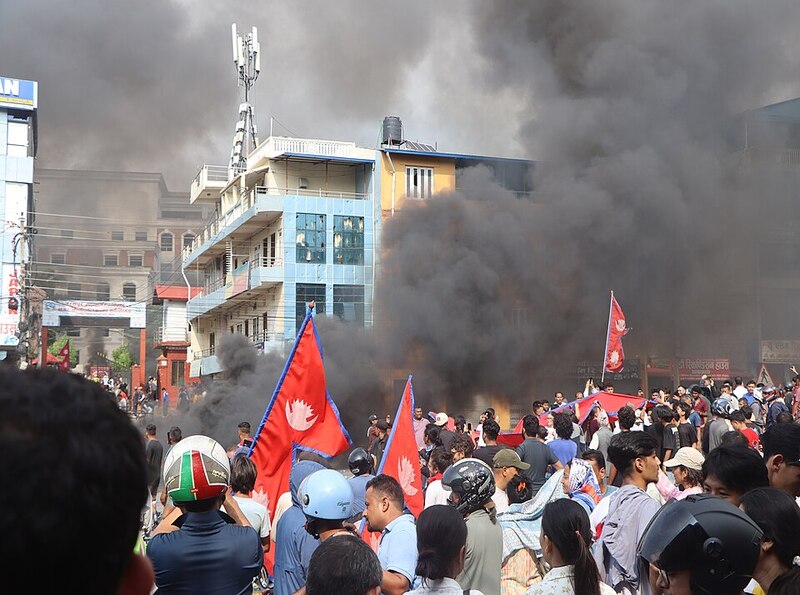
By September 2025, large-scale protests broke out across Kathmandu and other cities. Security forces used tear gas, water cannons, and rubber bullets. This escalated when security forces used live ammunition, leading to the deaths of around 19 people and hundreds of injuries. Protesters stormed key government buildings, including Parliament, and set parts of the capital alight, highlighting the depth of popular anger. Under mounting pressure, an emergency cabinet meeting was held, and the government lifted the social media ban on September 9. On the same day, Prime Minister Oli resigned, saying he would step down to help “resolve the problem politically.”
The government’s overthrow was not just about social media. The protests crystallized long-standing frustration among young people with elite capture, corruption, and weak institutions. Similar expressions of what could be called “anti-bureaucracy movements” can be seen throughout Latin America, Eastern Europe, Southeast Asia, and portions of Africa. Systemic failure rather than ideology is the main complaint of the local population. Three interconnected structural factors that are more broadly applicable and worldwide in scope are revealed by an analysis of these movements.
First, demographic pressures play a central role. Globally, South Asia, Latin America, and Sub-Saharan Africa continue to have disproportionately large youth populations, which raises expectations for economic participation that many states fall short of. This trend is best seen through the high rates of youth unemployment in Nepal, made worse by the nation’s structural dependency on remittances and the lack of local possibilities.
Second, the decline of trust in institutions has emerged as a key factor explaining political chaos. Global surveys, including the World Values Survey and the Varieties of Democracy Project, demonstrate that public trust in political parties and bureaucracies is steadily declining. This decline correlates strongly with both the intensity and speed of protest mobilization in multiple contexts. These uprisings show how democratic erosion triggers active civic responses. Nepal’s recent crisis reflects a similar dynamic, and therefore, this article suggests not looking at its political overthrow in isolation. In Nepal, years of institutional stagnation created a widespread perception that governance primarily serves elite interests rather than the general population. This frustration intensified when social media exposed the luxurious lifestyles of “nepo-kids” (a term that developed to describe the children of bureaucrats and public servants), further amplifying public anger and mobilization. The recurrence of these patterns across geographically and politically divergent contexts highlights a broader phenomenon. Institutional trust is a critical stabilizer for democratic resilience. This shows that when trust erodes, civic mobilization becomes both more rapid and more intense.
Third, digital connectivity has transformed the speed and scale of mobilization. Studies of the 2019–2023 protest waves in Iran, Myanmar, and Tunisia show that online platforms accelerate message dissemination, reduce transaction costs for participation, and allow narratives of systemic injustice to transcend local contexts. The same pattern was seen in Nepal;the mobilization around the social media ban exemplified this digital dynamic. The population made use of online networks to coordinate protests and demands, resulting in rapid responses that ultimately led to leadership changes. Comparing this across different regional contexts highlights that these structural factors are not exclusive to emerging democracies. This trend can in part explain the recent victory of Zohran Mamdani, whose campaign was built on youth mobilization against corruption and a demand for transparency in governance. His image as a young, working-class-aligned candidate challenging political elites fits perfectly within this global pattern, which helps explain why voters supported him despite opposition from the US President, who labelled him a ‘communist’.
The structural parallels suggest that these movements are less episodic and more systemic. Across the Indo-Pacific, youth-led anti-corruption and governance protests have emerged as a defining force reshaping political landscapes. In Sri Lanka, widespread demonstrations in 2022 erupted after an economic crisis highlighted by gasoline shortages, inflation, and claims of government corruption. President Gotabaya Rajapaksa resigned, and the cabinet was drastically reorganized as a result of the protests, which were mostly led by young people and spread via social media. This marked a major rejection of long-standing elite governance. Recently, in 2024, a significant political revolution in Bangladesh was brought on by persistent public criticism over corruption and administrative overreach. This ultimately compelled Prime Minister Sheikh Hasina to flee to India. As a result of the crisis, the government’s foreign policy underwent a significant realignment, with officials attempting to rebalance their relationship with India and shifting toward stronger connections with China and Pakistan. This shift reflected both domestic turmoil and an attempt to restore sovereignty. In South Korea, public resistance pushed the government to revoke martial law declarations, illustrating that even formidable institutions in developed countries can be challenged and restricted by organized civil action.
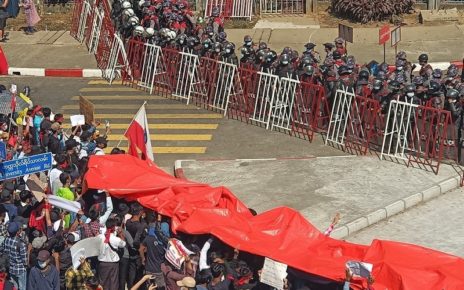
In Southeast Asia, Thailand’s 2020 pro-democracy movement involved large-scale youth mobilization, in which social media played a key role in organizing and amplifying demands. Myanmar experienced massive protests in 2021 after a military coup, when citizens challenged the legitimacy of the state and bureaucratic authority. These events show how populations protest structures they perceive as illegitimate, much like in Nepal.
This distinction is significant because it reframes political instability as a test of governance rather than a threat to regime legitimacy. Civic-led upheavals and government changes across the Indo-Pacific, such as Sri Lanka’s pivot away from China, Bangladesh’s realignment toward China and Pakistan, and South Korea’s domestic recalibrations, demonstrate that even governments retaining popular support for their democratic framework can face sudden political crises. These transformations have direct geopolitical consequences, impacting regional alliances, economic partnerships, and strategic balances of power, as states navigate both domestic accountability concerns and international ties.
International organizations and alliances that depend on stable governance for strategic calculations can benefit from this viewpoint. The European Union, NATO, and countries like Canada are becoming more aware of the strategic value of democratic resilience. The decline of institutional trust in even non-member states has consequences for regional stability and partnership dependability for NATO, whose structure is founded on predictable, rules-based collaboration among member states and aligned allies.
The global rise of digitally mediated protests introduces questions about the nature of democratic engagement itself. The pattern observed in Nepal, mirrored by other countries worldwide, suggests the emergence of a “digital democracy” ecosystem in which social triggers like viral content, online petitions, and rapid dissemination of narratives can compel institutional action or provoke systemic stress. In this emerging political scenario, governments face dual pressures of maintaining responsive bureaucracies and engaging with digitally empowered populations whose expectations and grievances operate at unprecedented speed.
The lessons are loud and clear. If the global wave of anti-bureaucracy protests continues, it may mark the emergence of a new era of digital democracy in which the speed and reach of social mobilization fundamentally dictate the relationship between citizens, institutions, and global alliances like NATO. Nepal is not an exception but a preview of the challenges facing democracies worldwide. It is important to see this as a signal that adaptation, both domestic and international, is essential for sustaining political stability.
Photo by Himala Suvedi – Own work, CC BY-SA 4.0 – Accessed by Wikimedia Commons 2025
Disclaimer: Any views or opinions expressed in articles are solely those of the authors and do not necessarily represent the views of the NATO Association of Canada.