In 2025, with the start of Donald Trump’s second U.S. presidential term, Ukraine faced a dramatic shift in the American position on providing it with direct military support. The United States — previously Ukraine’s main supplier of military equipment, covering roughly 30% of Ukraine’s defence needs — has now completed the delivery of aid packages approved under former President Biden. The new Trump Administration has not approved any additional aid packages in 2025. Instead, U.S. policy has shifted toward attempts – so far unsuccessful – to broker a ceasefire or peace agreement between Russia and Ukraine, using the delivery of critical American equipment as leverage against Kyiv.
Under these challenging conditions, Ukraine’s other international partners, including Europe and Canada, had to adapt by increasing their military assistance to the war-torn country and launching a new initiative aimed at financing the purchase of American equipment with their own funds.
Canada’s Bilateral Support to Ukraine
According to the German-based Kiel Institute’s tracker of support to Ukraine, Canada ranks fifth among donors by total assistance allocated between January 24, 2022, and October 31, 2025, having provided €13.36 billion (CAD $21,5 billion) in financial, humanitarian, and military aid. The Government of Canada reports that CAD $6.5 billion has been allocated specifically for military assistance to Ukraine, which will allow Canada to continue delivering this support through 2029.
On Ukraine’s Independence Day, August 24, Prime Minister Carney made an unannounced debut visit to Kyiv, where he pledged a substantial CAD $2 billion package of military support.
The current delivery projects listed as “in progress” on the Global Affairs Canada website include donations across several key military capability areas:
- Air defence: Donation of AIM-9M rocket motors and various AIM-7 rocket motors and ancillaries that the Armed Forces of Ukraine (AFU) can use for ground-based air defence and drone applications, as well as AIM-7 missile components from surplus CAF equipment.
- Air Force Capability Coalition: Donation of flight simulators built by CAE to support F-16 pilot training for the AFU.
- Electronic warfare (anti-jammer kits): Donation of EW anti-jammer kits from Canadian defence industry partners.
- Military clothing and gear: Donation of Cold Weather Safety Boots and CAF clothing and other equipment.
- Medical equipment: Donation of combat medical kits for AFU personnel trained under Operation UNIFIER, along with other critical medical equipment sourced from Canadian industry.
- Commercial-pattern vehicles: Donation of Coyote and Bison armoured vehicles.
- Rocket launchers: Donation of LAU-7A rocket launchers from surplus CAF stocks.
- Small arms: Donation of small arms and ammunition sourced from the Canadian industry.
What has already been accomplished throughout 2025 includes a $12 million contribution to the Drone Capability Coalition’s Common Fund to strengthen Ukraine’s drone capabilities, as well as a $100 million contribution to the Danish Model to support the production of military drones by Ukraine’s domestic defence industry, plus an additional $40 million to provide urgently needed capabilities to the AFU through the same mechanism.
Canada has also supported the Leopard 2 Maintenance and Repair Facility in Poland and donated $60 million for 16 MX-15 EO/IR imaging systems and 13 MX-20 EO/IR imaging systems. In addition, Canada has donated more than 80,000 CRV-7 rocket motors and 1,280 warheads from CAF inventory to Ukraine.
On a less positive note, Canada canceled its plan to transfer 25 repaired light armoured vehicles to Ukraine in October 2025. The reasons for this decision remain undisclosed, with officials citing “trade secret obligations.”
Canada participates in several international Capability Coalitions coordinating support for Ukraine, including the air force, drone, armour, and IT coalitions. It also joined the Coalition of the Willing initiative, led by the United Kingdom and France, and announced in 2025. The Coalition of the Willing brings together European Union countries, NATO members, and states outside these blocs that are committed to supporting Ukraine. The Coalition of the Willing emerged as a response to shifts in the United States’ role in coordinating military support for Ukraine, with European leaders stepping in to take on greater responsibility.
Prioritized Ukraine Requirements List (PURL): Canada’s Contribution
Following the shift in U.S. policies, in August 2025, NATO and the United States launched a new mechanism to support Ukraine through the Prioritized Ukraine Requirements List (PURL) initiative.
Its goal is to ensure the rapid delivery to Ukraine of weapons and systems that the United States can supply in large quantities, strengthening Ukraine’s position and creating the conditions for a just and lasting peace.
The new mechanism allows Ukraine’s partners to contribute financial donations to a fund that is then used to purchase American systems.
The most urgent priorities for Ukraine are air-defence systems (such as Patriots) and air-defence missiles, which Ukraine desperately needs to repel Russian ballistic missile attacks targeting civilian infrastructure.
In August 2025, Canada announced a $680 million package and allocated an additional $200 million in December for PURL-related acquisitions. These funds will be used to purchase U.S.-sourced equipment intended to strengthen Ukraine’s air defence and provide other critical military assistance.
Ukraine is expected to receive USD $5 billion in weapons under the PURL program by the end of 2025. According to the Head of Ukraine’s Mission to NATO, currently about 75% of Patriot interceptor missiles and roughly 90% of interceptors for all other air-defence systems reach Ukraine exclusively through the PURL mechanism.
Canada Considers Joint Drone Production with Ukraine
Separate attention should be given to the launch of Ukraine’s “Build with Ukraine” initiative, announced by President Zelensky in June 2025. The initiative aims to establish joint co-production facilities in partner countries to offshore the manufacturing of critical equipment for the Armed Forces of Ukraine — equipment whose domestic production is increasingly at risk due to intensified Russian strikes.
According to the Defence Minister David McGuinty, Canada is assessing the possibility of a defense co-production arrangement with Ukraine that would involve joint manufacturing of military equipment, including drones.
In August, Canada announced a CAD $220 million contribution to acquire drone, counter-drone, and electronic-warfare capabilities, including investments in joint ventures between Ukrainian and Canadian industries. This support aligns with the Letter of Intent on Canada–Ukraine Joint Production of Defence Materiel, signed on Ukraine’s Independence Day by President Zelensky and Prime Minister Carney in Kyiv. The document confirms Canada’s intention to finance the joint production of Ukrainian-origin defence materiel in both Canada and Ukraine, to support Ukraine and enhance jointly manufactured systems.
Areas such as unmanned technologies and counter-UAS systems, where Ukraine has developed the world’s most battle-tested expertise, represent the strongest opportunities for Canada to deepen cooperation and modernize its own capabilities.
Canada Further Sanctions Russia
In 2025, Canada also strengthened its sanctions regime against sectors that generate significant revenue for Russia. The latest round of measures, introduced in November 2025, is designed to intensify economic pressure on Moscow by targeting its energy income and financial facilitators. The package includes sanctions against 13 individuals and 11 entities; among them are several organizations connected to the development and deployment of Russia’s drone program.
Since 2014, Canada has sanctioned more than 3,300 individuals and entities involved in violating Ukraine’s sovereignty and territorial integrity or responsible for serious human rights abuses. Working alongside allies and partners, Canada has also taken action against Russia’s “shadow fleet,” sanctioning over 400 vessels used to transport goods and assets for the benefit of Russia or Russian-linked actors.
Canada’s efforts to support Ukraine have not gone unnoticed. In 2025, Forbes Ukraine named Canada “Ukraine’s top friend.” The country ranked first among 21 states providing the most support to Ukraine during the full-scale war, based on key indicators such as the volume of financial assistance, the number of Ukrainian refugees accepted, reductions in imports from Russia, and the revenues of domestic companies operating in Russia.
In 2026, despite ongoing attempts to reach a Russia–Ukraine peace agreement, hostilities are likely to continue in one form or another. At the same time, with or without a peace deal, Ukraine sees its future in building strong domestic military capabilities and forming technology-sharing partnerships with its most trusted allies, including Canada. This creates significant opportunities for both countries to deepen their military cooperation and apply lessons learned from the war with Russia to strengthen Canada’s sovereign defence capabilities.
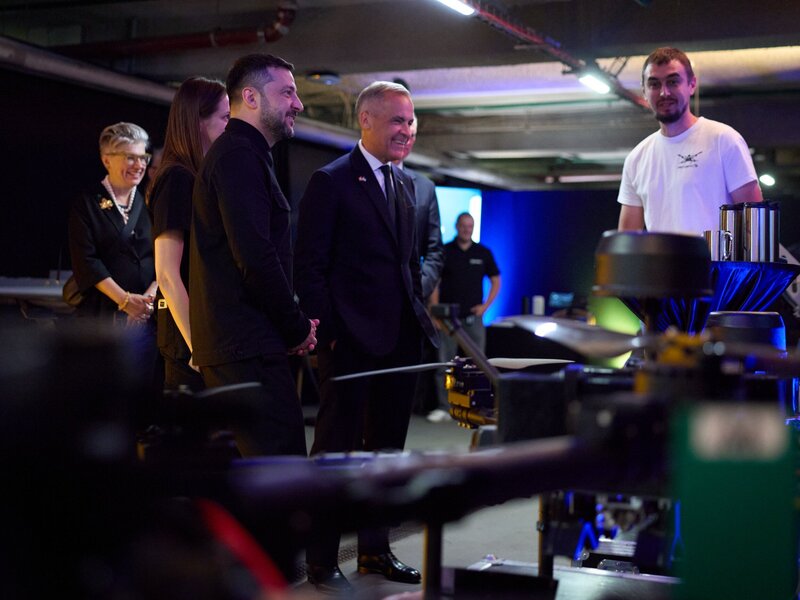
Photo. President Zelensky and Prime Minister Carney took part in a forum dedicated to defence cooperation and the production of equipment for the needs of modern warfare. Credit: Office of the President of Ukraine(used with permission).
Disclaimer: Any views or opinions expressed in articles are solely those of the authors and do not necessarily represent the views of the NATO Association of Canada.