
Introduction
“Tomorrow is the day of retribution, the day in which I will have my revenge against humanity, against all of you.” These were the words of Elliot Rodger in a YouTube video he uploaded the day before he carried out the 2014 Isla Vista killings, murdering six people and injuring fourteen others. Driven by a deep hatred of women, Rodger wrote in his 141-page manifesto: “They denied me a happy life, and in return I will take away all of their lives. It is only fair.” More than a decade later, Rodger has been glorified as “The Supreme Gentleman” within incel, or “involuntary celibate,” communities, where subsequent attackers invoke his manifesto and videos as ideological inspiration. Most recently, this pattern has emerged in Canada, where a shooting in Montreal left a civilian, a police officer and the attacker dead. Like Rodger, the perpetrator left behind a lengthy manifesto in which he identified with the incel subculture, a movement situated within the broader network of male-oriented online communities commonly referred to as the mansosphere.
For years, incels have been dismissed as a fringe internet subculture, caricatured as isolated, socially disconnected young men venting their frustrations online. Yet, such a characterization overlooks a far more troubling reality. Many incel spaces operate as self-reinforcing disinformation ecosystems that cultivate conspiratorial worldviews, deepen distrust of democratic institutions and legitimize violence against women and others perceived as embodying the social order they reject. Reflecting the dynamics of “salad bar” extremism, these communities selectively combine statistics, pseudoscientific claims, and narratives drawn from multiple ideological traditions across online platforms to construct an alternative system of knowledge that normalizes misogyny and becomes resistant to outside challenge. The consequences of these ecosystems extend well beyond the digital sphere. Canada has experienced multiple violent attacks linked to incel ideology, reflecting a broader global pattern that has been associated with approximately 90 deaths and more than 100 injuries since 2014. Several perpetrators have explicitly cited previous attackers as sources of inspiration, illustrating that while these attacks are carried out by lone actors, the radicalization that precedes violence is fundamentally collective, emerging from transnational online communities that continually reinforce and legitimize these beliefs.
As these digital communities expand, they increase vulnerability to radicalization, facilitate ideologically motivated mass-casualty violence, and erode the shared standards of truth upon which democratic societies depend. Consequently, conspiracy-driven misogyny should no longer be understood as merely a form of violent extremism, but as the product of transnational disinformation ecosystems that construct alternative systems of knowledge capable of justifying violence, making it an emerging national security concern for Canada and NATO member states alike.
What Are Incels?
Incels constitute a distinct subgroup within the broader manosphere, a network of predominantly male-oriented online communities found across chatrooms, forums, podcasts, and social media platforms. These spaces often function as echo chambers in which feelings of male entitlement, resentment, and anger are reinforced, while rigid and often aggressive conceptions of masculinity are normalized. While the communities that make up the manosphere differ in their beliefs and objectives, they are generally united by discussion surrounding masculinity, gender relations, and the perceived consequences of feminism and the sexual revolution. Central to the politics of the incel ideology is the vocabulary of “pills,” borrowed from The Matrix, which distinguishes incels from other manosphere belief systems. Less extreme proponents of the incel movement subscribe to the “blue pill/red pill” duality, where the “blue pill” represents those who reject and are unaware of this ideological framework, and the “red pill” represents those in the manosphere who have “awakened” to feminism’s brainwashing and how males have been oppressed. Once aware of this, those who take the red pill endeavour to improve their social standing through what is known as “looksmaxxing,” the practice of enhancing one’s physical appearance in the hope of becoming more attractive to women. This can range from relatively conventional methods, such as skincare routines, exercising, and dieting, to more extreme practices, including aesthetic surgery and “bonesmashing,” in which individuals repeatedly strike the bones of their face with hard objects in an attempt to create microfractures to reshape their facial features. Through these efforts, adherents hope to “ascend” to a higher tier of attractiveness to attain romantic or sexual relationships, and ultimately escape inceldom, a term referring to both the state of involuntary celibacy and the subculture as a whole.
More extreme adherents to incel ideology believe in a third option: the black pill. Unlike the “red pill,” which permits the possibility of self-improvement, the “black pill” is characterized by fatalism and nihilism, reflecting the belief that one’s circumstances are hopeless. As extremism researcher Dr. Amarnath Amarasingam detailed in an interview conducted as part of this report, incels who subscribe to the “black pill” believe that an individual’s ability to form intimate relationships is determined exclusively by physical characteristics such as height, race, genetics, and appearance, factors they perceive to be entirely beyond their control. However, as Amarasingam explains, “that kind of fatalistic worldview doesn’t necessarily lead to violence.” The danger emerges when fatalism becomes intertwined with conspiracy narratives that attribute responsibility for one’s circumstances to external actors. As he observed, “once they believe that [their situation] has been imposed on them from some sort of structure, then you can start to see backlash,” because hatred and violence become directed not only at oneself, but those perceived to have deliberately engineered or perpetuated an unjust social order. From this, black-pilled incels believe that their “inferior” traits condemn them to failure within a society that hates them, designed to reward only the genetically superior. They reinterpret their rejection as evidence that society itself is fundamentally rigged against them. Within these communities, selective statistics and pseudoscientific claims are often presented as “scientific truth” to demonstrate the supposed inevitability of inceldom. One common example is the belief that women are inherently hypergamous and therefore biologically predisposed to pursue only the most attractive and socially dominant men. According to this logic, women then reject their “looksmatch,” creating what incels describe as an unequal distribution of sexual access and a hyper-stratified sexual marketplace. This narrative recasts individual rejection into evidence of a fundamentally unjust social order, transforming individual experiences into collective grievance directed toward women, feminism and the broader society they believe have engineered this system.
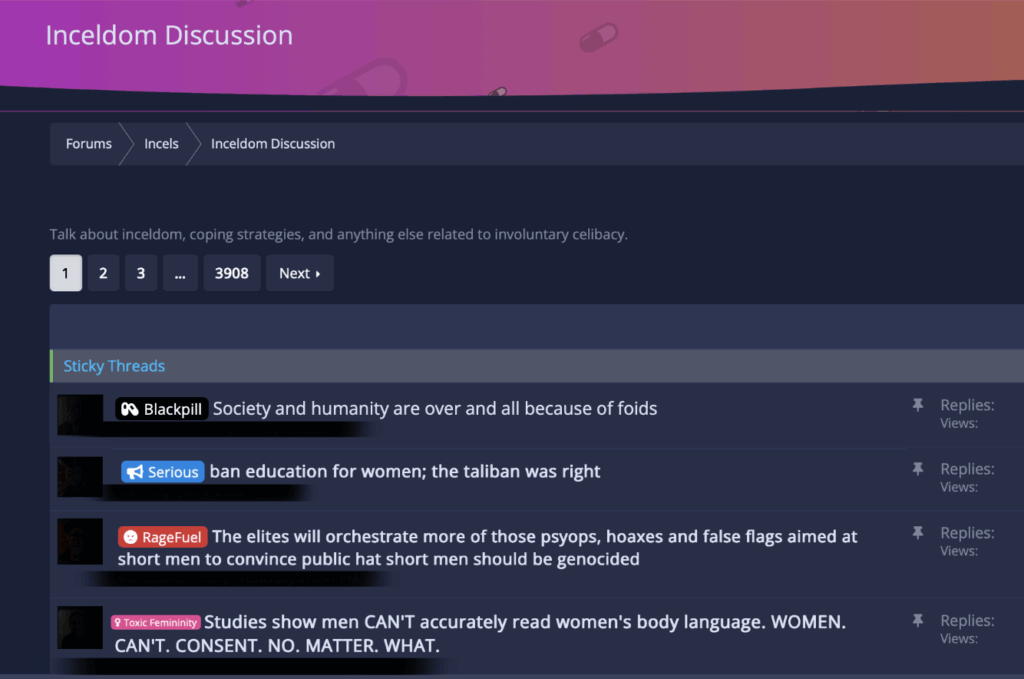
It is this shift from fatalism to external blame that allows the incel ideology to form a kind of anti-public sphere, resisting democratic institutions and the social structures that support gender equality. Through “pilled” narratives, incel communities cultivate shared grievances centred on male victimhood and female blame, becoming a powerful mechanism of social cohesion while facilitating radicalization and disengagement from democratic life. The victimhood narratives that underpin incel ideology frame its members as existing under a constant existential threat, creating conditions that can lead not only to inward-directed violence, including self-harm and suicide, but also to outward-directed violence against those perceived to be responsible for their suffering. As a sense of injustice becomes collectively reinforced, violence is increasingly framed as not only an act of revenge, but the only means of forcing society to recognize the injustices they believe have been inflicted upon them, often in an attempt to compel change to the system they blame for their circumstances.
In this way, the anti-public nature of incel discourse becomes politicized, framing democratic efforts toward gender equality as evidence of a society that has become fundamentally hostile to men. As adherents come to view a modernizing and more diverse society as a threat, their feelings of marginalization take the form of politically charged information warfare directed against the institutions and values they believe are responsible. As a result, incels become more receptive to narratives portraying democratic institutions as deceptive or acting against their interests, reinforcing anti-gender and anti-institutional grievances. When circulating in online incel communities, this allows violence to be framed as a means of achieving broader socio-political objectives: exacting revenge against a society that has oppressed them, drawing attention to the perceived consequences of feminism and the sexual revolution, and ultimately restoring an idealized traditional gender order. An excerpt from the Montreal shooter’s manifesto exhibits just this: “our operations will spread our cause, which itself will eventually take power, and destroy the hypergamy state forever.” This presents a significant challenge for governments, policymakers, and security institutions, including NATO. Attempts to challenge these beliefs through evidence provided by governments, academia, or other trustworthy sources are frequently dismissed as further proof of institutional corruption, fueling skepticism and strengthening antidemocratic sentiments. Consequently, public condemnation, policy responses, and even the classification of attacks as extremism can be incorporated into the conspiracy itself, further entrenching these beliefs.
It is through this process of outgroup rejection that a recurring pattern of radicalization emerges. The following three Canadian case studies illustrate how this ideological framework is translated into violence, demonstrating why conspiracy-driven misogyny represents not only a domestic security concern for Canada, but an emerging challenge for democratic societies across the NATO alliance.
Grievance to Violence: The Canadian Cases
2018 Toronto Van Attack
On April 23 2018, shortly after posting on Facebook that “The Incel Rebellion has already begun!,” 25-year-old Alek Minassian drove a rented van onto a crowded sidewalk along Toronto’s Yonge Street, killing ten people and injuring fourteen others. To this day, it is considered the deadliest mass killing in Toronto’s history. After ten minutes, police were able to bring the van to a stop. Minassian exited the vehicle and advanced toward police while pointing a wallet at them to resemble a handgun, repeatedly demanding that officers shoot him. Recognizing that he was unarmed, police instead ordered him to the ground and took him into custody.
What is known of Minassian’s motivations and radicalization has emerged only through sparse social media posts and a lengthy police interrogation. During the interrogation, Minassian repeatedly framed the attack as part of the broader “Incel Rebellion,” explaining that he sought to overthrow a social hierarchy dominated by ‘Chads’ and ‘Stacys,’ terms used within incel communities to describe highly desirable men and women. He further admitted that he deliberately chose the location because he knew “it would be a busy area,” demonstrating that the attack had been planned to maximize casualties. Central to Minassian’s worldview was Elliot Rodger, whom he identified as the primary inspiration for the attack, referring to Rodger as the movement’s founding father and stating that he was “proud of [Rodger] for his acts of bravery.” Minassian also adopted the title “Supreme Gentleman,” echoing Rodger’s own description, and expressed resentment that women directed their affection toward what he described as obnoxious men rather than individuals like himself. When asked how he felt about his actions that day, Minassian simply replied: “I feel like I accomplished my mission.”
Minassian was sentenced to life in prison with no possibility of parole for 25 years. During the trial, the defence argued that he was not criminally responsible due to autism spectrum disorder, claiming that it impaired his capacity for empathy. The court rejected this argument, concluding that the attack was planned and executed by a rational and deliberate mind. Although autism is sometimes discussed in relation to incel communities due to higher rates of social isolation and difficulty navigating conventional dating norms among some individuals, there is no conclusive evidence that autism constitutes a causal or motivational factor in violent extremism. Reducing the attack to autism risks reinforcing harmful stereotypes of autistic individuals while obscuring the broader ideological context in which the attack occurred. The response within online incel communities illustrates why the attack must be understood as ideological rather than an isolated act of individual pathology. Rather than condemning the attack, forum users celebrated Minassian as a hero, elevated him to the status of a saint, and called for further acts of violence, including mass rape and acid attacks against women, reinforcing the movement’s ideological hatred of women. As Amarasingam argues, this case demonstrates why dismissing incel perpetrators as merely mentally ill or socially isolated individuals is insufficient. These characteristics may coexist, but they do not preclude individuals from embracing conspiracy-driven belief systems that legitimize and encourage violence.
2020 Massage Parlour Stabbing
On February 24 2020, 17-year-old Oguzhan Sert carried out a fatal attack at a Toronto massage parlour, killing 24-year-old Ashley Arzaga and injuring another employee. Before entering the parlour, Sert carried a handwritten note declaring “Long live the incel rebellion,” alongside a 17-inch sword inscribed with the words “THOT SLAYER.” During the attack, he repeatedly directed misogynistic abuse at his victims, shouting, “You fucking whore” and “Die, die, die.” When police arrived, they found Sert lying on the ground with his weapon nearby. He reportedly stated, “I wanted to kill everyone in the building,” adding that “I am happy I got one.”
Sert’s pathway into incel ideology was shaped by prolonged social isolation and engagement with online extremist communities. Evidence presented at trial revealed that he experienced persistent bullying through high school before dropping out in Grade 9, after which he became increasingly withdrawn, spending much of his time alone in the basement of his father’s home. During this period, he became immersed in fringe websites, YouTube content and online gaming communities that promoted incel ideology alongside broader alt-right conspiracy narratives. His commitment to the movement became increasingly explicit as he consumed incel-related content and promoted misogynistic threats across social media and gaming platforms. Sert publicly identified himself as both a “proud incel” and a “Seeker of Martyrdom,” while repeatedly expressing his hatred toward women. Following his arrest by police, Sert stated that people like him deserved a country of their own and claimed that he could not advocate for those rights without hurting women because “nobody would take us seriously.”
In sentencing, the judge observed that Sert had demonstrated a high degree of planning and ideological commitment, citing his months-long immersion in misogynistic beliefs and his identification of Minassian as an “inspiration.” The court concluded that the murder reflected not merely an act of personal violence, but the influence of a broader extremist movement, observing that Arzaga was “butchered” by Sert, reflecting the brutality encouraged by the incel ideology he subscribed to. As Amarasingam observes, incel violence often appears as “a series of lone actors,” causing many to overlook the ideological movement connecting these attacks. As a result, Amarasingam explains that incel violence is often not taken seriously because perpetrators are frequently dismissed as socially isolated young men rather than recognized as participants in a broader extremist ecosystem. Sert’s case demonstrates why this distinction matters: while he acted alone, it was through these online spaces where he was radicalized, justifying his act of violence.
Sert was sentenced to life imprisonment with no eligibility for parole for 10 years. The case marked a significant legal milestone, becoming the first instance in Canada in which a court recognized an incel-motivated attack as an act of terrorism. In reaching this decision, the court concluded that the incel movement constituted an identifiable ideological framework capable of motivating terrorism and that Sert intended to intimidate the public through his actions.
2026 Montreal Shooting
Much remains unknown about the shooting that occurred on June 22, 2026, in Montreal’s Côte-des-Neiges neighbourhood. According to witnesses, a man was seen with “a gun sticking out of a window” before multiple shots were fired, prompting a call to police. When officers arrived, an exchange of gunfire ensued, resulting in the deaths of one police officer, one innocent civilian, and the perpetrator, 25-year-old Seth Hatfield from Lethbridge, Alberta. What is known suggests that the attack was motivated by a complex ideological framework in which incel beliefs served as the primary lens through which Hatfield interpreted society. In his manifesto, Hatfield described his actions as part of a violent revolution against modern capitalist society and what he termed the “hypergamy state.” He declared that “the only path that leads forward is that of radical action,” framing violence as the only viable solution to the perceived social order responsible for his circumstances.
Before the attack, Hatfield left behind both a manifesto and a substantial digital footprint that documented his ideological development. Beyond publishing his manifesto, he followed conspiracy-oriented content online, including videos by Paul Joseph Watson, the former editor of Alex Jones’ Infowars. Watson has been described as an ideological entrepreneur whose content blends political commentary, conspiracy narratives, and online entertainment. Hatfield’s manifesto similarly drew upon conspiratorial, anti-capitalist, and anti-Western narratives, repeatedly claiming that “common” men had abandoned monogamy, which he argued acts as a restraint on women’s supposedly innate hypergamy. Echoing core incel beliefs, Hatfield described the modern sexual marketplace as “characterized by an intense and appallingly unequal distribution of intimacy,” portraying male disadvantage as the inevitable consequence of what he believed to be the hypergamy state.
Importantly, Hatfield’s writing illustrates that incel ideology does not exist in isolation, but functions as the foundation upon which other grievances are built. As Amarasingam reveals, Hatfield’s case demonstrates that “the left-right [partisan] binary doesn’t really work” because incel beliefs function as the “load-bearing ideology,” while his anti-capitalist, Marxist, and other political commitments serve as supporting explanations for how he believed society had become structured. Amarasingam noted that Hatfield, unlike other incel attackers, sought to “intellectualize” his worldview, producing a manifesto complete with a structured argument and footnotes in an attempt to explain what he viewed as a fundamentally rigged society. In doing so, Hatfield selectively interpreted biological concepts and presented contested assumptions about human behaviour as objective facts. One example is his self-described scientific principle, the “contradiction of the imperatives,” which claims that the biological imperatives of men and women are inherently incompatible. By presenting contested assumptions about mate selection as objective biological law, he portrayed male disadvantage as a scientifically verifiable feature of society. Through this synthesis of ideas, Hatfield transformed personal grievance into a political cause that he used to justify violence. In his manifesto, he concluded by declaring, “For the first time in a very long while, the western bourgeois class will finally know true fear again,” before calling on readers to “be unflinching, go forth, and KILL THEM ALL!”
What The Canadian Cases Reveal About Collective Radicalization
Jointly, the three cases examined in this report reveal a recurring process of collective radicalization sustained through online communities that normalize misogyny, reinforce conspiracy narratives, and rationalize violence. While each perpetrator followed a distinct pathway to an isolated act of violence, they were united by a common ideological framework that transformed personal grievance into a shared political identity.
Although the movement lacks the formal organizational structure associated with many extremist groups, this should not be mistaken for ideological incoherence. In place of a centralized leadership is a shared information ecosystem, anchored by an ideological subscription to misogyny. Online misogynic hate functions as a form of connective tissue, where provocation, harassment, and dehumanization become markers of group identity and belonging. In doing so, these communities normalize hostility, facilitate coordinated abuse, and create environments in which acts of extremist violence become increasingly conceivable and sometimes necessary, posing a tangible national security concern. Through pseudoscientific claims, selective interpretations of evolutionary psychology, and comparative theories about feminism and social hierarchy, incel communities construct a worldview that reframes interpersonal rejection as evidence of systematic oppression. Research demonstrating that over 82% of discussions on incel forums contain misogynistic language underscores that these worldviews are not peripheral, but a defining feature. Consequently, attacks against women and members of the public should be understood as manifestations of an ideology that legitimizes violence through a shared framework of grievance and perceived victimization. The Montreal case further demonstrates the adaptability of incel ideology. Hatfield fused multiple ideological traditions, reflecting “salad bar” extremism that resists conventional left-right categorization. As movements such as the incel community continue to splinter and hybridize beyond rigid extremist organization structures, they present growing challenges for security institutions seeking to identify and respond to emerging forms of extremist violence.
Recognizing these ecosystems as a form of collective radicalization is therefore essential to understand the broader security implications they pose. NATO recognizes terrorism as one of the most significant asymmetric threats to the security of Allied citizens and to international peace. If incel violence continues to be understood solely through the lens of individual pathology rather than radicalization, democratic societies risk overlooking evolving extremist movements that continually legitimize a disinformation ecosystem that continually reproduces violence.
The evolution of these hybrid ideological movements also creates practical challenges for security institutions. Under Canadian terrorism legislation, prosecutors must establish, beyond a reasonable doubt, that an act of violence was motivated by an ideological objective. However, because courts have lacked a clear definition of what constitutes an ideology, movements such as the incel community have proven more difficult to classify than organizations that appear on Canada’s list of terrorist entities. This legal ambiguity highlights the importance of understanding the incel movement as a coherent ideological belief system capable of motivating acts of terrorism.
Why the Threat Lies Beyond the Violent Minority
Although only a small minority of incels commit acts of violence, the movement’s broader threat lies in the self-reinforcing ecosystems that normalize misogyny, cultivate grievance, and rationalize violence. Preventing future violent attacks therefore requires disrupting the processes of collective radicalization that make them conceivable in the first place.
Understanding these ecosystems as coherent ideological movements has important implications for both prevention and policy. As Amarasingam argues, ideology is essential to understanding radicalization, but confronting it directly is rarely the most effective starting point for deradicalization. Instead, successful interventions begin by addressing the personal vulnerabilities that make individuals susceptible to extremist worldviews before gradually engaging with the beliefs that sustain them. This approach is particularly important given that the anti-feminist movements have emerged as one of the fastest-growing extremist ideologies in recent years. If democratic societies hope to prevent future acts of incel-inspired violence, they must move beyond responding to individual attacks and confront the evolving incel ecosystems that continue to cultivate, reinforce, and legitimize these worldviews.
Image 1: “Mass attack at Yonge and Finch” (2018) by Can Pac Swire via Flickr. Licensed under CC BY-NC 2.0.
Image 2: “Incel Forum Threads” (2026), compiled by Dorigen Gray.
Disclaimer: Any views or opinions expressed in articles are solely those of the authors and do not necessarily represent the views of the NATO Association of Canada.