Countries from around the world are invited to represent themselves through national pavilions at the Venice Biennale, an international cultural exhibition with a focus on art in Venice, Italy. In 2026, 100 nations participate in the festival. It provides a unique platform for cultural diplomacy, the projection of soft power, and for countries to showcase their leading artists, many of whom gain international recognition following the exhibition.
Culture is a powerful means through which countries become known and understood abroad. Even an appreciation for a country’s music, cuisine, or art can create greater interest in its society, increase sympathy for its concerns, and encourage economic and cultural engagement. States can therefore use cultural platforms strategically to shape international perceptions. The Venice Biennale is a great tool for engaging with culture in such a way that will not only increase a country’s cultural prestige but also address its more immediate humanitarian and political concerns.
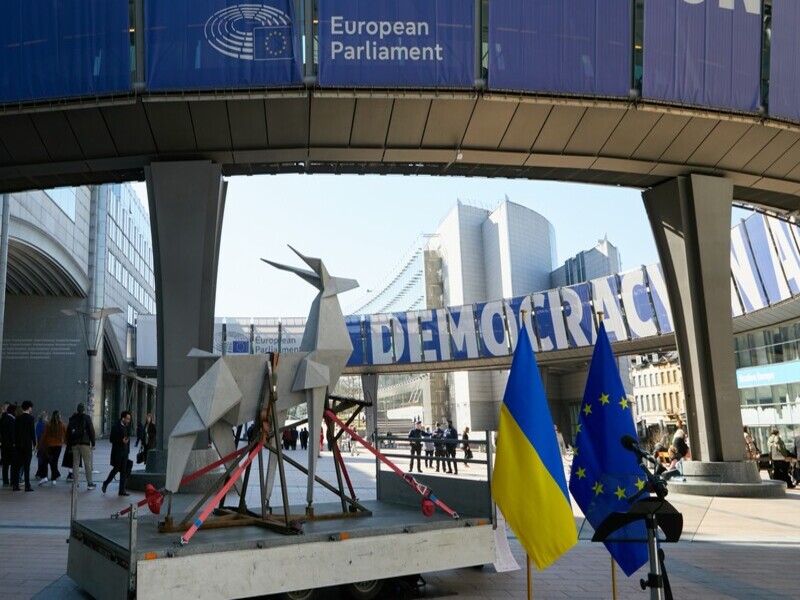
Ukraine’s entry in 2026 is titled, “Security Guarantees,” and explores the empty security guarantees of the Budapest Memorandum from the UK, US, and Russia after Ukraine surrendered its nuclear arsenal in 1994. Commissioner of the Ukrainian Pavilion, Tatyana Berezhna, emphasizes the significance of the theme of this year’s pavilion in a recent press release, asserting that “security guarantees is a phrase that comes up in almost every negotiation.”
The pavilion reflects Ukrainian concerns about whether future security guarantees and peace agreements can be trusted. By revisiting the Budapest Memorandum, the exhibition highlights how past failures continue to shape Ukraine’s approach to negotiations today. Evidently, the Biennale provides avenues for artists to engage politically through artistic means. Reflecting on Ukraine’s past, present, and future, Ukrainian artists commented on the challenges facing Ukrainians and the difficult road ahead, while emphasizing that the preservation of humanity remains the central goal.
However, some political debates at the Biennale are beyond those intended by the artists.
After Russia launched its full-scale invasion of Ukraine in 2022, it was excluded from participation in the exhibition in 2022 and 2024. In 2026, Russia is making its partial return to the festival after being extended an invitation from organizers. The Venice Biennale once promised that as long as the war goes on, not to “accept the presence at any of its events of official delegations, institutions or persons tied in any capacity to the Russian government.” The organizers also stated that they “[reject] any form of collaboration with those who […] have carried out or supported such a grievous act of aggression.”
This promise was not kept. The curator of the Russian pavilion, Anastasia Karneeva, runs an art consultancy firm with the daughter of Russian foreign minister Lavrov. Karneeva’s own father is an executive at Russia’s biggest defence contractor, Rostec. In other words, Karneeva has close ties with the political leadership of the Russian Federation that is currently waging war.
One of the participating folk ensembles posted a YouTube video of a farewell ceremony held for one of its members who had been conscripted into the Russian army. Taken together, these developments raise questions about whether cultural participation can ever be fully disentangled from the political and military structures of the state it represents.
Despite there still being no end in sight to the atrocities and the war crimes committed by Russia, the ban on Russian flags, anthem, and in some cases participation, was recently lifted by the Paralympics, World Gymnastics, International Fencing Federation, and the International Chess Federation. Meanwhile, Russia continues to systematically damage and destroy cultural and historical sites in Ukraine.
As of May 13, 2026, UNESCO verified that 527 cultural sites were damaged by Russia. On May 24, 2026 alone, Russian strikes significantly damaged the National Art Museum of Ukraine and the Institute of Literature, while the Ukrainian National Chornobyl Museum lost 40 percent of its artifacts.
The return of the Russian Federation to the Venice Biennale caused widespread discussion and backlash. This raises broader questions about the relationship between culture and international legitimacy. To what extent should states accused of destroying or suppressing the cultural heritage of others continue to benefit from platforms dedicated to cultural exchange and representation? The issue has become increasingly salient as cultural institutions grapple with the effect of national representation and international conflict on artistic expression. How much should politics and politicians impact art and self-expression?
While art has the right to remain free from censorship, it is essential that it remains humane and is created with intentions that do not impact humanity in a negative way. European Parliament’s Vice President Picierno said, “That pavilion should never have opened… It became a hymn to regime propaganda.”
Russia’s exhibition, “The Tree is Rooted in the Sky,” is centred on musical performance rather than traditional visual media such as painting or sculpture. The pavilion featured a range of folk, electronic, and contemporary music accompanied by dance performances, while waiters were serving free vodka to the visitors. Katia Margolis, a Venice-based Russian dissident artist who assisted in organizing the protests against the Russian pavilion, called it “offensive to art and artists.”
The response from international political figures has been stark. Italy’s Minister of Culture, Alessandro Giuli, did not attend the opening of the event in protest against the reopening of Russia’s pavilion, while various members of the Italian government voiced either support for or opposition to the decision to reinstate Russia.
Beyond Italy, the European Commission threatened to suspend Biennale’s funding of two million euros if they would not provide a “satisfactory” reason for including the Russian Federation, and called for the exhibition organizers to reconsider the inclusion. The EC Executive Vice President Virkkunen and Culture Commission Micallef stated in a note, “Member States, institutions and organizations must act in line with EU sanctions and avoid giving space to individuals who have actively supported or justified the Kremlin’s aggression against Ukraine.”
Ukraine’s foreign and culture ministers also joined the discussion and issued a joint statement urging the Venice Biennale to once again bar Russia from participating, arguing that Moscow uses art as a tool of political influence and propaganda while simultaneously destroying the culture of another nation.
Political implications are also being discussed by non-political figures.
The Belarusian team is composed of exiles and former political prisoners and is represented by the Belarus Free Theatre, which presented works conveying the experience of living under a brutal and repressive dictatorship. Natalia Kaliada, the cofounder of the Belarus Free Theatre, expressed her opinion on Russia’s pavilion: “It’s a failure of international law and institutions. It’s inseparable from the world failure on Ukraine. Who is being legitimised? When the state says, ‘The pavilion is coming’, it means the machinery is coming, the money is coming.” A national pavilion is inherently tied to the state and its politics since it is state-sponsored and consequently operates as an extension of the state’s values, priorities, and international image.
Zhanna Kadyrova, the artist representing Ukraine at the 2026 Biennale, said that her team will focus on improving their pavilion instead of protesting against one of the Russians. Her response suggests a belief that a compelling artistic presentation can be a more effective form of cultural diplomacy than protest, exerting greater influence on international audiences and shaping perceptions through engagement rather than confrontation.
Posters were displayed throughout Venice advertising events by Ukrainian artists and authors that could have taken place at the Ukrainian pavilion, such as a book launch for Victoria Amelina’s Looking at Women Looking at War. However, each poster was stamped with the words: “Cancelled. Because the author was killed by Russia.”
Another initiative that brought attention to the war and Ukraine’s defenders was by artist Darya Koltsova. She replaced the laundry traditionally seen hanging on lines above Venetian streets with military uniforms donated by Ukrainian artists serving in the armed forces, women in the military, and members of the Azov Brigade, most of which had been worn in combat.
Art is used to explain, persuade, and even contest ideas on an international stage. However, like any arena of competition, it requires fair regulation. Art can be an effective tool when it emerges from a bottom-up approach, where politics is shaped through public engagement rather than imposed from above. At the same time, creative production should also be driven by individuals and communities, not solely by the state. Governments can play a role by ensuring a fair platform for expression, one that is not exploited to display regime propaganda in place of genuine artistic work.
Silence or ’neutral’ artistic production does not exist outside of politics. It remains embedded within political systems, especially when artists are connected to state structures through funding, taxation, and social ties. In this sense, silence can be interpreted as a form of consent, while the avoidance of political engagement and the framing of a pavilion as purely cultural risks normalizing the very events it leaves unaddressed. ’Apolitical’ cultural presentation can soften the perception of violence and complicate efforts to maintain a consistent international response, including sanctions and aid. For example, artists can also be drawn into narratives that argue for weaker sanctions by highlighting the impact on civilian life in Russia. Taken together, this reinforces the difficulty of separating culture from the political structures that enable it.
In the end, politics cannot be escaped – even in art. As philosopher Karl Jaspers writes, “There is no absolute division of politics and human existence as long as man is still realizing an existence rather than perishing in eremitical seclusion.”
Image credit: Presentation of the sculpture in Brussels (2026) by Ukraine Pavillion via Press Kit. Public Domain.
Disclaimer: Any views or opinions expressed in articles are solely those of the author and do not necessarily represent the views of the NATO Association of Canada.