In Canada, the increasing frequency and intensity of wildfires, driven by climate change, have evolved from an environmental challenge into a national security concern, threatening critical infrastructure, displacing communities, and straining the capacities of emergency and military response systems. This is most evident in British Columbia, where recent wildfire seasons have forced governments to escalate their response beyond traditional emergency management frameworks. In response to severe wildfire outbreaks in British Columbia, provincial leaders formally requested federal assistance, resulting in the deployment of the Canadian Armed Forces to support firefighting, evacuation, logistics, and reconnaissance efforts. Federal mobilization is seen as a critical need since airlift evacuations and tactical support help stabilize communities when wildfires exceed provincial response capacities. These deployments are conducted under Operation LENTUS, the CAF’s domestic disaster response mission, which is activated when provincial capacities are overwhelmed, and a formal request for Federal assistance is issued.
However, the growing reliance on the military for disaster response raises serious national security concerns. Senior military officials have warned that the Canadian Armed Forces is increasingly overstrained, balancing domestic disaster response with its national defence obligations. Frequent deployments for wildfire response risk diverting personnel, equipment, and readiness away from traditional security priorities. This creates a strategic vulnerability, where Canada’s ability to respond to external threats can be indirectly weakened by the internal climate crisis. Thus, the need for establishing a dedicated national force may become necessary in future wildfire seasons, reflecting concerns about whether provincial resources alone can adequately handle future wildfires.
Furthermore, the Government of British Columbia has acknowledged that wildfire seasons are becoming longer and more destructive, driven by rising temperatures, prolonged droughts, and changing climate patterns. This evolving threat to the environment has led to calls for the creation of a dedicated national disaster response force. Such a force would reduce the burden on the military while ensuring rapid, specialized responses to climate-related emergencies. The idea reflects a broader recognition that climate change is a systemic threat multiplier that exacerbates existing vulnerabilities across governance, infrastructure, and security systems.
Wildfires have a direct impact on climate change by releasing massive amounts of greenhouse gases and aerosols into the atmosphere. The carbon emissions from wildfires in Canada’s boreal forests can rival the annual emissions of some industrialized nations during severe fire seasons. This makes wildfires both a symptom and a driver of climate change, creating a feedback loop in which warming temperatures and prolonged droughts increase the likelihood of fires, which in turn accelerate climate change.
Beyond greenhouse gas emissions, wildfires also affect air quality, for local and global climates. Smoke plumes from large fires carry particulate matter, black carbon, and volatile organic compounds. When black carbon settles on ice and snow, it reduces surface albedo, which causes ice and snow to absorb more sunlight and melt faster. This accelerates polar ice loss and contributes to sea-level rise, linking a localized event, like a wildfire in BC, to global climate impacts of rising sea levels for nations like Tuvalu and the melting of the Arctic.
Moreover, climate models indicate that under continued global warming, wildfire frequency, size, and intensity are expected to rise. This makes wildfires both a climate feedback mechanism and a warning signal. Wildfires are not a localized, isolated environmental hazard; they are a global climate concern. Their emissions on the atmospheric processes accelerate warming and intensify extreme weather events. Recognizing this highlights the urgency of integrating wildfire management into broader climate change mitigation strategies, something the Canadian Council of Forest Ministers has acknowledged. Without proactive intervention, wildfires will continue to amplify greenhouse gas concentrations, exacerbate ecological degradation, and intensify threats to human, environmental, and national security.
The interplay between wildfires, climate change, and national security highlights a complex, systemic challenge for Canada. As wildfires grow more frequent and intense, the reliance on federal resources through mechanisms like Operation LENTUS hinders the limits of provincial emergency capabilities. Climate-related disasters act as threat multipliers, amplifying vulnerabilities across governance, security, and public welfare systems. At the same time, the environmental consequences of wildfires perpetuate the cycle of risk. As stated above, carbon emissions, black carbon deposition, and ecosystem degradation contribute to global warming, which in turn increases the probability and severity of future fire seasons. These feedback loops create a scenario in which local disasters have global implications. As such, vulnerable populations, both within Canada and internationally, face heightened risks as human security is undermined by displacement, property loss, and economic disruption.
Addressing these challenges requires both improved disaster management and climate mitigation strategies. Expanding dedicated domestic response forces could reduce pressure on the military while improving rapid response to climate emergencies. Investments in forest management, early-warning systems, and carbon reduction measures are essential to break the wildfire-climate feedback loop. Canada’s experience demonstrates that climate change is not merely an environmental issue; rather, it is a national security concern that is linked to ecological, human, and defense vulnerabilities. In essence, wildfires serve as a stark reminder that environmental responsibility and security planning must be integrated. They ensure a rethinking of national preparedness, not only to protect lives and infrastructure but also to mitigate the cascading effects of climate-driven disasters on global stability.
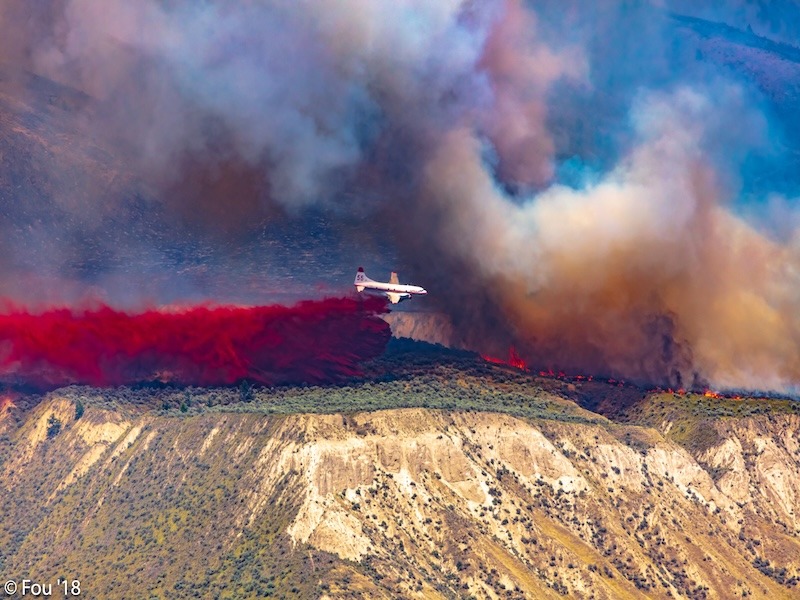
Image credit: Kamloops Wildfire, July 2018 (12 July 2018), depicting a fast-moving grass wildfire near Kamloops, British Columbia, by Murray Foubister via Wikimedia Commons. Licensed under CC BY-SA 2.0.
Disclaimer: Any views or opinions expressed in articles are solely those of the author and do not necessarily represent the views of the NATO Association of Canada.