As global conflict, climate change, and poverty continue to drive people from their homes, the number of refugees and cases of forced migration keep rising. By mid-2024, over 122 million people worldwide had been displaced from their homes, marking the twelfth consecutive year of increasing displacement numbers and a trend which shows no indication of slowing down.
Host countries cannot always plan for a sudden influx of people arriving in crisis, and the systems meant to support them are rarely prepared for the scale or speed of what follows. This raises the question: when NATO coordinates a mass evacuation, who is responsible for what happens next?
Getting People Out
NATO’s humanitarian and evacuation missions often focus on rapid extraction of individuals from affected areas rather than long-term integration, with refugee flows going to allied and partner countries, leaving member states to manage the social and healthcare burdens without additional economic or physical support.
Following the collapse of Afghanistan’s government in August 2021, allied forces evacuated more than 120,000 people from Kabul within a two-week period. NATO subsequently initiated Operation Allied Solace, relocating evacuees to temporary processing sites across Europe before permanent resettlement. Canada, in line with its international commitments, welcomed approximately 40,000 Afghan refugees between 2021 and 2023, with an additional 20,000 accepted under special immigration measures.
Although NATO has coordination tools, such as the Euro-Atlantic Disaster Response Coordination Centre to support emergency responses, its involvement significantly decreases once evacuees arrive in host countries. At that point, responsibility for housing, healthcare, and long-term integration shifts almost entirely to individual states, without dedicated financial or logistical support from NATO itself.
Canada’s Healthcare System is Strained
What does it mean to absorb thousands of refugees without structured post-arrival support? It is important to turn inward domestically and examine what Canada’s healthcare system looks like right now.
As of 2025, the country is short of nearly 23,000 family physicians. The median wait time for medically necessary care sits at over 28 weeks. Four in ten healthcare workers say they are considering leaving the profession entirely within the next three years. And Canadians are not receiving this care for free. A typical Canadian family pays approximately $19,060 per year from their taxes toward healthcare, making Canada’s universal system one of the most expensive of its kind in the world. Canada’s significant public investment is already stretched beyond its limits.
Refugee’s Needs and Costs
Refugees arrive with many critical and complex health needs, as they have spent many years exposed to violence, poverty, and trauma both mental and physical, and severely limited access to healthcare.
One study tracking refugee healthcare use in Canada between 2011 and 2020 found that monthly clinic appointments grew from around 455 to over 2,200 across that period. Federally, Canada spent $896.5 million in a single fiscal year (2024-2025) providing basic health coverage to over 623,000 asylum claimants and refugees. This coverage includes essential services such as: disease screening, tuberculosis monitoring, mental health support, and primary care access, which are not optional services, but the minimum required to protect both newcomers and the broader public.
At the same time Statistics Canada estimated that Canada’s population grew by 744,324 people, and of that growth, 97.3 percent came from international migration. As of 2026, there are currently around 300,000 pending asylum claims sitting in the backlog.
This has implications for refugees, who often face language barriers, administrative challenges, and documentation delays when trying to access care.
Case Study Example
This problem is not unique to Canada. Countries like Italy, which operates under the European Union’s “first-entry” rule governed by the Dublin Regulation, face disproportionate pressure as primary points of arrival for refugees. In 2024 alone, Italy recorded more than 66,000 asylum claims from sea arrivals. Canada faces a different version of the same problem. It accepts significant numbers of refugees through international commitments and NATO-adjacent operations, without any corresponding framework that distributes the long-term financial or logistical costs of integration.
NATO coordination has responsibility quietly shifts to individual member states, with no agreed mechanism for sharing what comes next. But so has the operational burden, the burnout, and the financial strain on the workers and institutions carrying it.
Without coordinated investment in healthcare staffing, services, and culturally competent care, Canada risks overstraining a system that is already struggling, while simultaneously failing to give newcomers the standard of care they need and deserve.
Bridging The Gap
NATO has the tools to move people out of crisis zones quickly, which is significant, but extraction is not the same as support, and resettlement is not the same as integration.
One potential approach would be the creation of a NATO-supported post-evacuation fund to assist host countries with the costs of integration, particularly in critical areas such as healthcare, so that the burden does not fall entirely on domestic systems.
Canada must assess what the receiving system can sustain, what investments are needed to expand that capacity, and what support should reasonably come from the international structures that set the evacuation in motion. Canada’s commitment to resettlement reflects its values and its obligations under international law. But good intentions without infrastructure and shared responsibility risk burning out the very system people depend on, therefore establishing the need to have alignment of refugees with capacity as much as possible.
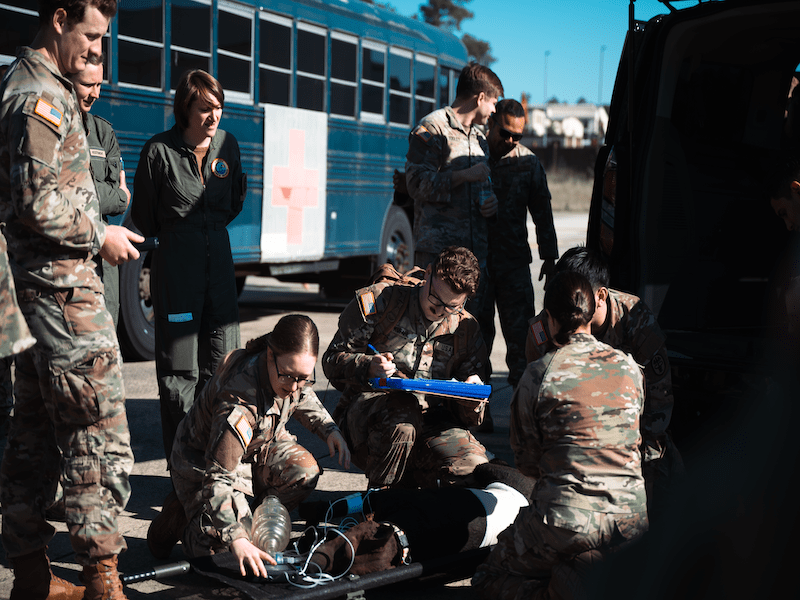
Image credit: 86th AES, NATO Allies execute aeromedical evacuation exercise (15 May 2025; photo ID 9045316), depicting U.S. Air Force personnel and NATO allies participating in an aeromedical evacuation exercise at Ramstein Air Base, Germany, by Staff Sgt. John Foister via Wikimedia Commons. Licensed under public domain.
Disclaimer: Any views or opinions expressed in articles are solely those of the author and do not necessarily represent the views of the NATO Association of Canada.



.png)
