The Afghan Rights Monitor has released statistics showing that the escalating violence in Afghanistan is at its worst since the beginning of the almost nine year war.
This year alone, 1074 civilians have been killed, as international forces struggle to combat the escalating insurgency attacks. However, the Afghan Rights Monitor has also said that fewer civilians are being killed by international forces, with the number of NATO airstrike victims halving due to new restrictive rules of engagement put in place last year.
The drop in civilian casualties as a result of a NATO airstrike has been accredited to the former Commander of the International Security Assistance Force, General Stanley McChrystal, who put in place restrictions that severely limited the circumstances where troops could call in an airstrike or fire into buildings.
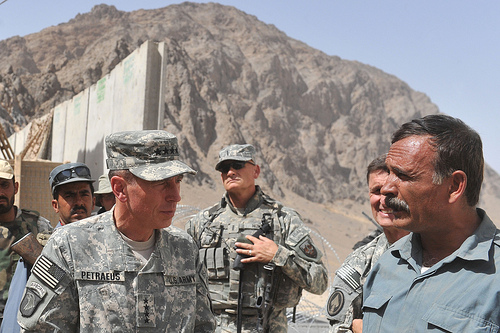
Critics have worried that any change in policy would increase the danger to coalition forces. However, Brigadier General Josef Blotz, spokesman for NATO, issued a statement reiterating that, contrary to the speculation over the arrival of new coalition forces commander General David Petraeus, there would be no change in policy.
With the recent 30 000-strong American troop surge to bolster international forces in Afghanistan, the intensity and frequency of insurgency attacks have also increased. As a means of strengthening Afghan government control, the reinforcements have been deployed to Taliban strongholds in the southern and eastern regions of Afghanistan. Insurgents have responded with a wave of suicide attacks, assassinations, roadside explosions and ambushes.
According to Ajmal Samadi, director of the Afghan Rights Monitor, 212 civilians were killed last month alone. The statistics were compiled based on interviews with witnesses, the families of victims, media reports and local and community officials. June, 2010, marked the worst month for attacks and civilian casualties since 2002, with almost 1200 violent incidents. Coalition forces fared no better, with 103 personnel and troops killed, 60 of which were American
The Afghan Rights Monitor’s report said that in terms of security, “2010 has been the worst year since the demise of the Taliban regime.” The insurgency has been responsible for 61 per cent of the civilian casualties, which highlights the need for international forces to succeed in the goal of protecting the Afghan people.
This goal is the focal point of NATO’s counterinsurgency strategy, which aims to protect the local population from the Taliban and win the support of locals to encourage a greater exchange of information regarding insurgents.
With the arrival of Gen. Petraeus, architect of US counterinsurgency strategies in both Iraq and Afghanistan, there are concerns about changes he will make, despite President Obama’s reiteration that a change in personnel does not equate to a change in policy.
However, many military analysts are of the view that the surge under McChrystal has failed to achieve its objective.
Some analysts are saying that perhaps one change Gen. Petraeus can make is by reducing the number of American troops in Afghanistan and selecting a smaller yet more efficient and motivated team, which may be more effective in dealing with the NATO-estimated 15 000 insurgents.
Samadi has urged Gen. Petraeus to stick with Gen. McChrystal’s strategy regarding the rules of engagement, as “those measures might be changed in a way that would allow international forces to use more firepower…then you could be back in a situation where more civilians could die.”
Prior to McChrystal’s ouster, he described the Afghan resistance as “a resilient and growing insurgency,” and the surge in southern Afghanistan seems to have only galvanized the Taliban, which has pushed into new areas, including the north, where their presence used to be comparatively minimal.
Nevertheless, Gen. Petraeus remains optimistic about the current surge and strategy, maintaining that gaining the trust of the local population is still a top priority at this “critical moment”. The current US plan to win over the Afghan population includes proving that the increased presence of US soldiers can, and will, reduce the number of insurgent attacks.
By Tanah Sullivan
*Disclaimer: The opinions expressed in this article are solely of the author’s, and do not represent those of The Atlantic Council of Canada.