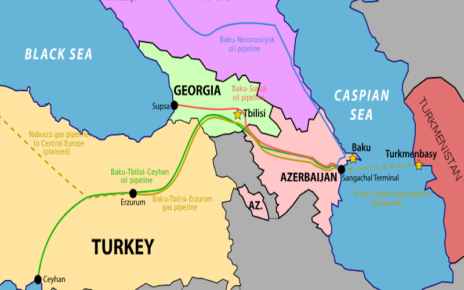
The Trans-Caspian Pipeline (TCP) project from Turkmenistan to Azerbaijan is a geopolitical and strategic pipeline for Europe. It will bring large quantities of natural gas from Central Asia to southern Europe and, via the White Stream pipeline under the Black Sea, also to Central and Eastern Europe. The Baku–Tbilisi–Ceyhan (BTC) oil export pipeline 20 years ago established and reinforced the independence of the participating countries, Azerbaijan and Georgia. It also happened to be commercially very advantageous. Like it, the TCGP is a unique opportunity to ensure Europe’s economic benefit and political influence in the region. Also like the BTC, it is a
demonstration project that will open the broader region to greater international investment. Gas from Turkmenistan costs much less than gas from Siberia. Implementation of Turkmen gas exports to the EU in sizeable quantities will serve the geopolitical purpose of cementing Central Asia’s relations with Europe, promoting integration and stability.
Robert M. Cutler earned his doctorate at The University of Michigan after receiving two Bachelor's degrees from the Massachusetts Institute of Technology. After over a dozen years in leading universities in Canada, France, Russia, Switzerland and the United States, he expanded into policy analysis and consulting as an Energy Security and Geo-economics Specialist. He has over 25 years' experience in international energy diplomacy: advising energy firms, governments, international institutions and NGOs; framing policy and research issues and leading teams to address them, and producing briefings and analytical bulletins.
He has published scores of refereed academic articles, policy articles and book chapters. He Practitioner Member at the University of Waterloo's Institute for Complexity and Innovation (WICI) and Senior Fellow at Strategy International. He is a past fellow of the Canadian International Council and Canadian Global Affairs Institute, and was for many years a senior researcher at Carleton University's Institute for European, Russian and European Studies. He is fluent in English, French and Russian. He can be reached at rmc@alum.mit.edu and posts to X from @RobertMCutler.
Robert M. Cutler earned his doctorate at The University of Michigan after receiving two Bachelor's degrees from the Massachusetts Institute of Technology. After over a dozen years in leading universities in Canada, France, Russia, Switzerland and the United States, he expanded into policy analysis and consulting as an Energy Security and Geo-economics Specialist. He has over 25 years' experience in international energy diplomacy: advising energy firms, governments, international institutions and NGOs; framing policy and research issues and leading teams to address them, and producing briefings and analytical bulletins.
He has published scores of refereed academic articles, policy articles and book chapters. He Practitioner Member at the University of Waterloo's Institute for Complexity and Innovation (WICI) and Senior Fellow at Strategy International. He is a past fellow of the Canadian International Council and Canadian Global Affairs Institute, and was for many years a senior researcher at Carleton University's Institute for European, Russian and European Studies. He is fluent in English, French and Russian. He can be reached at rmc@alum.mit.edu and posts to X from @RobertMCutler.
Last summer, before the Second Karabakh War broke out between Armenia and Azerbaijan in autumn, the Turkish company BOTAS opened a tender to construct a gas pipeline from Igdir into the Azerbaijani exclave of Nakhchivan, which is surrounded by Armenia and Iran but has a short border with Turkey. Nakhchivan has relied principally on gas Read More…
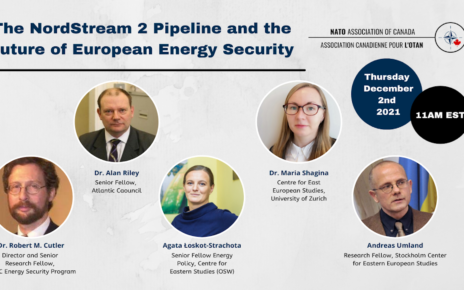
Title: The NordStream 2 Pipeline and the Future of European Energy SecurityFeatured Speakers: Dr. Robert M. Cutler Senior Research Fellow and Director, Energy Security Program NAOC; Dr. Alan Riley Senior Fellow, Atlantic Council; Agata Łoskot-Strachota Senior Fellow, Energy Policy, Institute for Eastern Studies (OSW); Dr. Maria Shagina Centre for East European Studies, University of Zurich; Andreas Read More…
In this article Joseph Bouchard examines the issues of corruption in Russia’s energy sector exposed by Alexei Navalny, how those issues impact Russia’s influence in the global energy sector, and how resolving them could impact Russia’s future and its relations with the West.