Climate Change, or Climate Crisis, should it be aptly named in this scenario, has become an existential threat to our way of life as it is now. The North Atlantic Treaty Organisation (NATO), as a defensive charter, can no longer sit on the sidelines, but to act proactively, and not only to prevent, but adapt. The Strategic Concept 2010 has first defined climate change to be an emerging threat towards the alliance amongst other humanitarian aims. Until the 2022 document, the climate crisis has since evolved to encompass a wide range of detrimental strategic implications, including regional destabilisation, resource depletion, and increased risks of natural disasters. It is no longer that the weapons and foes define the battlefield, but rather the environment itself. In all previous defence calculations, the factor that was once thought to be immutable in all plans—terrain—is now rapidly changing.
In the words of Jamie Shea: “NATO’s purpose has always been to defend its populations against challenges that evolve into concrete security threats and that require military forces or military organizations.” The Canadian Armed Forces (CAF), like most other militaries around the world, has in recent times become more and more entrenched, or rather, forced towards a domestic role. The increasing threats have not only come from foreign, strategic rivals, but rather in the form of domestic hazards, as identified by the NATO Climate Change and Security Action Plan, to encompass a wide range of factors from extreme weather patterns to greater temperature extremes. In particular, there has since been an increasing demand for the CAF to intervene and assist with civil authorities to respond to natural disasters, such as hurricanes, floods, blizzards, and forest fires, which growingly afflict the Canadian heartland.
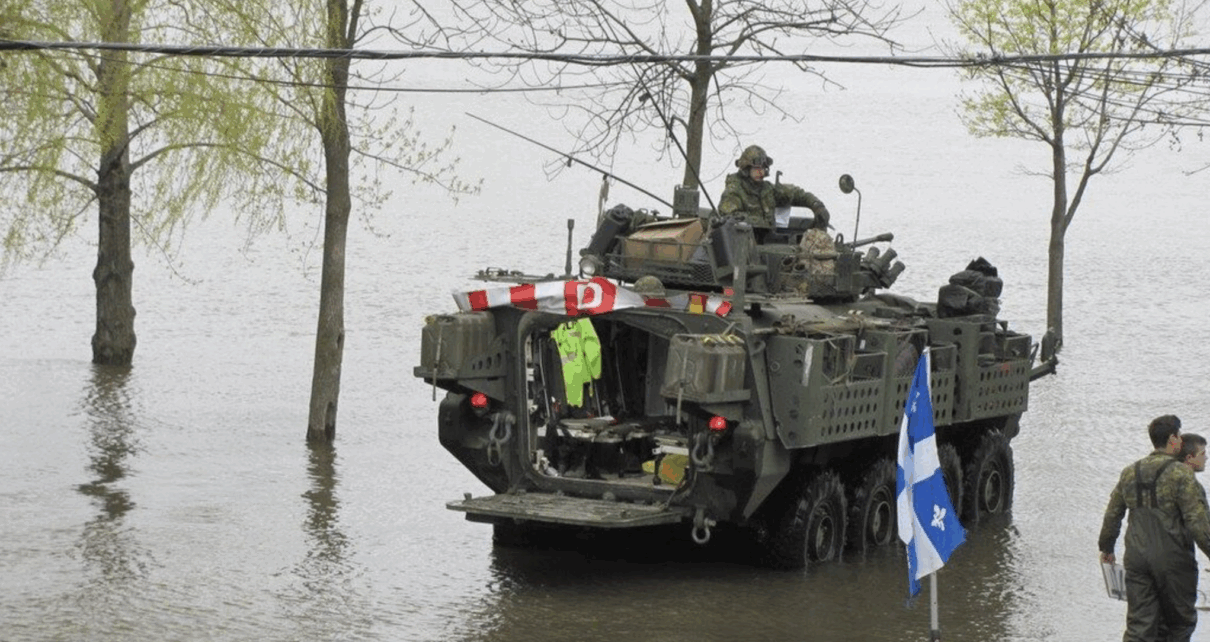
In 2010, the CAF had undergone its first deployment within Canada, under the designation of Operation LAMA, which involved regulars and reserves assisting with authorities to rescue communities in southern and eastern Newfoundland, as well as Labrador, that were cut off due to Hurricane Igor. Yet, the number of environmental incidents requiring the assistance of the CAF have roughly doubled every five years since 2010, and notwithstanding the Covid Pandemic, which has warranted CAF missions to be implemented through a comprehensive legal framework, under Operation LENTUS. As aforementioned, the growing frequency of weather and climate incidents can no longer be appropriately confined to, nor resolved by, a member state on its own. Rather, the present situation warrants the cooperation of allies to coordinate rapid responses to natural disasters.
NATO has principally advocated to lead allied efforts in civil emergencies, and in particular, establishing the Euro-Atlantic Disaster Response Coordination Centre (EADRCC) to become NATO’s principal response mechanism and framework, coordinating international responses and providing disaster relief. The EADRCC has mainly provided alliance support, namely to the Türkiye earthquake in 2023, though its orientation and mandate is not only limited to the internal affairs of member states. The EADRCC has also assisted in other capacities, such as the humanitarian efforts to support Ukrainian civilians, coordinating with the NATO Military Authorities, in response to the Russian invasion of Ukraine. This initiative provides a key division of labour, as well as synergy, between military and civil authorities, aptly to respond in a comprehensive, robust, and diverse manner.
Yet, given the present situation of increased global tension and conflict, a constant concern sounds in the backdrop of greater domestic and humanitarian activism, that is, to what extent are the strictly military capabilities of NATO, and particularly the CAF, maintained? As outlined under the 1964 Defence White Paper, Canada’s role in the NATO alliance has been “to preserve the peace by supporting collective defence measures to deter military aggression…and to provide for the protection and surveillance of our territory, our air-space and our coastal waters.” The CAF has primarily acted in a supporting role within the alliance, which, by means of protecting the sovereignty of its own waters and air from the intrusion of unfriendly forces, provides early detection for the alliance since the Cold War.
But as aforementioned, the rapid shifts in the climate and environment has impacted the capabilities of militaries worldwide. Climate change has acted as a “threat multiplier,” as defined in the 2022 Strategic Concept, and echoed by the NATO Climate Change and Security Centre of Excellence (CCASCOE), that has since linked to directly and indirectly threaten the mission and vision of NATO. The effects are twofold. The CAF has found itself contending with operating under harsher circumstances, and particularly in the Arctic north, facing attrition that tests its installations, personnel, and equipment. Moreover, the effects are multilayered, to mention the health risks, such as disease, that is directly caused by climate change itself, or indirectly through the economic deprivation, which can all influence the efficacy and the ability of the alliance to prepare and respond in times of crisis. Therefore, climate change is not isolated to the environment, in the narrow geological sense, but also the inherent societies and politics of the land. A study on military preparedness and climate change should then situate the effects of the latter within the wider economic, social, and political scopes.
The latter detail will be subsequently discussed shortly in a second part, by analysing the strategies in place to combat a changing and wide-ranging threat such as global warming, focusing on the mitigation of climate change through emissions control, within the wider NATO strategy on environment and energy. This particular essay has discussed the growing domestic concerns of security threats emerging from the environment, as opposed to the traditional hard power threats, that require the might of the alliance as a whole. However, the focus on domestic affairs, such as internal deployment and intervention of troops in a civic role, calls into question the preparedness of the force against state-level actors in the future.
Any views or opinions expressed in articles are solely those of the authors and do not necessarily represent the views of the NATO Association of Canada.
Photo: “Canadian soldiers from Operation LENTUS deployed on a flooded street in Laval, Quebec (4 Aug 2019)” by Eytan Kaziberdov (user Baelzvuv). Licensed under Creative Commons CC BY-SA 4.0. Wikimedia Commons.