Public support for NATO is often treated as a background statistic – measured through opinion polls, but rarely examined in depth. In democratic societies like Canada, however, public support is more than a reflection of sentiment. It is a key source of democratic legitimacy for foreign and security policy, shaping political decision-making and sustaining long-term commitments to collective defence. As NATO adapts to a changing security environment, maintaining public trust has become central to the alliance’s strength.
Canada has long been a committed NATO ally, contributing to deterrence, collective defence, and crisis management operations. These commitments, however, rely not only on political leadership – but also on public understanding and consent. In a period marked by geopolitical uncertainty, rising defence costs, and political polarization, public support cannot be taken for granted. This is particularly true among younger Canadians, who will shape the future of Canada’s security priorities.
Public Support and Democratic Legitimacy
Public support is not merely a domestic political variable. In alliance politics, it shapes credibility, deterrence, and burden sharing. Alliances depend on the perceived reliability of members, and that reliability is partly sustained by domestic consent for defence commitments, military spending, and collective action. When public confidence erodes, governments face greater constraints in sustaining deployments, funding defence initiatives, or responding decisively during crises. In this sense, public opinion becomes strategically relevant to alliance cohesion.
In democratic states, foreign and defence policy does not operate in isolation. Public opinion influences electoral outcomes, parliamentary debates, and budgetary decisions, especially when military deployments or defence spending are involved. Public support, therefore, underpins the credibility of Canada’s commitments to NATO, both domestically and internationally.
Survey data suggests that Canadians continue to view NATO favourably. A 2025 Pew Research Center survey found that 69% of Canadians hold a positive view of the alliance. While this indicates broad support, favourable perceptions do not necessarily reflect deep public understanding of NATO’s role or Canada’s responsibilities within it.
A national survey conducted by Ipsos on behalf of the NATO Association of Canada in 2018 found that approximately 60% of Canadians were unable to correctly identify NATO’s core mission when asked to match the organization with a description of collective defence. Many respondents confused NATO with other international institutions, indicating that while the Alliance is viewed positively, its purpose and Canada’s role within it are not always well understood by the public.
Support that is shallow or passive may weaken during moments of crisis or political controversy. Democratic legitimacy requires informed engagement, not just approval. Beyond legitimacy, public support influences alliance credibility, as adversaries monitor domestic political constraints within member states when assessing deterrence and resolve.
Generational Differences and Civic Engagement
Public engagement with NATO is not uniform across Canadian society. Polling by Ipsos and the Macdonald-Laurier Institute suggests that while Canadians broadly support international cooperation, levels of engagement vary across age groups. Younger Canadians often express strong commitments to democracy, human rights, and global justice, yet feel disconnected from traditional security institutions.
This presents both a challenge and an opportunity. Many issues that resonate with younger audiences, including democratic resilience, disinformation, and global stability, increasingly intersect with security policy. NATO’s own resilience framework reflects this shift, emphasizing that Alliance security depends not only on military capabilities but also on the ability of societies to withstand disruption, maintain cohesion, and sustain public trust in institutions. In this sense, contemporary security threats are understood to include pressures on societal stability and democratic systems, not just conventional military risks. Framing NATO through this broader lens can help bridge the gap between public values and security policy.
NATO, Societal Cohesion, and Public Trust
In recent years, NATO has placed greater emphasis on societal resilience and democratic cohesion as elements of collective security, reflecting a growing recognition that military capabilities alone are insufficient without the ability of societies to absorb disruption and maintain institutional trust. NATO’s resilience framework explicitly states that Alliance security depends on members’ capacity to withstand and recover from a wide range of threats, including those targeting civilian infrastructure, social cohesion, and public trust in democratic institutions.
This understanding is also reflected in the Alliance’s 2022 Strategic Concept, which affirms that today’s security environment is global and interconnected, affecting both military and non-military domains and requiring comprehensive responses that strengthen societal resilience alongside defence preparedness. Framing NATO through this broader lens underscores how public trust and democratic cohesion are integral to collective security.
For Canada, this means that public support for NATO is a strategic asset in itself. A population that understands and debates security policy openly is better equipped to resist disinformation and engage constructively with international partners. Conversely, disengagement can weaken domestic consensus and undermine alliance credibility.
What Strengthening Civic Education and Public Dialogue Looks Like
Strengthening civic education and public dialogue does not mean promoting uncritical support for NATO. Rather, it involves creating accessible and inclusive spaces for informed discussion.
In practice, this could include integrating contemporary security issues into civics and social studies curricula, with a focus on Canada’s current NATO commitments rather than only historical conflicts. Educational initiatives could explore debates around defence spending, alliance solidarity, and the relationship between security and democratic values.
Public institutions and civil society organizations also have a role to play. Universities, think tanks, and youth organizations can host public lectures and forums that connect policymakers, experts, and young Canadians. Digital engagement is equally important. Podcasts, short explainers, and social media content can help make security issues more accessible, particularly for younger audiences who consume information online.
Why Youth Engagement Matters
Engaging young Canadians is not simply about shaping opinion. It is about preparing future citizens to participate meaningfully in democratic decision-making. Today’s students and young professionals will become tomorrow’s voters, policymakers, and public servants. Their understanding of NATO and international security will influence Canada’s future role within the alliance.
Recent Nanos Research polling shows growing Canadian support for increased defence spending to meet NATO commitments. This suggests that when security issues are clearly explained, Canadians are willing to engage with complex policy choices. Ensuring that younger generations are included in these conversations is essential to sustaining democratic legitimacy over time.
Reflections
Public support for NATO is not static, nor is it guaranteed. In Canada, it reflects a broader relationship between civic engagement, democratic legitimacy, and international responsibility. As NATO continues to adapt to new security challenges, public trust and understanding will remain central to the alliance’s effectiveness.
By strengthening civic education and fostering open public dialogue, particularly among young Canadians, Canada can reinforce both its democratic foundations and its role as a credible NATO ally. Public support, in this sense, is not merely an opinion measure, but a cornerstone of collective security.
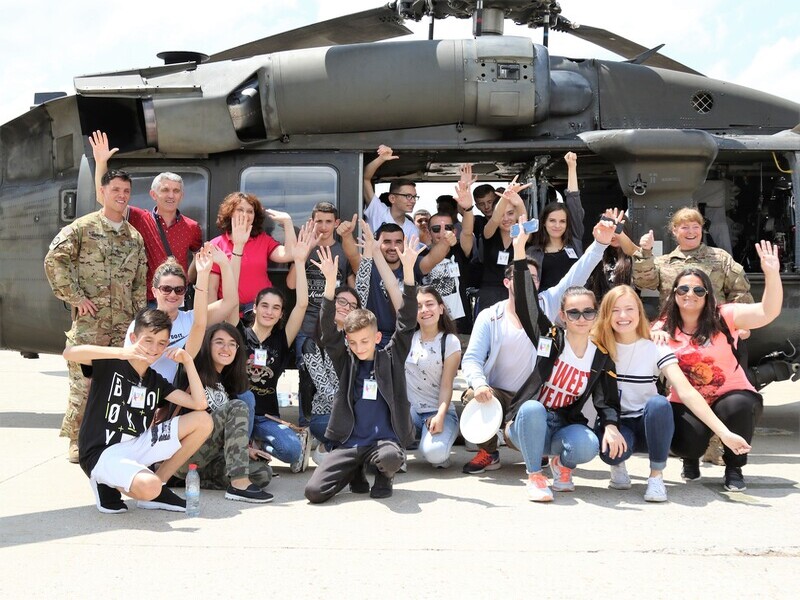
Image credit: Albanian and Kosovar-Serbian youth pose with Soldiers from KFOR’s Multi-National Battle Group – East during a visit to Camp Bondsteel, Kosovo (2018) by United States Army via Wikimedia Commons.
Disclaimer: Any views or opinions expressed in articles are solely those of the authors and do not necessarily represent the views of the NATO Association of Canada.