On the opening morning of the 79th World Health Assembly (WHA) in early May, the WHO Director-General, Dr. Tedros Adhanom Ghebreyesus, declared a Public Health Emergency of International Concern over the growing Bundibugyo Ebola outbreak in the Democratic Republic of the Congo (DRC); this marked the first time in the organization’s history that an Emergency Committee was not convened first. Adding a second simultaneous crisis to the delegates’ agendas, the well-known Dutch expedition cruise ship, the MV Hondius, has now produced a cluster of Andes hantavirus infections among passengers and crew from 23 countries, making it the only hantavirus strain known to transmit between humans. By May 27th, 13 confirmed cases had been reported across Canada, the Netherlands, and Spain, with three deaths and a 42-day quarantine still running for hundreds of contacts across more than 20 countries. Both of these outbreaks demanded the kind of real-time, multi-jurisdictional coordination the WHO supposedly exists to provide, and both also made the Assembly’s central failure that week that much harder to defend.
This failure was the additional extension of negotiations on the Pathogen Access and Benefit Sharing (PABS) Annex. Also known as the component of the 2025 WHO Pandemic Agreement without which this pioneering Agreement cannot open for signature. Member States agreed to push the deadline, once again, to the next WHAin May 2027. Or a special session later in 2026, after the Intergovernmental Working Group (IGWG) assigned to the agreement reconvenes for its seventh meeting from July 6-17.
The Pandemic Agreement adopted at WHA78 in May 2025 was itself the product of three years of grueling negotiation, launched in direct response to the inequities that defined the COVID-19 global response. Rich countries hoarded vaccines, and poor countries, which often detected and reported outbreaks first, were left without. Under the new agreements’ terms, pharmaceutical manufacturers participating in the Pathogen Access and Benefits Sharing (PABS) system would make available to the WHO 20% of their real-time production of vaccines, therapeutics, and diagnostics for any pathogen causing a pandemic emergency, distributed according to public health need with particular attention to developing countries.
However, after six rounds of negotiations, the structural deadlock is the same. A bloc of approximately 100 low and middle income countries are continuing to demand mandatory benefit-sharing as the condition for rapid pathogen data disclosure; while high-income countries, led by the EU, resist binding commitments in return for open access to sequence data. The new ebola strain, to give a real-world example, has no licensed vaccine or treatment, as it is emerging from a country whose biodiversity makes it among the likeliest sources of the next pandemic pathogen. The fact that the DRC bears the burden of detection and containment with no guaranteed access to countermeasures developed from its own biological material is an example of the exact asymmetry the Pandemic Agreement was designed to correct, but still remains unresolved.
The institutional backdrop surrounding these negotiations has not improved since the Assembly was convened. The WHO carries a 45% budget gap for 2026-2027, and following US withdrawal, with assessed contributions unpaid, Beijing is now the organization’s largest financial contributor. Moreover, as of April 2026, 29 countries have signed bilateral memoranda of understanding with Washington under their America First Global Health Strategy; committing to share pathogen and genetic sequence data with the US within five days of detection, with no reciprocal benefit guarantees.
This means that the institution through which NATO allies are meant to coordinate global outbreak intelligence is now being disproportionately shaped by states whose strategic interests diverge sharply from member states, while a parallel US-led architecture is growing more entrenched with each country that signs on. An early warning sign of a novel pathogen is essentially intelligence, and a system that routes that intelligence through the US’s bilateral network, rather than a shared multilateral system creates asymmetric dependencies with direct implications for collective security. For Canada and its NATO partners, this is a larger problem than simply a health policy issue.
Canada attended WHA79 holding structural advantages no other G7 member currently combines, with no domestic pharmaceutical lobby distorting its Geneva position in the same sense that shapes EU member state behaviour; fresh multilateral credibility from the Carney government’s six months of active trade and security diversification; and direct working relationships with both IGWG co-chairs. Additionally, at Davos earlier this year, Carney told the world that the rules-based order is rapidly changing, and has since called explicitly for middle powers to build new multilateral institutions rather than wait for an old order that is not coming back. This WHO Pandemic Agreement is precisely the kind of institution he was describing.
Yet Canada did not arrive in Geneva with a concrete financing proposal for the PABS Annex; the one dimension that has gone unresolved across every round of IGWG negotiations, and the one that the Geneva Graduate Institute’s Global Health Centre has identified as most likely to break the deadlock. The main issues are the early-phase public financing, which was written into the Annex itself, specifically, mandatory contributions to a dedicated fund with distribution modalities agreed over time by the Conference of Parties. This would give lower-income countries the concrete assurance they need to accept voluntary manufacturer participation structures. Canada was positioned to co-sponsor precisely this kind of proposal with an allied country. It did not.
So what exactly does this mean? Well, the Pandemic Agreement for one is not dead. With the IGWG reconvening in July, a special session in late 2026 still remains possible. With the US’s bilateral framework adding signatories with each passing month, the WHO’s funding crisis deepening, and both the Ebola and Hantavirus clusters still spreading, it is clear this agreement is needed now more than ever. Canada cannot prevent the US from building its parallel system which restricts other countries, but what it can still do is ensure the multilateral alternative is substantive enough to be worth signing. At this stage, “carefully assessing” the Agreement before committing is not the same as leading. Carney has argued that middle powers not at the table will be on the menu, and Geneva in July is the next opportunity to demonstrate which of those Canada intends to be.
Disclaimer: Any views or opinions expressed in articles are solely those of the authors and do not necessarily represent the views of the NATO Association of Canada.
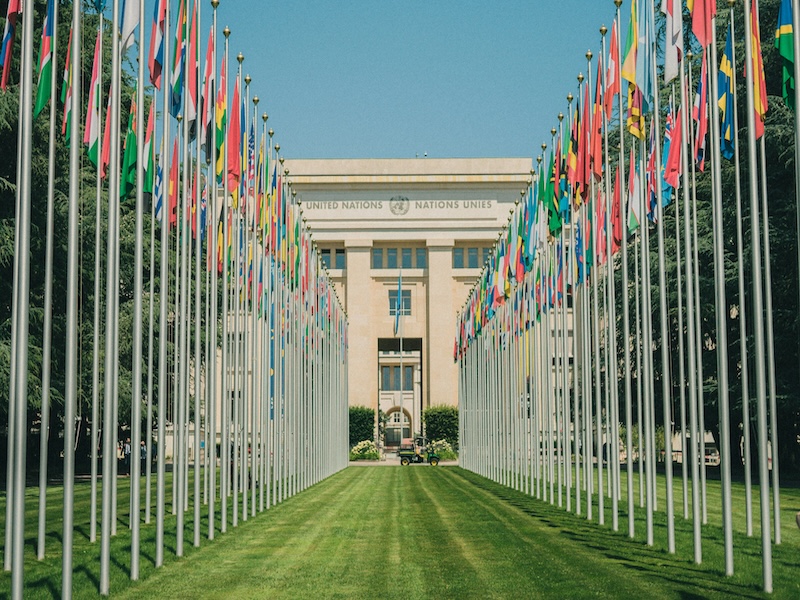
Image credit: A long row of flags in front of a building (published 27 July 2024), depicting rows of national flags outside the United Nations in Geneva, Switzerland, by Gavin Li via Unsplash. Licensed under the Unsplash License.