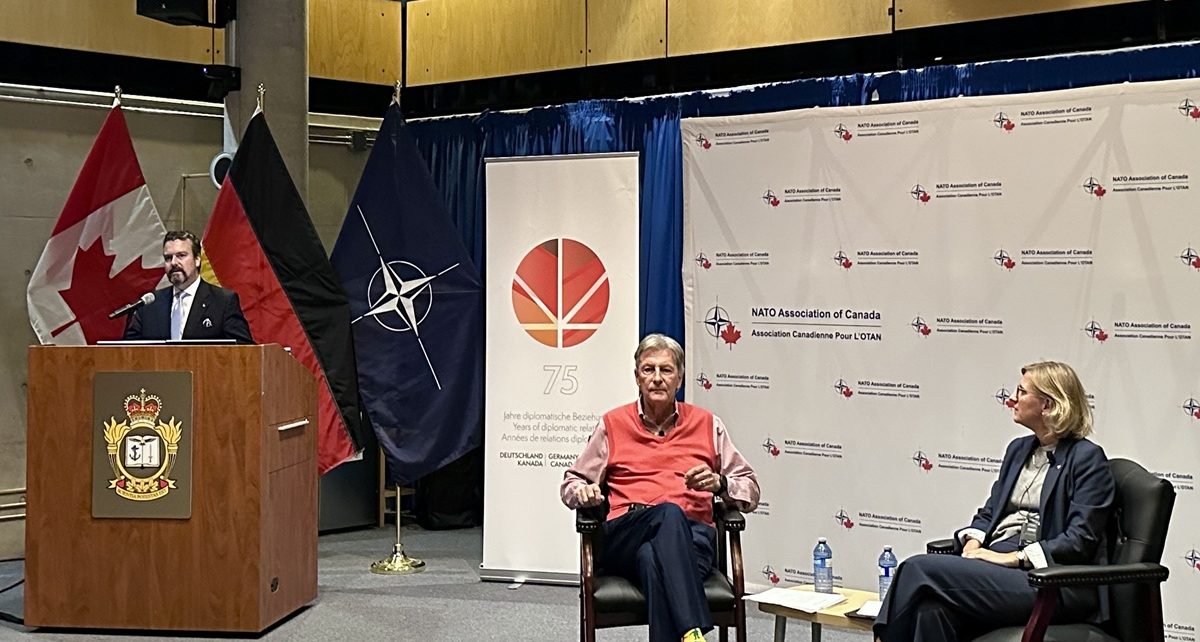
On September 24th, 2026, the NATO Association of Canada (NAOC) hosted a fireside chat on the Europeanization of NATO in collaboration with the German Consulate in Toronto. The event was held at the Canadian Forces College, and brought together academics, policy experts, students, and members of civil society to discuss the current state of the NATO alliance, and the role Canada can play as an emerging leader.
The speakers, Dr. Pia Furhop, Head of the International Security Research Division at the German Institute for International and Security Affairs, and the Honourable John McKay, former Parliamentary Secretary to the Minister of National Defence (2015–2017), discussed the changing U.S. role in NATO, what the Europeanization of NATO means in practice, Canada’s emerging role, and the capability gaps that exist within the EU.
The event commenced with remarks from NAOC President & CEO Robert Baines, who highlighted the timeliness of this event given ongoing discussions about Canada’s potential status as an associate member of the EU. Reflecting on NATO’s history and the challenges the alliance faced in sustaining its cooperative partnership, Mr. Baines emphasized the NAOC’s commitment to keeping Canadian youth informed about the current state of affairs as a key part of the association’s mandate.
The event proceeded with a panel discussion, held under the Chatham House Rule, wherein the panellists highlighted how the U.S.’ transactional approach is reshaping NATO’s operations, eroding the alliance’s norms of collective defence and the cooperative values on which it depends. The panellists also noted that the unpredictability of the U.S. administration can make cooperation more challenging, and that a withdrawal from NATO would be a collective drawback.
The discussion then moved to the threat Russia poses to European security. The panellists highlighted that in Europe, Russia’s threat is more imminent and tangible, as geography dictates, not distant nor abstract. This is worsened by the fact that Russia’s rhetoric towards Europe has not softened, despite the war with Ukraine.
The central theme of the discussion was the Europeanization of NATO as a means of strengthening the alliance’s resilience in the event of reduced U.S. engagement. The panel emphasized that increased defence spending and economic diversification are two clear ways to Europeanize NATO, but with an important caveat being that increased defence spending is not a holistic solution to structural issues. Moreover, the panellists highlighted that if a shift takes place, leadership must be collective and not individualistic, but warned against premature formalization of members’ roles.
The conversation highlighted that Canada is positioned as an emergent player with a unique opportunity to assert itself beyond being an intermediary between the U.S. and Europe. Prime Minister Carney’s emphasis on middle powers and enthusiasm from European counterparts signal a path for Canada to become a significant actor in NATO.
Looking ahead to 2030, the discussion emphasized that Canada and Europe should not be reactive, but rather proactive in maintaining the values of the alliance; prioritizing absolute gains and interdependence must be preserved. The Europeanization of NATO should be seen as an effort to strengthen the alliance by ensuring that Canada and European member states can assume greater responsibility for collective defence in an increasingly uncertain security environment.
Photo: NATO Association of Canada